Latin America’s energy storage market set to hit 23 GW by 2034

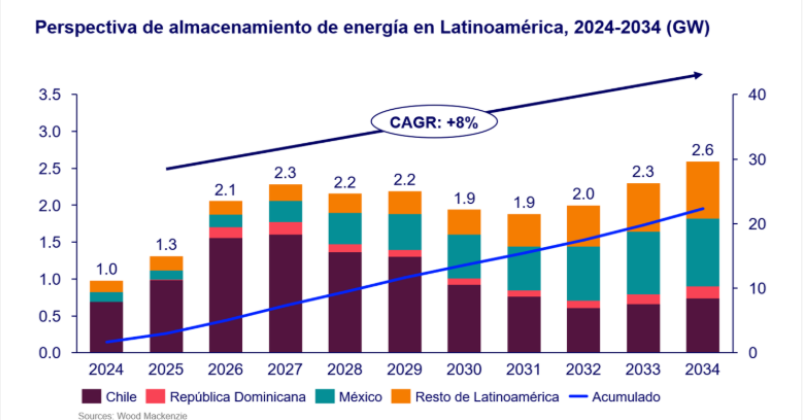
Wood Mackenzie forecasts a compound annual growth rate (CAGR) of 8% in the Latin American energy storage market through 2034, reaching a cumulative capacity of 23 GW.
In its new report titled Latin America Energy Storage Outlook 2025, the research and consultancy firm finds that Chile leads the region with the largest installed storage capacity, thanks to its advanced regulatory policies, accounting for nearly half of the total regional capacity.
Following Chile are Mexico and the Dominican Republic, although Mexico faces regulatory challenges while the Dominican Republic exhibits accelerated growth.
The report highlights that the large-scale industrial segment has dominated the adoption of battery energy storage systems (BESS) during the analysis period, particularly with standalone projects in Central America and the Caribbean.
In Mexico and South America, the high penetration of solar energy has spurred the deployment of hybrid systems that integrate solar generation with storage. Meanwhile, the commercial and industrial (C&I) sector shows promising potential for expansion by the mid-2030s.
Wood Mackenzie identifies several drivers behind the regional storage deployment, including ambitious renewable energy targets, grid operating constraints, and competitive bidding processes. Battery integration is crucial to stabilizing grids with a high share of variable renewable energy. Updated energy plans across multiple countries already include long-term storage targets.
Challenges ahead
Despite the promising outlook, regulatory challenges continue to threaten growth. The absence of comprehensive regulatory frameworks, clear operating models, and tailored remuneration mechanisms across market segments hinders BESS implementation. Additionally, high upfront costs and infrastructure limitations pose obstacles, although increased participation from various stakeholders is expected in the medium term.
Pamela Morales, Research Analyst at Wood Mackenzie, emphasized that the future of energy storage in the region depends on the development of robust regulations and the removal of barriers across all market segments.
According to a recent report by the Latin American Energy Organization (Olade), Latin America and the Caribbean currently have approximately 2.5 GW of installed energy storage capacity. Of this, 1.5 GW comes from battery energy storage systems, while 1 GW is from pumped hydro storage.
From pv magazine LatAm
Written by




Popular Posts