The European PPA market shifts toward storage, as solar price pressure accelerates hybrid contracts

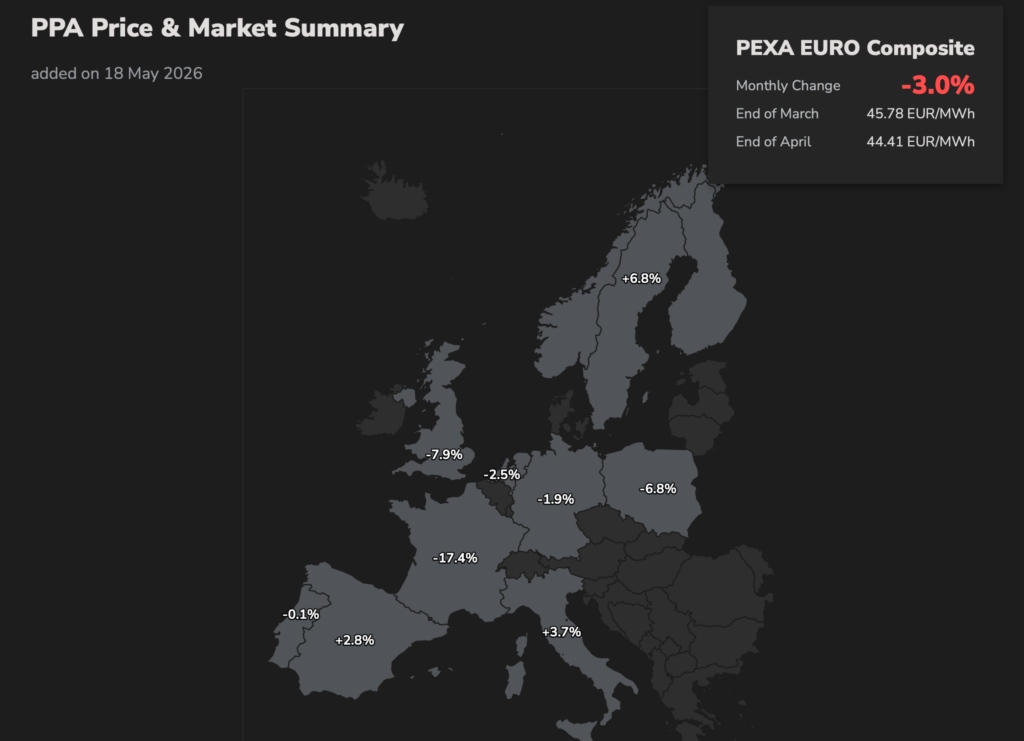
The European Power Purchase Agreement (PPA) market is increasingly turning its attention toward energy storage. According to Swiss consultancy Pexapark, 17 PPAs totaling 966 MW were recorded in Europe during April, a month characterized by price declines in most markets, with the exception of the Nordics, Italy, and Spain.
April’s activity included two hybrid solar-plus-storage PPAs. Notable among these was a 150 MW virtual hybrid PPA signed between Endesa and Sonnedix, which covers a portfolio of solar and battery assets across both Spain and Portugal.
According to Pexapark’s latest report, “While co-located renewable energy and storage systems (hybrid systems) remain an emerging trend in the European PPA market, they are gaining significant traction.” The consultancy notes that this momentum is primarily driven by cannibalization risks and the increasing frequency of negative pricing, both of which are putting downward pressure on standard solar PPA prices.
“As the business case for standalone solar becomes more challenging, developers and investors are increasingly looking at storage options to capture higher electricity prices during peak hours and mitigate the impact of low or negative pricing periods,” Pexapark states.
In April, the Pexapark Euro Composite Index decreased by 1.9% month-on-month, closing the period at €51.80/MWh.
This downward trend in PPA prices affected the majority of regional markets. Price drops were led by Portugal, which saw a 6.4% decline, followed by France at 5.7%, and Germany at 4.6%. In contrast, certain markets defied the broader trend: prices rose by 5.3% in the Nordic region, 1.3% in Italy, and 0.5% in Spain.
Meanwhile, the European energy storage market maintained a strong pace of activity. After surpassing 1 GWh of battery-related PPAs in March, April closed with nine agreements related to BESS systems, equivalent to 800 MW and 2.8 GWh of storage capacity. According to the consultancy, merchant structures and Flexibility Purchase Agreements (FPAs) still predominate. The United Kingdom led the way in contracted capacity thanks to the Hams Hall BESS project.
The report also points to significant regulatory changes in various European markets. Poland is preparing a reform of grid access for renewables and storage that will tighten the financial and technical requirements for new projects. Meanwhile, Greece could revive the corporate market for industrial PPAs following the European Commission’s approval of a scheme to reduce electricity charges for energy-intensive consumers.
For its part, Italy plans to launch three FER-X auctions between 2026 and 2027 to incorporate up to 26 GW of renewables under regulated hybrid revenue schemes, while in the United States uncertainty is growing about the future of the PJM capacity market, an element that could indirectly affect the revenue of renewable projects and the associated PPA structures.
From pv magazine Spain.
Written by
Comments



Popular Posts