AES Andes begins testing 340 MW/1,360 MWh BESS in Chile


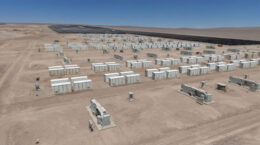
AES Andes has begun testing the battery energy storage system (BESS) at its Cristales project in Chile’s Antofagasta region.
The BESS has a power output of 340 MW and four hours of duration, equivalent to 1,360 MWh of storage capacity. The company is using the testing phase to verify the performance of the equipment, control systems and safety devices.
AES Andes said it will also begin commissioning the solar plant at the complex soon. In its latest corporate information, the company puts Cristales’ solar capacity at 287 MW to 288 MW, while Chile’s Ministry of Energy lists the project as having 400 MW of PV capacity in testing.
The ministry’s latest Energy Sector Construction and Investment Projects Report, published in July, already listed the Cristales BESS among systems undergoing testing. At 340 MW/1,360 MWh, it was the second-largest system in the portfolio by power output, behind Grenergy’s 430 MW/3,010 MWh Elena Phase I BESS.
The project has undergone several configuration changes since it was originally proposed. When submitted for environmental assessment in 2023, it comprised 379 MW of PV and a BESS of up to 542 MW with five hours of duration.
Cristales received environmental approval in April 2024. The approved configuration included up to 340 MW of solar and 542 MW of storage with five hours of duration, as well as the Cristales substation and a 220 kV transmission line. The planned investment was then $710 million.
In August 2025, AES Andes announced the start of construction of Cristales and the Pampas project. For Cristales, the company then reported a configuration of 288 MW of solar and 340 MW of storage. The two projects represented a combined investment of more than $1.1 billion.
From pv magazine LatAm
More about
Written by


Popular Posts