‘Relationships still key for bankers’: Financing BESS across emerging European markets

European battery energy storage system (BESS) deployments continue to expand across Europe, with a recent report from European solar PV and storage sector association, SolarPower Europe surprising some with Ukraine and Bulgaria in the top five countries for BESS.
As wider nets are cast into Central and Eastern Europe, project developers face attractive revenues but new financial landscape. Merchant spreads attract capital, but securing debt for largely unhedged assets means lenders taking a much harder look at the assumptions behind revenue forecasts. Or as one lender on stage described it, the rough-and-tumble of real efforts to break apart by stresstesting a spreadsheet.
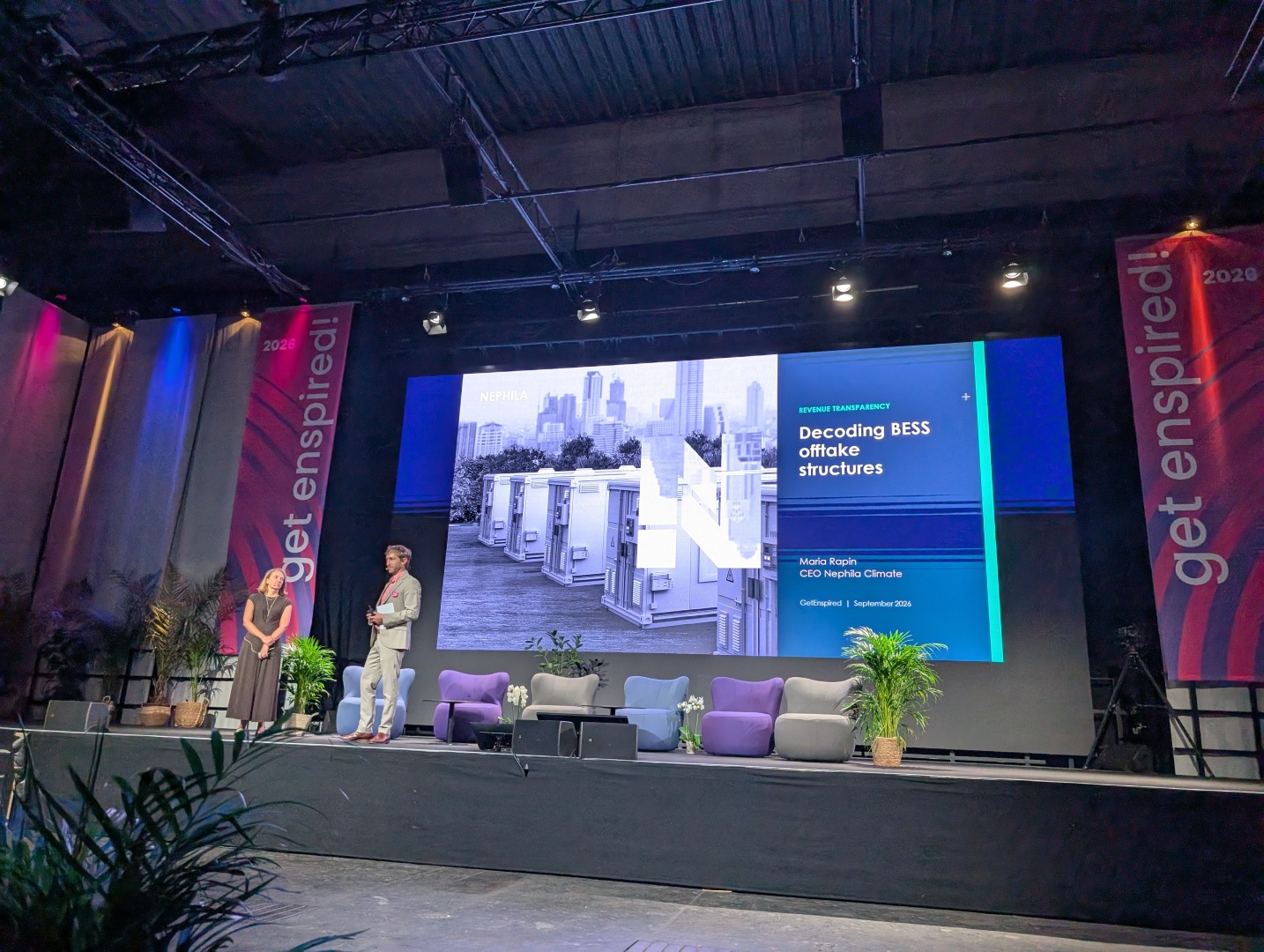
Such were the comments at a financing-focused session of get enspired! 2026, a conference by optimizer Enspired in Berlin, where bankers, optimizers and risk underwriters looked beyond whether BESS is bankable to what revenues lenders will actually finance, and why.
‘Volatility Stacking’
Speaking during the finance and market transparency session, Gareth Foulkes-Jones, senior transactor and director of project development and origination at Austrian infrastructure bank Kommunalkredit, explored the bank’s view on contracted revenues and forecasts.
Foulkes-Jones explained to the audience that long-term contracted cash flows, floor structures, and capacity market payments give lenders what he described as a “warm, tingly feeling”.
In contrast, looking further down into frequency response and merchant arbitrage forecasts requires far higher risk scrutiny, with warnings that layering multiple merchant revenue streams can quickly turn into “volatility stacking” rather than true revenue stacking.
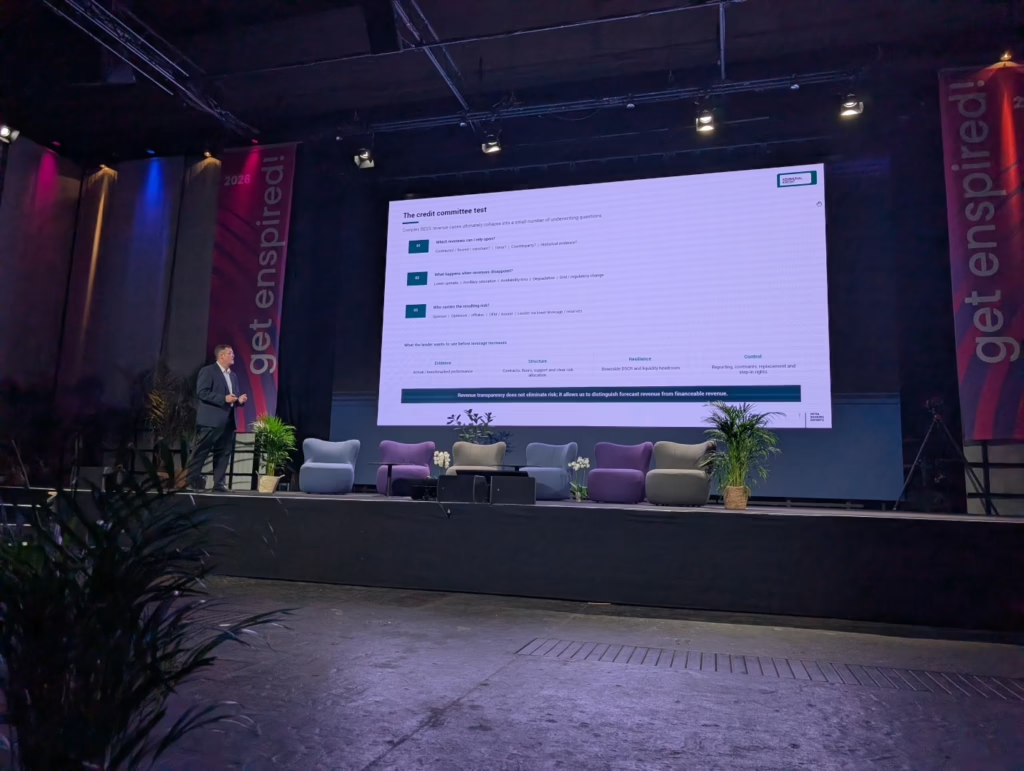
When banks and their credit committees stress-test projects, Foulkes-Jones colorfully explained how lenders scrutinize claims. Forecasts are backtested to show how data acted “when smacked in the face by real market stress.”
Debt servicing is evaluated by testing debt reserves, sweep mechanisms, and sizing to see what the project can afford, alongside the more basic question of who ultimately carries the downside if revenues disappoint.
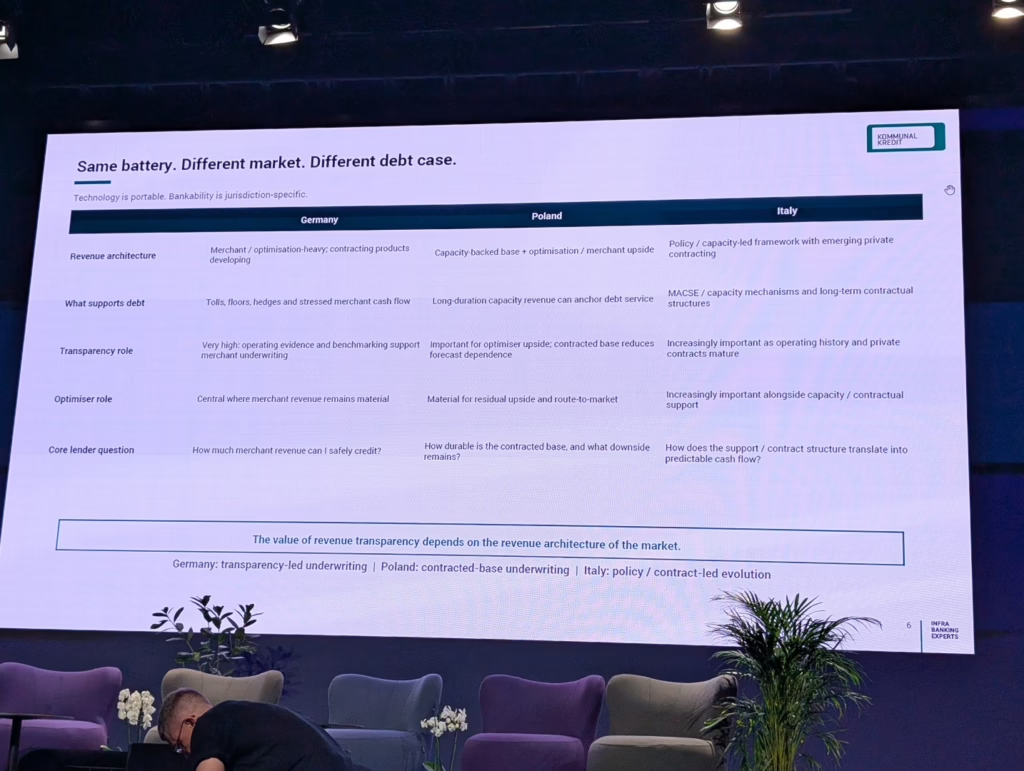
While battery technology can be transported across borders, Foulkes-Jones said and showed slides detailing the financing case cannot. Germany remains relatively merchant- and optimization-heavy, while Poland has more capacity-backed revenues and Italy is developing around capacity mechanisms and longer-term contracting.
Lenders are aware, and this changes their focus. In Germany, for example, the question is how much merchant revenue can be credited. In Poland, how durable the contracted base is; and in Italy, how policy support and contracts translate into predictable cash flow.
The human element in credit committees
Despite the industry’s reliance on algorithmic modeling and spreadsheet testing, Foulkes-Jones emphasized that debt financing in emerging or merchant-heavy markets, such as Romania and Poland, still has a fundamentally relationship-driven element.
Foulkes-Jones noted that when a lender evaluates a transaction where the borrower or framework carries inherent uncertainties, trust in the operational team can be established and confidence can build.
As he put it, in emerging markets, if the banking team can say ‘We believe in the team’s ability to deliver,’ Foulkes-Jones said that means “We fight harder at the credit committee,” shining a light on the internal processes happening within a bank.
Real trading data vs. theoretical backtests
Ryan Alexander, head of global strategic and market intelligence at Enspired, presented insights from the company’s German portfolio performance index, which the company does publish in the aim of transparency. The independently verified data shows that unconstrained two-hour batteries in Germany earned just under €200,000/MW per year over the past 12 months, outperforming one-hour systems by roughly 35% to 40% due to strong aFRR capacity revenue capture.
Alexander highlighted that theoretical backtests fail to capture real-time market dynamics, particularly continuous intraday re-trading. In practice, this can contribute double-digit percentage gains to total arbitrage revenues, one that can be missed.
Enspired’s index presented at the session revealed the spread between top- and bottom-performing assets in the same market ranged from 15% below average to 17% above average. Alexander indicated that early design choices, EPC setups, and warranty constraints directly dictate an asset’s operational flexibility and ultimate revenue capture.
Risk transfer and bridging the equity-debt gap
Addressing how developers can satisfy conservative lender requirements without sacrificing merchant upside, Maria Rapin, CEO of Nephila Climate, which specializes in offering risk transfer solutions, detailed the risk-transfer structures and structured revenues it provides across European, US, and Australian markets.
Rapin explained that global storage markets are continuing to track a predictable maturity cycle that industry observers know well. Early-stage markets attract those more risk-ready developers seeking 100% merchant upside with a battery, while late-stage markets work towards much more structured deals that involve revenue floors and synthetic hedges for both securing financing and protecting returns as assets and risk accumulate.
Rapin noted that risk-transfer products can allow developers to exchange some uncertain upside for a more predictable revenue floor, with the exact split usually negotiated between the parties rather than a set model. These “balance-sheet-backed” structures can reduce revenue volatility, but do not shift every project risk onto the floor provider.
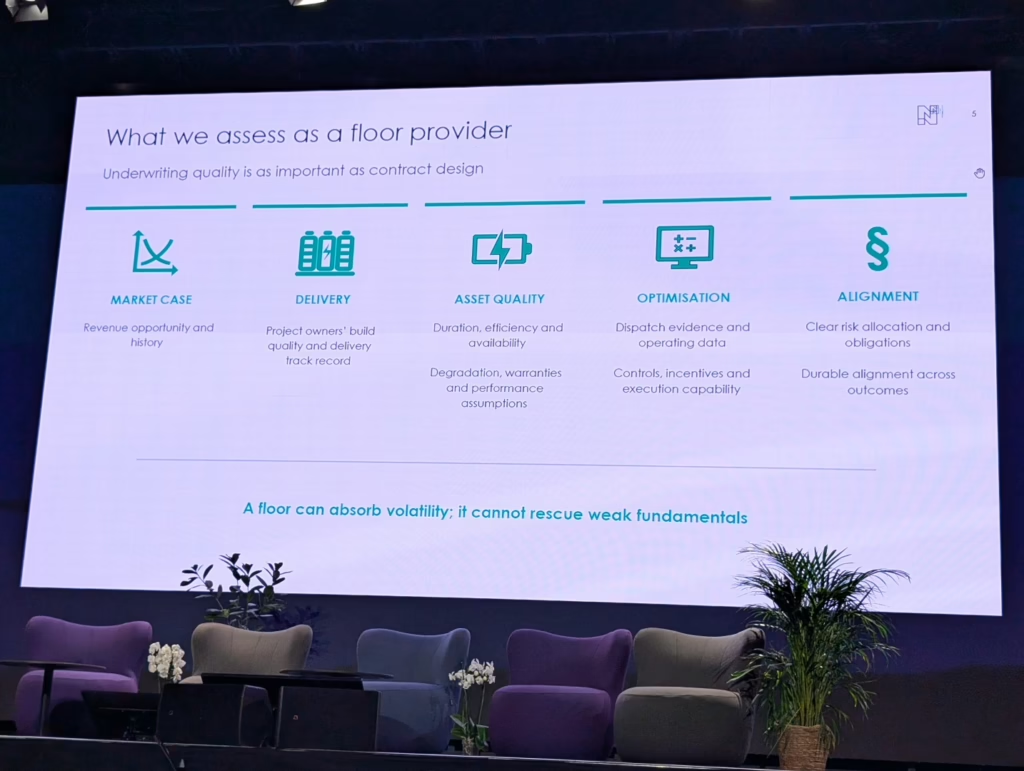
Nephila still assesses the underlying market case, asset quality, delivery record and optimization strategy. As Rapin put it via her talk and slides ‘a floor can absorb volatility, but it cannot rescue weak fundamentals’. That leaves owners with influence over battery performance, while keeping the consequences of poor asset or operational decisions with them.
Written by



Popular Posts