Shell brings data-centre cooling tech to batteries in world-first immersion storage system

Shell (Shanghai) and Chongqing-based QingAn Energy Storage (QAES) have announced a strategic partnership to introduce immersion-cooling technology – a method long used in high-performance data centers – to the world of grid-scale and commercial battery storage.
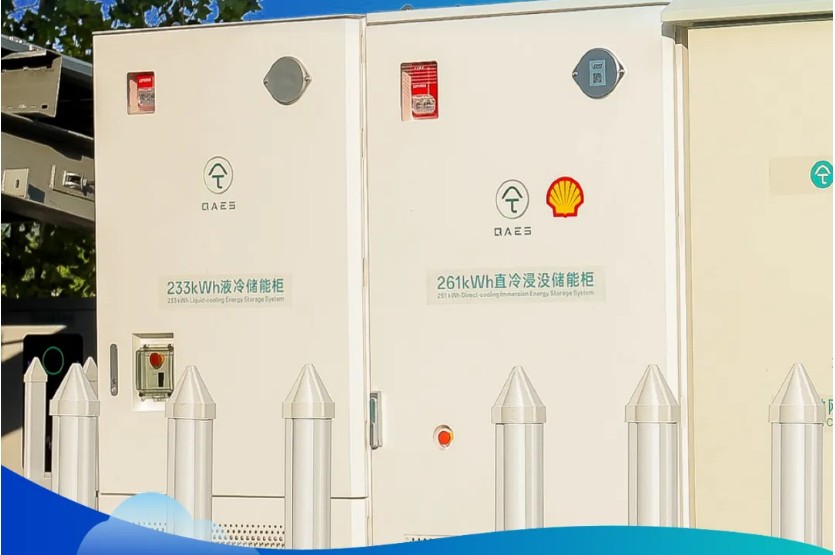
The two companies unveiled what they describe as the world’s first “direct-cooled immersion” battery energy storage system (BESS) at an energy forum in Chongqing on September 24. The system is being positioned as a low-energy, high-safety alternative to traditional air or cold-plate cooling methods typically used in large-scale lithium-ion installations.
The technology is built on Shell’s single-phase immersion fluids, a Gas-to-Liquids (GTL)-derived dielectric designed to fully submerge electronic hardware while dissipating heat through natural convection. Shell has positioned these fluids as PFAS-free and inherently biodegradable, and in May received Intel certification for use in immersion-cooled data center racks – a third-party endorsement that supports the company’s broader cross-sector push.
QAES, a Chongqing-based systems integrator specializing in modular, safety-oriented storage projects, will contribute system packaging, localized engineering, and deployment services, the partners said. According to company materials and local reporting, the joint solution combines “immersion safety” with “direct-cooling efficiency”: battery cells are fully submerged in Shell’s fluid and cooled without pumps or complex piping – a design the companies claim reduces balance-of-system (BoS) energy use and streamlines operations. QAES will also host pilot deployments at industrial and commercial sites.
Statements released in Chinese media cite notable efficiency improvements: auxiliary power consumption is said to drop by around 60%, while temperature differentials across individual cells reportedly fall to ~1°C, and system-level spreads to within 3°C. These gains, the companies argue, translate into longer cycle life and modest improvements in usable charge throughput. However, these performance metrics were provided by the vendors and event organizers; independent, long-duration field data for storage-specific applications remains scarce.
The announcement highlights a broader industry shift, where liquid cooling techniques proven in data centers and high-performance computing (HPC) are being adapted for energy storage. Shell’s pedigree in data-center cooling – backed by the Intel certification – adds technical credibility. Still, experts caution that the economics and operational logistics of immersion cooling differ significantly when scaled from server racks to multi-megawatt-hour battery systems. Immersion systems typically entail higher upfront costs for fluids and containment, and raise end-of-life and recycling challenges that remain largely undefined.
Shell and QAES said they intend to pursue joint standards development, extended compatibility testing with large-format battery cells, and a phased rollout across industrial pilots. They also plan to engage with battery manufacturers and regulators to help codify safety and performance benchmarks.
If validated at scale, the venture could reshape thermal management strategies for long-duration storage and drive broader adoption of higher-density, lower-maintenance systems. For now, however, the sector will be watching for independently verified data, certification specific to storage use cases, and transparent cost comparisons with incumbent cooling solutions.
Written by





Popular Posts