Norwegian startup offers new BESS noise modelling software

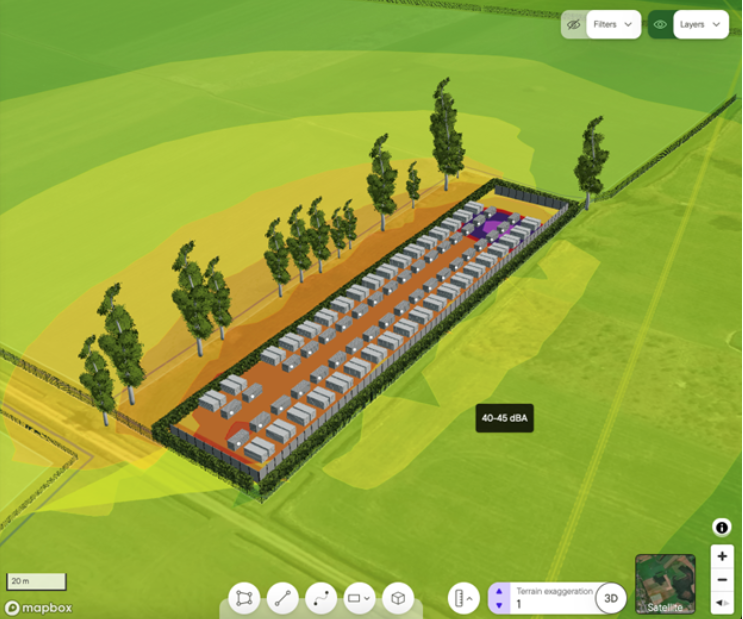
Norway-based Glint Solar has added a new noise modelling feature for battery energy storage systems (BESS) to its solar and storage project developer site planning software platform.
A spokesperson told pv magazine that the new software enables noise impact assessments for battery storage installations at an “early stage in project development.” It helps users to model “how sound from equipment will behave across a site by factoring in terrain, ground absorption, and barriers.”
Specifically, it provides support for either localized noise emissions data or default profiles, and incorporates real-world data, such as topography, ground absorption, and barrier effects, as well as easing simulations of the impact of mitigation measures, such as sound walls or layout modifications.
“With this new noise modelling capability, developers no longer need to wait weeks for expensive consultant reports and can actively de-risk stakeholder pushback during early project development,” said Even J. Kvelland, Glint Solar co-founder and chief commercial officer, in a statement.
Indeed, equipment sound emissions are increasingly a factor influencing project success, as pv magazine ESS News and pv magazine have been reporting.
“During early-stage site screening, this new feature helps teams rule out acoustically challenging locations before committing time or budget,” the company said, adding that ahead of public consultations, “it equips teams with clear, stakeholder-friendly visuals” to communicate project impacts.
New users require no specific geographic information systems (GIS) skills, nor acoustic software expertise, “to generate maps of decibel propagation,” make comparisons of layouts, and export images for regulatory and stakeholder communication, it added.
The acoustic simulations can be done at the beginning of project development within the same platform already used to design and analyze the customers’ solar and storage sites, according to Kvelland.
This new noise modelling tool is Glint Solar’s latest feature after adding support earlier this year for BESS prospecting, design, and analysis to its flagship solar planning platform. The original software package, used for prospecting, design, and evaluation support, considers things like location-based degradation potential, distance to the grid or substations, topography, soil depth, and solar irradiation.
The Oslo-based company, founded in 2020, claims to have users of its cloud-based software in over 35 countries.
Written by



Popular Posts