Battery storage drives record year for UK renewables planning approvals

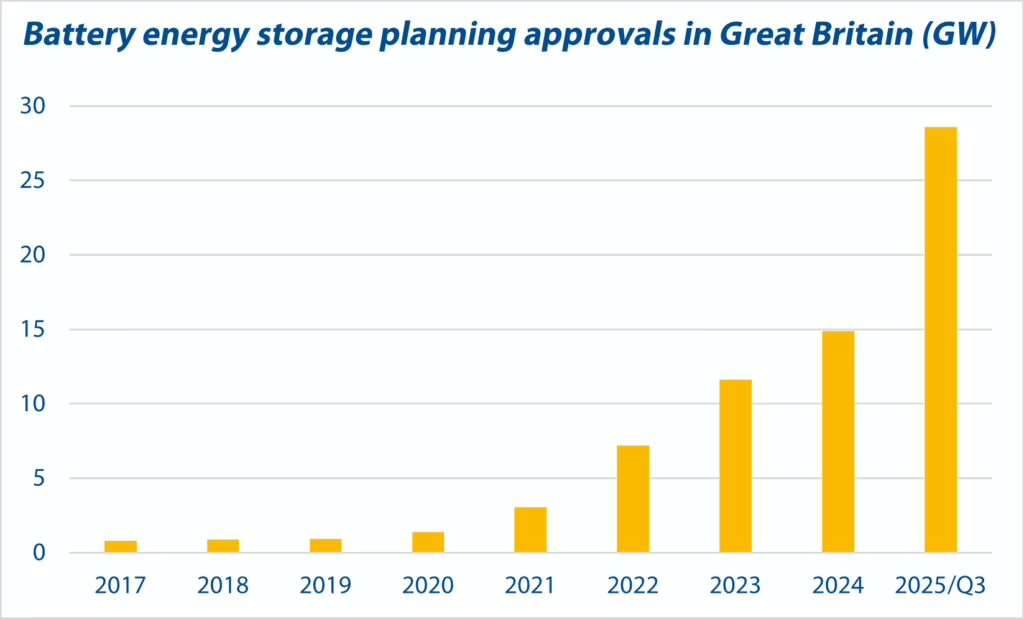
Planning permission was granted to 28.6 GW of battery energy storage projects in Great Britain in the first three quarters of 2025, up 92% on the 14.9 GW of approvals secured for BESS in all of 2024, according to analysis from Cornwall Insight.
Growth in BESS approvals drove a record year for renewables planning approvals, accounting for more than half the 45 GW of capacity approved in the first three quarters of 2025, compared to 23 GW in 2024. This represented a 96% gain on the previous year with three months left to run, and included 5.72 GW solar, 9.9 GW offshore wind and 1.15 GW onshore wind securing planning permission.
Data shared with ESS News reveal a 1955% gain in BESS planning approvals in Great Britain since 2020, when 1.39 GW of projects secured planning permission, making battery storage the fastest growing energy technology progressing through the UK planning system by a significant margin.
Cornwall Insights suggested a range of factors have driven increased planning approvals, including a greater level of maturity in the BESS market, as well as a reaction from developers seeking to secure planning consent ahead of reforms to Great Britain’s grid connections queue.
The number of BESS projects seeking planning consent had ballooned under the previous grid connections queue rules, which operated on a first-come, first-served basis. This led grid operator NESO to implement a new methodology based on project readiness introduced in late 2025, with criteria such as planning consent playing a larger role in assigning connection dates.
NESO axed 153 GW of zombie projects from the queue in December 2025, instead making connection offers to projects with “protected” status – typically meaning the developer had secured planning permission or land rights. ´
Cornwall Insights analysis also noted local elections may have also influenced timing of planning consent applications, due to uncertainty around renewable energy planning policies. Developers may have accelerated planning applications rather than risk a change in local administration.
In a press release, Robin Clarke, senior analyst at Cornwall Insight said that “on paper” the UK renewables pipeline has never looked stronger.
“This record-breaking surge in planning approvals signals real momentum in the UK’s energy transition, with offshore wind and battery storage reshaping what’s possible at scale;” Clarke said.
However, the analyst warned “approvals alone don’t generate electricity” and said there is an urgent need to “move from ambition to actual delivery of these projects.”
“Too much capacity is still stuck in queues or waiting on grid upgrades. Grid bottlenecks remain one of the biggest risks to turning today’s approvals into tomorrow’s power,” said Clarke. “The recent grid connection reforms are a significant step forward, and should help clear some of the backlog, but they won’t solve everything.
“We need faster decisions, more investment in the grid, and real collaboration between government, regulators, and industry. Without that, these record numbers risk becoming just another statistic.”
More about
Written by
Comments




Popular Posts