Jinko ESS SunTera 5MWh Passes Large-Scale Fire Test, Validating Safety Boundaries
Jinko ESS, a global leading energy storage solution provider and a subsidiary of Jinko Solar Co., Ltd., recently announced the successful completion of a large-scale fire test for SunTera 5MWh Liquid-Cooling Energy Storage System. Conducted at a specialized testing facility in Suzhou City, Anhui Province, the test followed the CSA C800 standard and the November 2025 draft of UL 9540A and was witnessed on-site by CSA Group representatives and North American fire protection engineers.
By simulating fire scenarios under real-world utility-scale deployment conditions, the evaluation assessed fire behavior, thermal runaway propagation potential, enclosure integrity, and the impact on adjacent units. These results provide measured data under the Large-Scale Fire Testing (LSFT) framework referenced in the forthcoming NFPA 855:2026 provisions, supporting the industry’s transition from compliance-driven safety toward performance-validated safety.
Engineering Performance Under Conservative Conditions
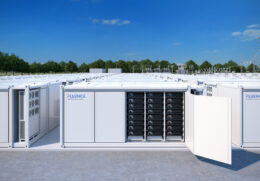
The SunTera 5MWh system is Jinko ESS’s flagship product, built on a high-capacity 314Ah cell platform. The system features advanced liquid-cooling thermal management, a nominal energy capacity of 5.015MWh, and supports 0.5P continuous charge and discharge. With an IP55 protection rating and C4/C5 corrosion resistance, it is designed for a 20-year operational life.
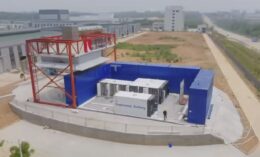
For this evaluation, four SunTera containers were deployed in a high-density configuration to replicate practical project spacing:
- Unit A (Initiating Unit): Target unit for forced ignition.
- Unit B: Back-to-back with Unit A at a 15cm spacing.
- Unit C: Side-by-side with Unit A at a 1m spacing.
- Unit D: Face-to-face with Unit A at a 3.5m spacing.
To evaluate passive protection performance under conservative conditions, all units were charged to 100% State of Charge (SOC), active fire suppression systems were disabled, and no manual intervention occurred during the test.
Measured Results: Effective Propagation Containment
On February 10, 2026, forced heating of Unit A commenced at 17:00. At approximately 18:10, cells reached ignition conditions, resulting in sustained combustion. During the event, the internal temperature of Unit A peaked at 1296°C.
Despite the intensity of the initiating fire, adjacent units remained stable. Maximum recorded internal cell temperatures were significantly below thermal runaway thresholds (Unit B: 51.3°C, Unit C: 38.3°C, Unit D: 41.2°C)。
Although external surface temperatures of adjacent enclosures reached elevated levels—up to 404°C on Unit D due to direct flame exposure—internal battery module temperatures remained within safe limits. This demonstrates effective enclosure-level thermal insulation and fire containment performance.
The fire self-extinguished at 07:50 on February 11, with a total combustion duration of approximately 13 hours and 40 minutes. Post-test inspections confirmed:
- Structural Integrity: Unit A maintained its structure with localized surface soot and no enclosure collapse. Units B, C, and D remained structurally intact.
- Functional Continuity: Functional testing verified that adjacent units (B, C, and D) retained full electrical functionality, with no observable impact on charge and discharge performance.
- Environmental Responsibility: The test incorporated controlled flue gas capture and treatment measures to minimize environmental impact.
Leadership Perspectives
“Large-scale fire test allows us to better quantify fire propagation limits,” said Carl Yang, Product General Manager of Jinko ESS. “The SunTera 5MWh system demonstrated thermal runaway containment within a single enclosure under challenging conditions. These data support more precise installation spacing guidance and contribute to reducing multi-unit propagation risk.”
Dora Zhao, Senior Product Management Engineer, said: “SunTera’s safety architecture is built on a three-level design philosophy: cell-level stability, pack-level insulation with engineered pressure relief, and system-level fire barriers. Even when insulation materials in the initiating pack were intentionally modified to accelerate ignition, adjacent packs maintained electrical functionality.”
Patrick Rimel, North America Product Manager, highlighted the market implications: “As regulatory frameworks evolve toward risk quantification, empirical data from LSFT becomes essential. These results provide AHJs, insurers, and project owners with performance-based insights that can inform permitting decisions and risk evaluations, especially in high-density deployments.”
Independent Expert Validation
Todd LaBerge, Fire Protection Engineer from ATAR FIRE, commented: “The test was conducted in accordance with CSA C800 and the latest UL 9540A draft. The system incorporates deflagration protection principles aligned with NFPA 68 and NFPA 69. With enclosure doors closed and venting mechanisms engaged, the initiating fire remained contained within the originating enclosure. The test execution and data integrity meet internationally recognized best-practice standards.”
The Significance Beyond Validation
The impact of large-scale fire testing extends far beyond mere technical validation. It serves as a mirror, reflecting the true safety boundaries of product design, and a yardstick, measuring a company’s fundamental commitment to risk responsibility.
For Jinko ESS, this test marks a new beginning. We remain committed to transforming “extreme conditions” into “standard configurations,” working alongside global partners to build a more resilient power system grounded in data-driven trust and safety-first principles.
Written by

Comments



Popular Posts