Flow Aluminum successfully tests aluminum-CO2 pouch cell

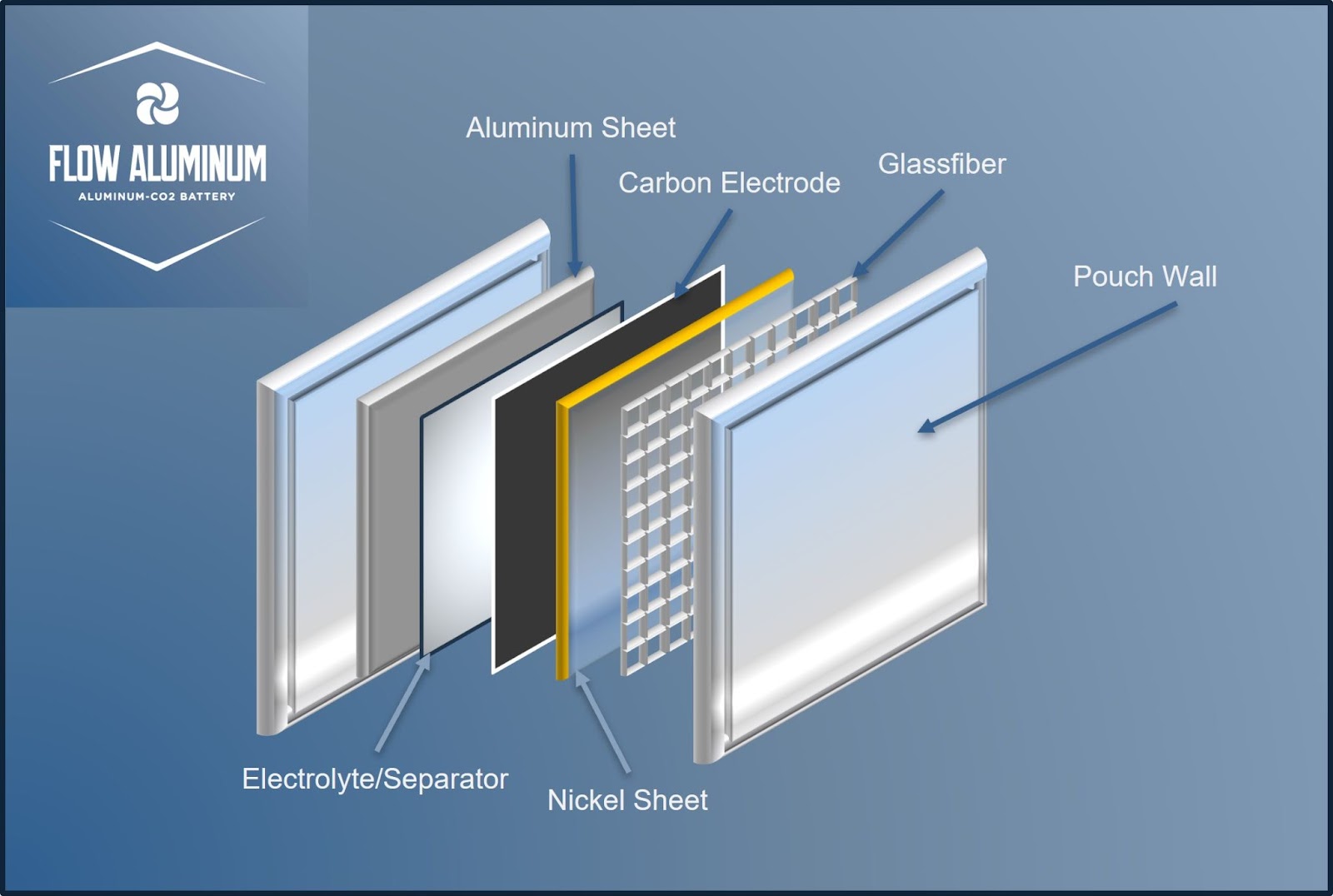
Albuquerque-based aluminum-carbon (Al-CO2) battery developer Flow Aluminum has demonstrated a full discharge and half-charge cycle in a pouch cell based on its “metal-gas” battery technology.
Having previously demonstrated its innovation under laboratory conditions at the University of New Mexico, Flow said it had successfully conducted 12 tests on a pouch cell version of its Al-CO2 product at the BIC, in Indiana, which helps commercial and defense clients achieve commercialization.
Olaf Conrad, chief technology officer (CTO) at Flow Aluminum, told ESS News the company’s electrolyte composition, cell architecture, and cathode layer design enables the process of electrochemically converting CO2 and aluminum into electrical energy to be fully reversible, with negligible capacity fade.
As a battery-chemistry alternative to lithium-ion devices, Conrad said, Al-CO2 has a much higher specific capacity, leading to competitive energy density; is immune to thermal runaway; can operate at temperatures ranging from 60 C to -40 C; has demonstrated voltage efficiency of more than 97% at a cell level; and relies on abundant CO2 and aluminum as raw materials.
Discharge capacity
With the BIC tests seeing Flow take a leap forward in its technology development roadmap, BIC battery engineer Brett Allen lauded the single-layer pouch cell experimental specific discharge capacity of around 1,500 mAh per gram of CO2, demonstrated by Flow’s device, describing the result as “staggering compared against the theoretical capacities of other battery chemistries actively being developed, such as lithium-ion, sodium, or potassium.”
Specific capacity
Flow CTO Conrad said the company’s aluminum-oxalate offers theoretical specific capacity of 506 mAh/g of the material. By comparison, he said, the theoretical specific capacity of lithium-ion nickel-manganese-cobalt (LiNMC) is 372 mAh/g of LiNMC and lithium ferro-phosphate devices offer around 180 mAh/g of LiFePO4.
Announcing the success of pouch cell testing at BIC, with a press release issued in October 2024, Flow Aluminum chief executive Thomas Chepucavage said, “The progress we’ve made at the Battery Innovation Center is a significant step forward for Flow Aluminum. Thanks to our CTO, Dr Olaf Conrad; our team; and BIC; we now have a clear path to refine and optimize our technology roadmap, bringing us closer to delivering an aluminum battery that will innovate energy storage applications.”
Written by






Popular Posts