‘The playbook is broken’: Solar’s PPA deal shortage makes co-located BESS a necessity

Europe’s renewable energy market is faltering under the weight of its own success. The era of developing standalone solar projects backed by long-term power purchase agreements (PPAs) may be coming to a close, as midday solar generation sees price cannibalization and negative-price hours across multiple regions.
While still a relatively nice problem to have versus too little generation for decarbonization and general progress in terms of clean energy, it’s still a quandary. And those with funds – banks – are clearly clutching the purse strings tighter, which is making standard solar assets more challenging to finance. Hence, opportunities around colocation with large batteries.
This was the topic of a detailed discussion at the conference ‘Get Enspired! 2025’, held in Berlin last week, focused on batteries.
Market overview
Dominique Hischier from the analytics firm Pexapark opened the discussion on colocation, detailing the realities facing renewable energy developers and investors gathered at the conference: falling revenue, increased negative hours, and long grid connection queues.
The other serious issue, discussed throughout the conference, is obtaining a grid connection from Transmission System Operators (TSOs).
Hischier spelled it out. “Let’s start with the why. Why should we even bother talking about co-location? Why don’t we just do the much easier standalone option?” she opened. “Well, if we look at the value of a generic German solar profile today, the numbers are actually quite worrying.”
“Our standard playbook for how to commercialize standalone solar is no longer working,” explained Hischier. “We’ve seen the value of that German solar profile drop from around 90% to around 50% in just two years compared to a baseload, she said. “Year-on-year, we’ve seen an 87% drop in the deal volumes signed [for German solar PPAs].”
This market failure necessitates a change in project design, resulting in a need for batteries. This leads to one conclusion, said Hischier said: “Exploring storage and co-location is really becoming a necessity.”
The analyst added that in the UK this is already happening in the majority.
“In the UK today, we see 70% of new solar projects already coming with a BESS asset, already co-located. And the standard model of how that’s commercialized is typically you have a solar asset under a government CFD or under a PPA, and then you have the BESS somewhat separately commercialized under a BESS optimization agreement. That could be fully merchant, it could be a toll [agreement], and so on, but really relatively separate.”
The hybrid proposition
The hybrid project, where solar generation is paired with a battery energy storage system (BESS), was then discussed. The simple idea is to storage solar power generated during the midday period, which may be curtailed or sold into negative spot prices, and then sold during high-priced evening peaks.
This wasn’t presented as a breakthrough concept. The key, though, is how the fixed revenue of a PPA could be combined with the merchant revenue of a battery without sacrificing too much of the battery’s potential, and proving to financiers that the model will work.
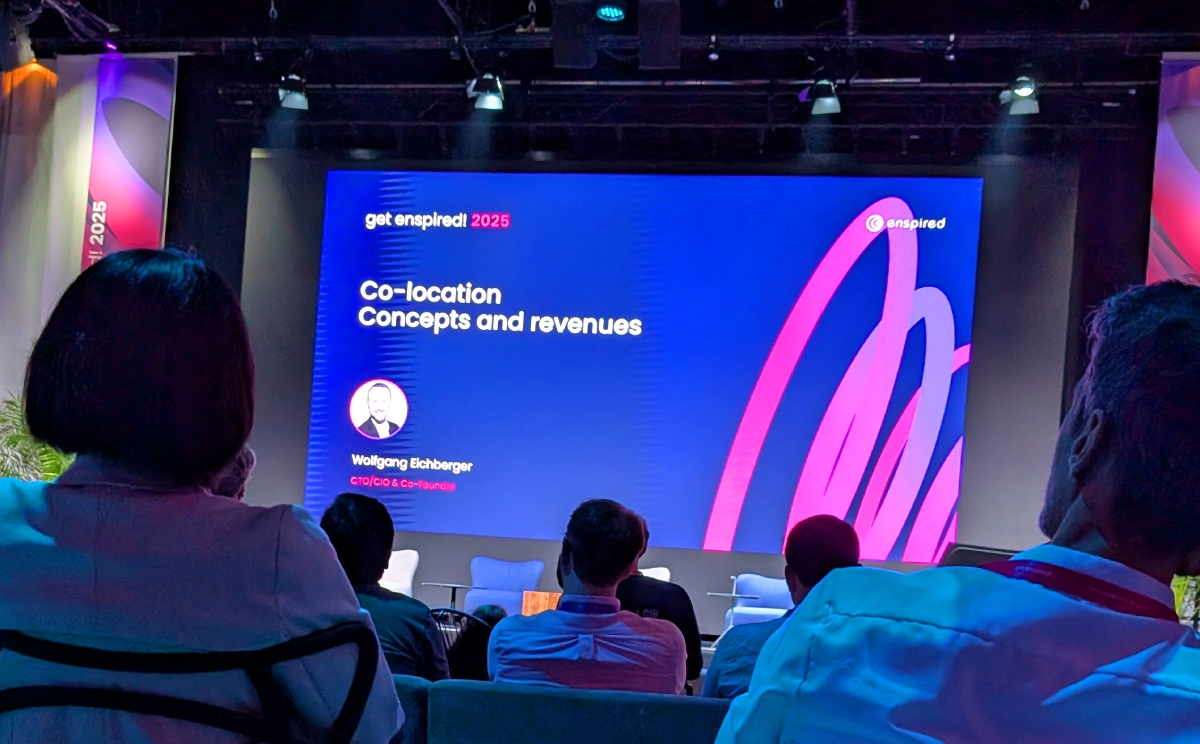
Wolfgang Eichberger, CTO and co-founder of Enspired, presented a detailed analysis over a series of slides and forecasting scenarios, showing that the financial trade-off, or “colocation penalty,” associated with solar plus storage versus storage alone is smaller than many assume. The issue can be the grid connection point being a bottleneck.
Eichberge showed modeling a co-located asset sharing a 10 MW grid connection point with a solar plant, against a fully merchant standalone battery, revealing a revenue reduction of only “3.2% to 4.4%” for the co-located asset.
Eichberger, during questions from the audience, implied the analysis he’d performed had taken around three weeks.
This analysis, while based on models, suggests developers can secure the revenue certainty needed for financing while retaining most of the battery’s merchant upside.
The art of the PPA deal
This financial reality is giving rise to a new generation of contracts. While some markets achieve success with separate contracts for the solar and BESS components, innovation is occurring in integrated hybrid PPAs.
Edoardo Simioni, Head of Trading and Flexibility from Reel, described one such model that provides a fixed revenue stream for the asset owner while preserving the battery’s ability to participate in other markets.
“What if I told you that you can actually have this contract long-term with fixed revenues but keep the upside into ancillary services?”
Other structures are also gaining traction. Lisa McDermott, Managing Director Energy Transition Project Financing at ABN AMRO Bank in the Netherlands noted the rise of financial tolls and revenue swaps.
One “very bankable” model she described is a “revenue swap on total revenues,” where a financial institution provides a guaranteed floor price for the project’s entire output in exchange for a share of the upside.
This allows project finance lenders to underwrite a predictable revenue floor while giving the asset owner exposure to market volatility.
Getting these hybrid projects financed, though, remains a dance that invites a bank to have confidence. With lenders accustomed to the output of a wind or solar farm, the underwriting of a more dynamic asset invites complexity; though banks and investors can relish this, given the depth of complexity in markets.
“Financing a battery is actually financing a trading strategy,” Lisa McDermott explained, a concept that is “something project finance is never used for.”
“And this is the reason,” McDermott said, “for why we’ll be coming with certain financial structuring mitigants to try and squeeze this thing into a project finance bucket. Battery revenues, as we all know, are stacked with lots of different types of revenues. It’s a complex revenue stack.”
To bridge this gap, financiers are adapting, with financial jargon building up as well. They are using solutions like “mini-perm loans” – where, as an example, a seven-year loan for a 20-year asset is offered, which reduces the bank’s long-term risk. At the end of that shorter term, a large portion of the original debt, the “balloon,” is still due, requiring the project owner to refinance. Lenders also build in “cash sweep” mechanisms, which use any surplus profits to pay down the loan faster, acting as a safety net.
McDermott also mentioned warranty as a “fundamental” component that needs to be established before applying for funds.
“Having a comprehensive warranty package before you go to a lender is fundamental. And one key point you should bear in mind is that tolling contracts are becoming more common. There are a lot of warranties and guarantees being given from the project to the offtaker. Please make sure that when you negotiate your warranty package on the contracting side, you make sure not to leave any exposure left for the project in between,” she said.
Update: At the request of the presenter, ESS News has removed some additional information and photos of a slide shown at the event.
Written by



Popular Posts