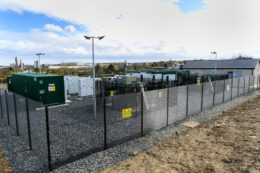
Grid update to provide major boost to battery storage in Ireland

Until now, grid-scale batteries in Ireland have mainly supported the power system by providing stability services. Soon, SEMO, the operator of the wholesale energy market in Ireland, will allow battery energy storage systems (BESS) to play a much larger role in balancing power across the island.
Industry players say the move, introduced on November 13, will benefit both battery owners and grid operators. EirGrid and SONI, the grid operators of Ireland and Northern Ireland will work with SEMO to implement the updates to the scheduling and dispatch program.
Under the update, grid-scale batteries will be able to trade energy more actively – charging when renewable energy is plentiful or prices are low, and discharging to supply power when demand is high.
Operators will also be able to signal their preferred charging and discharging times, based on market price signals and demand side need, helping grid managers make more informed decisions about how to plan and allocate grid resources. Removing some of this burden from the grid operators means battery operators can receive more accurate operational instructions from the grid, increasing their efficiency and responsiveness.
“This move supports Ireland and Northern Ireland’s shift to a low-carbon future by making the grid more flexible, efficient, and sustainable,” said EirGrid in a statement shared with ESS News.
Thanks to the expansion of their role in the power system, battery owners will be able to tap into new revenue opportunities in the day-ahead, intra-day, and real-time balancing markets.
Enabling batteries to participate fully in the real-time energy market will bring Ireland in line with other, more advanced energy storage markets in Europe.
Richard O’Loughlin, deputy CEO at energy optimization software company, GridBeyond, told ESS News that the update provides more certainty around investments creating a “clearer path forward for investment in batteries.”
For example, a 10 MW BESS owner could make between 12-37% more revenue in the next 10 years because they can participate in the wholesale market. These figures are based on internal market projections by GridBeyond.
The Ireland-headquartered company serves numerous markets globally, and O’Loughlin said the new market update will stimulate interest in GridBeyond’s optimization services. “It’s a change happening in the marketplace. And when there’s a change, there’s opportunity to inform different stakeholders, and try to work with them for mutual interests, where they align, and that’s what we’re looking to take advantage of. With this program coming out, we know a lot of the developers over the years from different conversations and [this update] makes the need for software to manage these assets more compelling.”
Ireland’s total installed BESS capacity is just under 1 GWh, and as O’Loughlin pointed out, a lot of battery assets are prevented from operating because they are facing permitting and planning stage blocks.
The industry and regulators have been “sitting on their hands a little bit, struggling with investment decisions and this will help with that in that it will provide another piece of revenue that’s a bit more certain in terms of how they can access it,” he said of the update.
The program will also bring more clarity for the grid operators ahead of the planned updates to the ancillary services procurement mechanism and the long duration energy storage (LDES) market update. EirGrid is planning to launch the LDES procurement round in Q1, 2027, with contracts to be awarded in Q4, 2027.
O’Loughlin believes the intention is to go towards a day ahead procurement mechanism, where, instead of a regulated tariff, the market decides what the price is based on daily bids and the anticipated volume of capacity required. “That’s what every other market in the world does,” said O’Loughlin.
He said the SDP provides more certainty around investments creating a “clearer path forward for investment in batteries.”
“Ultimately, for us to move towards net zero goals, we need to add more flexibility on the system. And that can come from demand response, it can come from batteries. It’s no use having piles and piles of wind and half of it being curtailed. There needs to be the right solution, and this is certainly part of that.”
Written by




Popular Posts