Global BESS demand jumps 51% in 2025 as installations top 300 GWh

Around 315 GWh was installed across both grid-scale and behind-the-meter battery energy storage system (BESS) markets, representing nearly 50% year-on-year growth, according to Benchmark Mineral Intelligence.
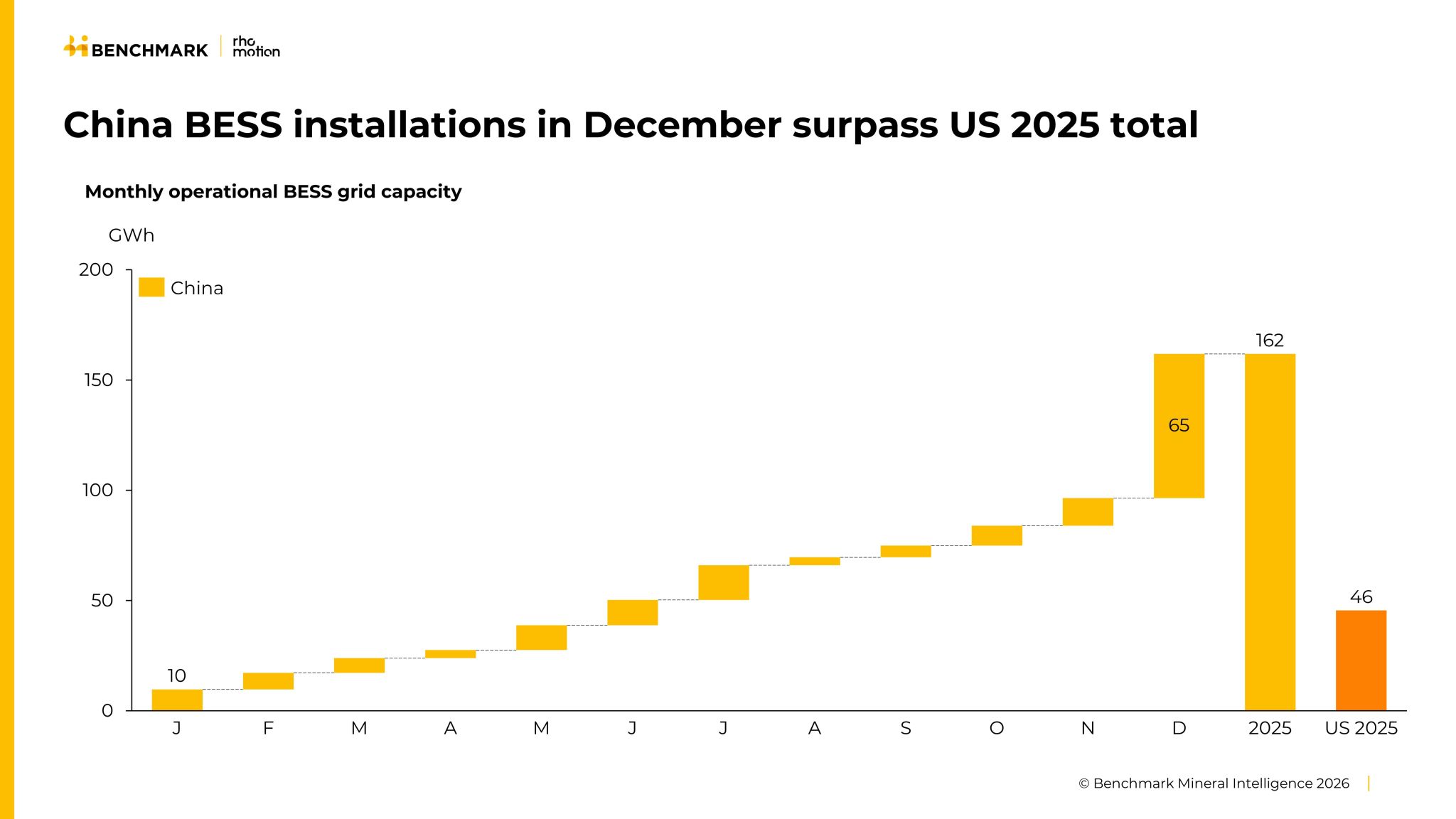
Geographically, China and the US led deployments, with China far outpacing all other markets. The world’s largest BESS market installed more battery capacity in December alone than the US – the second-largest market – deployed over the entire year. Meanwhile, Saudi Arabia, Australia, and Chile moved into third, fourth, and fifth place, respectively, displacing the UK and Italy from 2024’s top five markets.
Grid-scale projects were the primary driver of growth, accounting for nearly 240 GWh of global installations. Project sizes continued to increase, with 46 giga-scale projects entering operation in 2025, up from 17 in 2024. Looking ahead, more than 150 giga-scale projects are currently in the pipeline for 2026.
“2026 is set for another strong year for BESS, with our current forecast for new operational capacity at over 450GWh, compared to 315GWh in 2025”, Iola Hughes, Head of Research at Benchmark Mineral Intelligence, told ESS News. “There should be no material supply constrain here, with cell production for BESS cells outpacing this growth over the last year, and capacity set to expand further this year.”
Prices on the rise
In 2025, BESS system pricing reached new lows with project tenders in China falling to as low as $63/kWh. This aggressive pricing has also filtered into export markets, as a growing number of integrators look to higher-margin regions, according to Benchmark Mineral Intelligence.
However, the pricing environment has shifted at the start of the new year. Lithium prices have surged to a two-year high, driven by tightening inventories, mine production slowdowns, robust demand, and most recently China’s rollback of battery tax rebates. While the initial impact is already visible at the cell level, the full ripple effect has yet to reach system pricing.
“Currently, lithium accounts for around 7% of the cost of an AC block,” Hughes said. “The recent increase in lithium prices has begun to filter through into cell prices, with 314Ah ESS LFP cell prices rising by approximately 10% from the lows seen two to three months ago.”
It remains unclear how much of this increase will ultimately be passed on to system prices. “We are already seeing a small uptick in system prices within China,” Hughes said. “Outside China, margins are typically higher, which means some price increases can be absorbed. However, given the long lag between lithium demand and system deployment, cell and system producers are likely to use the current rally in ongoing price negotiations. The duration of the lithium price rally will be key in determining the overall impact on system pricing.”
Soaring demand
The rapid rollout of BESS has significantly boosted overall demand for lithium-ion batteries. Benchmark Mineral Intelligence reports that global lithium-ion battery demand rose by 29% in 2025, reaching 1.59 TWh.
BESS remained the fastest-growing major end-use segment. Battery demand from stationary storage jumped by 51% in 2025, compared with 26% growth in EV-related demand, continuing a structural rebalancing toward stationary energy storage.
Lithium iron phosphate (LFP) was the fastest-growing battery chemistry in 2025, with demand rising 48% year-on-year. Growth was driven by the rapid expansion of the global BESS market and the continued growth of China’s EV sector, both domestically and through rising vehicle exports. Outside China, LFP’s share of battery demand also increased to more than 30%. Meanwhile, the overall share of nickel-based chemistries declined.
Regional demand patterns diverged markedly. In China, EVs continued to dominate battery demand, with their share holding steady at 77% in both 2024 and 2025. BESS, however, gained ground, with its share rising from 16% to 19% year-on-year. In December 2025, BESS accounted for 45% of total battery demand, driven by a record month for installations.
In North America, BESS secured a much larger share of the demand mix, accounting for 26% of total battery demand, up from 16% in 2024. This shift coincided with slower EV demand growth, partly reflecting changes to Inflation Reduction Act (IRA) tax credit eligibility in the US.
In Europe, EVs remained the dominant driver of battery demand. The EV share of total demand rose to 85% in 2025, from 77% in 2024, underscoring the region’s continued focus on light-duty vehicle electrification. BESS, by contrast, saw its share fall from 16% to 8% over the same period.
Written by


Popular Posts