World’s largest compressed air energy storage station now fully operational in China

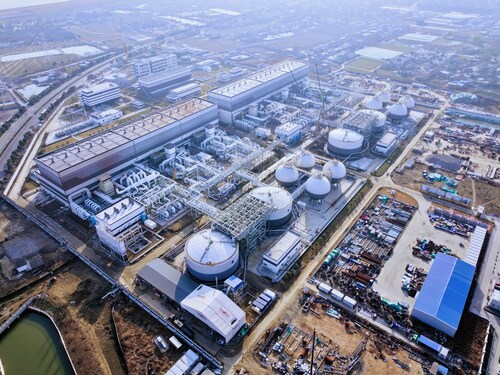
While compressed air energy storage (CAES) remains a relatively small share of China’s total energy storage market compared with batteries and pumped storage, the sector is expanding rapidly as larger long‑duration projects move forward.
The newly commissioned 600 MW/2.4 GWh Huai’an Salt Cavern project dramatically increases deployed CAES capacity, claiming the title of the world’s largest such project. Earlier, in January 2026, the record was held by a 300 MW/1.5 GWh CAES plant using two underground salt caverns in central China’s Hubei Province. Huai’an’s lead may be short‑lived, however, with a 700 MW/4,200 MWh CAES project in Sanmenxia’s Shanzhou district already in development.
For now, the Huai’an Salt Cavern CAES demonstration project in Jiangsu Province stands as the largest operating facility of its kind globally. The project features two 300 MW CAES units, utilizing roughly 980,000 cubic meters of salt caverns located 1,150–1,500 meters underground. It employs non‑supplementary combustion high‑temperature adiabatic compression technology, based on molten salt and pressurized thermal water, achieving approximately 71% conversion efficiency.
During periods of low electricity demand, air is compressed and stored in the salt caverns. At peak times, it is released to drive turbines, generating power while supporting grid stability through peak shaving and frequency regulation.
The first 300 MW unit reached full-load operation in December 2025, followed by Unit 2’s commissioning. According to project proponents, Unit 2 achieved grid connection and full-load power generation on the first attempt, providing valuable engineering insights for China’s evolving power system.
With a total investment of $520 million, the fully operational station is expected to generate 792 GWh of electricity annually. Harbin Electric Corporation and Shanghai Electric supplied core equipment, including air turbine units, generators, electric motors, and molten salt storage tanks.
More about
Written by
Comments



Popular Posts