A calm end to 2025, with flexibility still paying off

November had already brought a calm and well-supplied market with narrowed spreads, stable demand, and reduced imbalance signals. December continued along that path. In fact, with no negative price hours, a narrowing range of intraday opportunities, and easing reserve signals, December became the quietest and least lucrative month of 2025 for stand-alone battery storage systems.
This didn’t come as a surprise. The first half of the month brought steady winter demand, supported by reliable wind feed-in. Toward the holidays, industrial load tapered off, flattening the system further. While volatility didn’t vanish entirely, it dropped below the already-muted levels seen in November. Yet, and this might not come as a surprise either by now – even in this subdued environment, flexibility paid off – if deployed strategically.
December in numbers
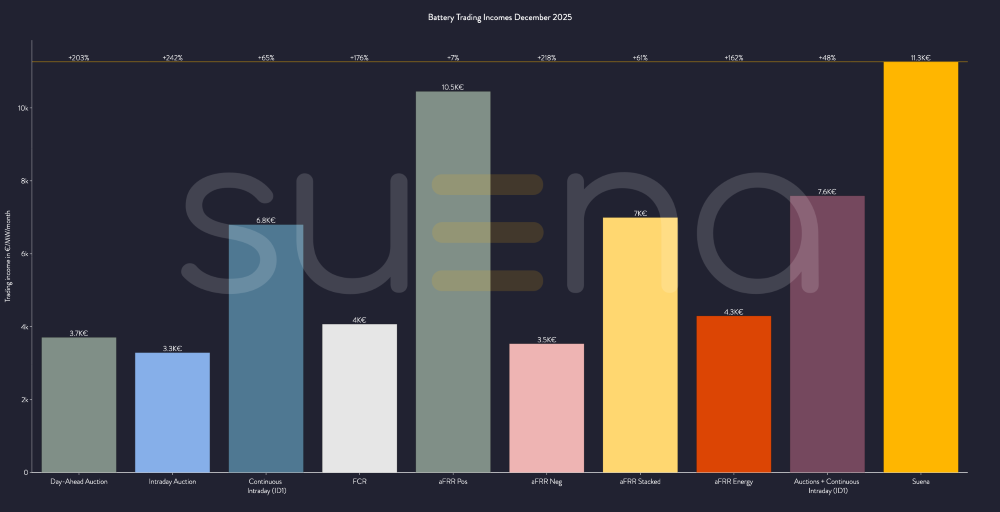
suena energy’s December benchmark confirms the cooling trend in battery revenues. Spot market strategies returned between €3.3k and €6.8k per MW, with continuous intraday trading again outperforming auction-based approaches.
Ancillary services remained a relevant revenue layer, but at noticeably reduced levels. FCR reached €4.0k per MW, while aFRR capacity values ranged from €3.5k to €10.5k per MW, with positive reserve bids performing slightly better in a tighter winter system. aFRR energy activations, as captured by the Picasso benchmark, returned €4.3k per MW, supported by solid clearing prices despite fewer pronounced system stress events.
In this muted landscape, the suena energy Autopilot once again demonstrated the value of real-time, multi-market optimization. With €11.3k per MW in trading revenues, it outperformed spot market benchmarks by 48-242 %, ancillary services by 7-218%, and the aFRR energy benchmark by 162%.
Winter stability
Unlike previous winter months marked by intermittent volatility, December 2025 was defined by stability. While average prices remained elevated due to strong seasonal demand, the underlying market dynamics grew flatter, more predictable, and less generous for arbitrage-driven strategies.
Wind feed-in was steady but rarely excessive. Solar played a minimal role, as expected, but without creating the kind of midday troughs that open arbitrage windows. Notably, there were no negative price hours recorded throughout the entire month.
The day-ahead market told the story clearly: Prices held steady through most of the month, but peak-hour spikes were shorter-lived and less pronounced than in November. While November had seen multiple day-ahead spikes above €300-€400/MWh, December’s most significant event, on the evening of December 3, peaked at €360/MWh, following a temporary drop in both solar and wind generation.
Beyond that, several periods of sustained wind generation, particularly in the first half of the month, helped cap upside movement and compress spreads between high and low-price intervals. Intraday markets did offer occasional dislocations, particularly around evening ramp periods, but these were typically short-lived and shallow.
Holiday harmony
Although ancillary service markets remained a solid contributor to overall revenue, they followed a similar pattern. Capacity prices across FCR and aFRR stayed positive and reliable, but rarely surged. On the energy side, fewer extreme imbalance events meant less volatility – yet higher activation prices supported stable aFRR energy revenues.
Toward the end of the month, the holiday slowdown further dampened activity. Industrial demand dropped as factories and commercial consumers wound down, leading to flatter load curves and a more balanced overall system. With fewer imbalance events and declining price dispersion, the market became harder to to profit from
Still, as our benchmark outperformance illustrates: even in flat markets, coordinated multi-market optimization remains the most effective way to systematically unlock value.
New year, new dynamics?
With the turn of the year, market dynamics typically begin to shift. As the holiday slowdown fades and industrial demand resumes, load patterns become more variable. This increased variability, combined with persistently high wind generation and seasonal forecast uncertainty, tends to create more complex system conditions.
With winter in full effect, January also tends to bring colder temperatures and with them, additional pressure on the power system. Freezing conditions can drive up heating-related demand, sharpen morning and evening load ramps, and increase the frequency of unexpected consumption spikes.
After a year marked by shifting market structures, evolving trading dynamics, and pockets of both volatility and calm, 2025 ended on a quieter note. Yet even in December’s subdued environment, the importance of coordination and responsiveness remained clear.
As 2026 gets underway, colder temperatures and a return to more variable demand could reintroduce more complex system conditions – and with them, the potential for a more active market phase ahead.
About the author:
Dr Lennard Wilkening is co-founder & CEO of suena energy, a green energy marketer for battery storage and renewables. suena offers marketing solutions that enable profit-maximizing multi-market trading and implement them through powerful trading algorithms. Lennard holds a PhD in grid-oriented use of battery storage systems from the Technical University of Hamburg and has more than nine years of experience in battery storage optimization and energy trading.
Written by





Popular Posts