Alfa Laval, IAE to deploy Korea’s first large-scale liquid air energy storage plant

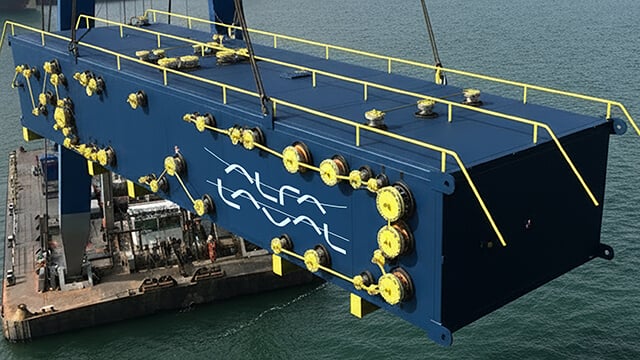
Alfa Laval has partnered with South Korea’s Institute for Advanced Engineering (IAE) to advance what the Swedish company describes as South Korea’s first large-scale liquid air energy storage (LAES) facility, aiming to improve grid stability and renewable integration.
Announced on March 3, 2026, the collaboration will combine Alfa Laval’s cryogenic equipment with IAE’s system design, integration and local engineering work. The system is designed to produce up to 10 tons of liquid air per day, which acts as the storage medium for later power generation during peak demand.
Alfa Laval said it will supply key cryogenic components tailored for extreme low-temperature duty, including brazed aluminum plate heat exchangers and a ten-stage vertical high-pressure cryogenic pump. The company positioned these as core enablers for efficient heat transfer and reliable liquid-air handling in LAES applications.
In a statement, Alasdair Maciver, head of Energy Storage Solutions at Alfa Laval, said the partnership is intended to “strengthen Alfa Laval’s position as a key supplier of LAES technology” in South Korea, adding that its cryogenic technologies are engineered to “maximize efficiency and reliability.” IAE’s Dr. Sungho Park, director of Energy Systems, described the initiative as a pioneering project aimed at setting a new benchmark for energy efficiency and sustainability in the country.
How LAES works — and what it offers
LAES stores electricity by cooling and liquefying air (around –196°C), keeping it in insulated tanks, then warming and expanding it to drive turbines and generate electricity when power is needed.
The technology is often positioned as a long-duration storage option using large standard industrial components and without the geographic constraints of pumped hydro. It is also typically described as inherently non-flammable at the storage medium level (air), which can be attractive for certain sitting and permitting contexts.
However, LAES carries trade-offs. Academic reviews commonly put standalone round-trip efficiency in the ~50–60% range, with performance improving when integrated with waste heat or cold streams. Systems also require complex cryogenic equipment and thermal management, which can increase capex and engineering requirements compared with mainstream lithium-ion systems.
While neither partner disclosed a power rating, storage duration, project location, or commissioning timetable in the announcement, the companies framed the collaboration as a step toward commercial-scale deployment of cryogenic storage in South Korea as the country seeks additional flexibility tools for a higher-renewables grid.
Written by

Popular Posts