How to achieve explosion control in energy storage systems

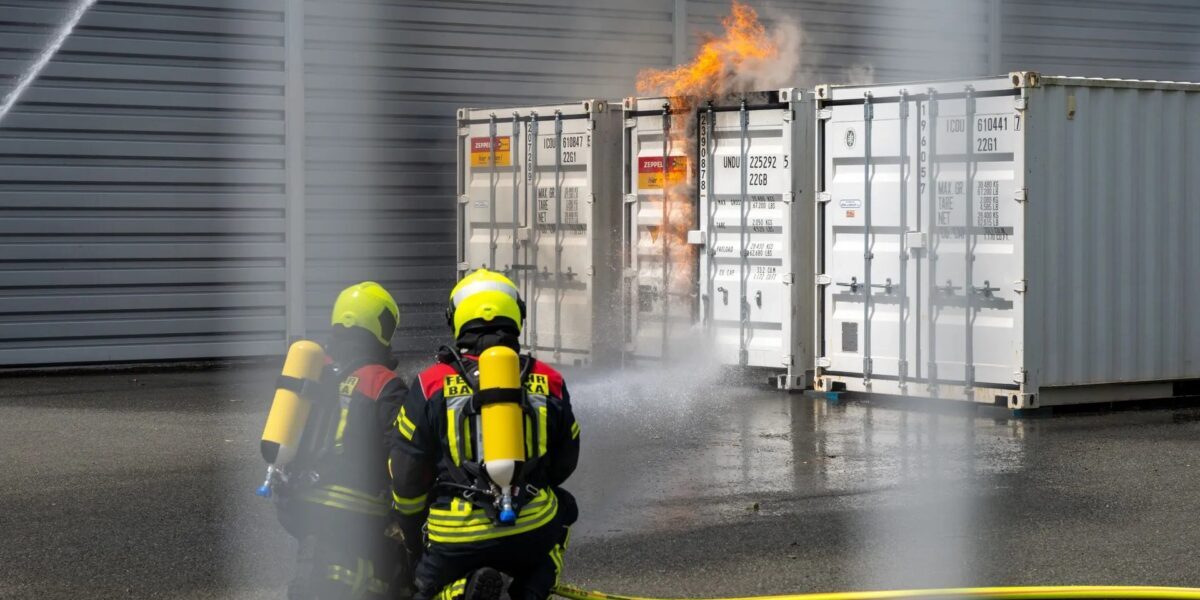
Along with the intense heat generated from each affected battery cell during thermal runaway, is a dangerous mixture of offgas. According to the US-based National Fire Protection Association (NFPA) standard 855 (A.9.6.5.6), thermal runaway results in the offgassing of “mixtures of CO, H2, ethylene, methane, benzene, HF, HCl, and HCN… and present an explosion hazard that needs to be mitigated.”
Also, due to the “cascading” element of thermal runaway, the more battery cells that are affected, the more explosive gasses that are generated.
That’s why NFPA 855 (A.9.6.5.6) references “explosion control” as an essential element to the overall safety of an ESS. However, many have questioned exactly how does the NFPA recommend achieving explosion control? When is it required? And what does reliable explosion control look like?
Current methods of explosion control
To prevent an explosion within an ESS, NFPA 855 states that flammable gas concentrations must not exceed 25% of the lower flammability limit (LFL) where gas may accumulate. Energy storage systems that prove they can maintain the LFL under this threshold are exempted by NFPA 855 from requiring explosion prevention and venting.
For those installations that do require explosion control, or even for authorities having jurisdiction (AHJs) who still require a protection strategy, methods that are used to reduce the risk of combustion include:
- Exhaust Ventilation – Ventilation systems are often used to periodically purge the environment of any potential offgassing and provide an extra layer of protection to ensure LFL is maintained below 25%.
- Explosion Venting – In scenarios where reliable exhaust ventilation isn’t possible or when protection against the worst-case scenario is necessary, explosion vents may be used to relieve a deflagration’s pressure and flames to a safe location.
- Gas Detection – As an added precaution, gas detectors may be used to identify offgassing between the activation of exhaust vents or the signs of thermal runaway in its very early stages.
Explosion control in the context of an ESS should include a vent of some sort because every battery that goes into thermal runaway generates explosive gas in that atmosphere and that gas has to go somewhere. It may be possible to achieve enough ventilation to stay below 25% of the LFL but in the case of an unpredictable factor such as an electrical failure that may take those systems down, passive explosion venting is still highly recommended in many applications.
How to reduce generated offgas from thermal runaway
Finally, there is another explosion control method that is not yet included in NFPA 855 – Fike BlueTM. Fike Blue flows through the ESS during the early stages of thermal runaway, fills the affected battery module, and absorbs the heat to ensure the cascading event is stopped.
Numerous tests at Fike’s Research and Innovation Campus have proven that applying Fike Blue saves most of the battery cells within the module except for the initial malfunctioning battery and a few of the adjacent cells. Because the spread of thermal runaway is suppressed, the remaining battery cells within the module will be unaffected and therefore will not produce offgas, resulting in a much safer outcome than other scenarios, such as letting the module, and potentially the entire ESS, consume itself.
In other words, if you have 1,000 cells inside a battery and you let all those burn, you generate 1,000 cells’ worth of toxic gas that is going into occupied spaces and rendering them unoccupiable for some time. If you’re able to suppress it and stop propagating thermal runaway, instead of losing 1,000 cells, you may only lose 50, which means that gas can be dispersed and get to levels which are not quite so toxic to people in the immediate vicinity.
Such non-standard protection strategies for ESS can ultimately help original equipment manufacturers achieve UL9540A certification.
About the author:
Tom Farrell is principal engineer of test and validation engineering at Fike Corporation and holds his Bachelor’s and Master’s degrees in aerospace engineering from the California Polytechnic State University in San Luis Obispo. He joined Fike in 2007 as a test engineer in the test and analysis laboratory and currently has primary responsibility over activities at the Fike Remote Testing Facility.
Written by







Popular Posts