‘Italy should expect battery and pumped hydro auctions in 2026’

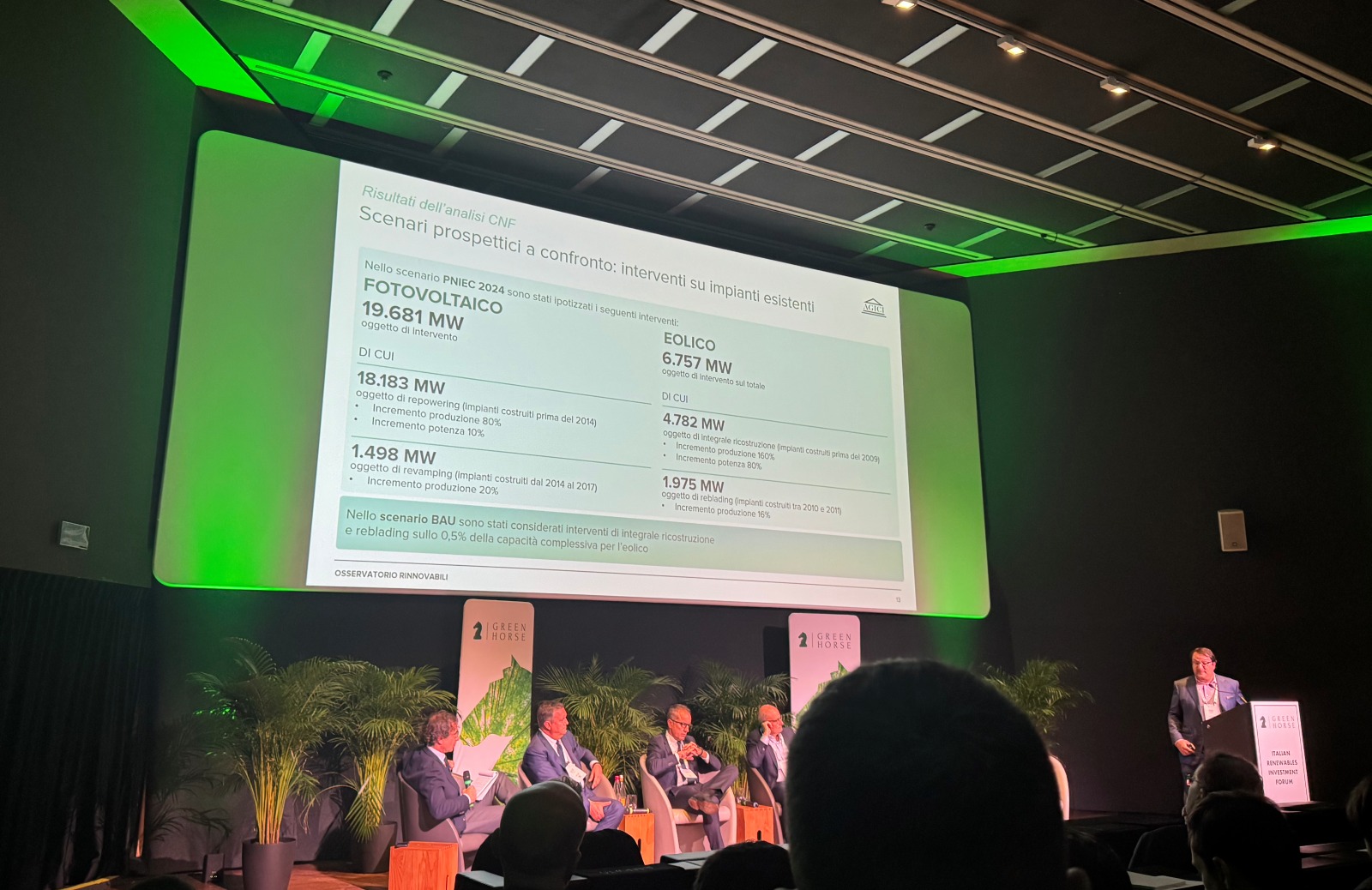
Attendees at the Italian Renewables Investment Forum 2025, held in Rome by Green Horse, predicted the nation will hold two Mercato a termine degli stoccaggi (MACSE) auctions next year: A second lithium-ion battery exercise and another dedicated to pumped hydro. At least one more capacity market auction was also predicted for 2026.
Stefano Granella, CEO of Dolomiti Energia Group, stressed the key role planning will have in the nation’s energy transition and said the MACSE program was a good start, but more is needed. “Batteries are needed, what happened recently is excellent but it is not the panacea,” said Granella.
The chief executive said the low margins of both the MACSE and Fonti Energetiche Rinnovabili (FER) X programs suggest they are tools that make investment feasible but only for companies which can develop projects and processes on an industrial scale.
Attendees at yesterday’s event agreed Italy’s energy prices make the country a more attractive location for investment than Spain, which has ultra-low energy prices; the United States, thanks to political headwinds; and South America, where curtailment of renewable energy occurs in some countries and others entail currency risk. Italy’s attractiveness has been boosted by subsidy policy, according to Green Horse Legal Managing Partner Carlo Montella, who said, “What makes Italy particularly attractive are the regulated remuneration schemes.”
Granella, however, warned the tariffs determined by the MACSE and FER X programs suggest Italy’s energy transition could follow a similar path to Spain’s.
Attendees agreed Italy needs to invest in batteries and the grid as well as renewable energy generation.
Luca Marchisio, head of system strategy at Terna, said Italy will have 200 GW of installed generation capacity by 2030, including 140 GW of clean power facilities. With the nation having had a peak load to date of 60 GW, Marchisio said, “Curtailment will be a structural element of the operation of our system, period.”
Marco Carta, CEO of Agici, said investing in renewables costs money but doing nothing costs much more.
“The overall loss for the national economy would amount to €137 billion ($159 billion) by 2050, equal to over €5 billion a year,” said Carta. “The cost of … doing [would be] €6,000 euros per inhabitant. This is constantly declined at the regional level.”
Carta presented a report indicating renewables investment benefits stand at around €160 billion and not investing in clean energy would mean 342,000 fewer jobs.
CVA Chief Executive Giuseppe Argirò noted a “very fractured and dangerous” geopolitical environment and said the Russian gas shock may prove to be the first of many. He stressed the importance, however, of future-proofing any new Italian energy system, adding, “Italy must build a system that is also redundant, with respect to what the needs are. I am convinced that, in a very few years technology will bring very significant performance at even lower prices. We must aim for a system that is safe, therefore reducing dependency.”
ERG chief executive Paolo Merli highlighted the poor performance of renewables stocks since peaking in January 2021 and said Italian support mechanisms were not doing enough.
“FER X, which is very well designed, stabilizes investment,” said Merli. “But that same FER X plant contributes to bringing plant prices to zero.”
Several attendees spoke about the Iberdrola model and the message from the event was that we are entering a phase in which competition will be significant in auctions.
Experts then said that, for next year, we should expect two MACSE auctions, one for lithium batteries and one for pumped storage, and at least one Capacity Market auction.
From pv magazine Italia.
Written by



Popular Posts