CES 2026: Bluetti integrates solar and car dual-source DC charging for batteries, and bio-circular materials

At the CES 2026 trade show in Las Vegas this week, portable power specialist Bluetti unveiled new products as it expanded its line-up, while new editions refined its portfolio.
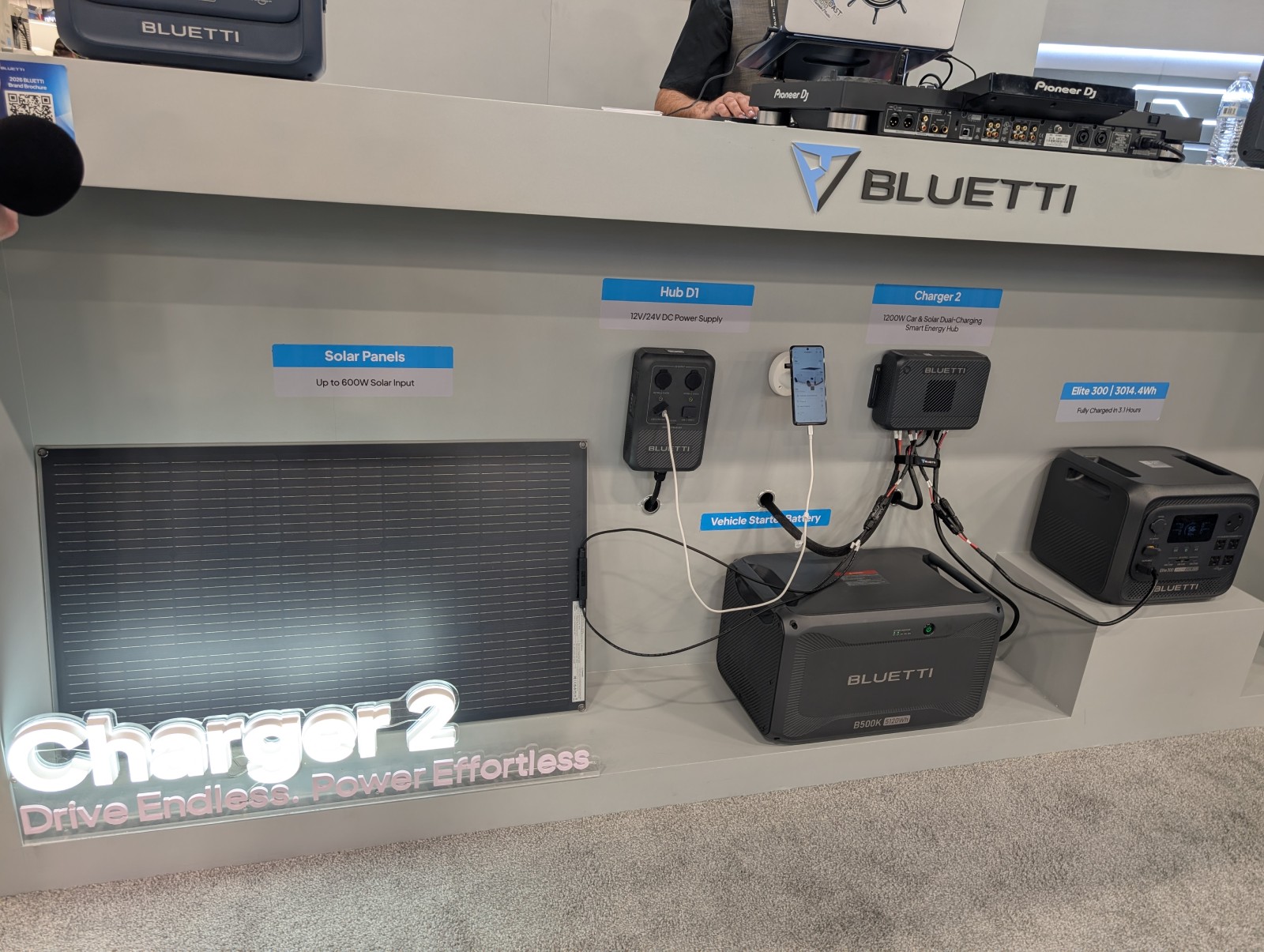
Launch devices present and on show included the Charger 2, a unified DC-DC vehicle hub for charging on the move from diesel power as well as solar, and three additions to the Elite power station series: the high-density Elite 300, the Elite 320 featuring wheels, and the material-focused Elite 100 V2 Bio-Based Edition that adds a blue tone, and uses bioplastics.
Charger 2
The Charger 2 targets the bottleneck of on-the-road charging: many would be familiar with very slow charging speeds from the 12V DC auxiliary outlet (often known as the cigarette lighter port). In attempting to boost car charging for power stations, Bluetti introduced the Charger 2, a vehicle-integrated hub designed to bridge the gap between automotive electrical systems and off-grid solar applications.
Unlike standard DC-DC chargers that typically toggle between inputs, the Charger 2 utilizes a dual-input architecture capable of simultaneously drawing power from a vehicle’s alternator and a PV array if available.
The system delivers a max combined output of 1,200 W, managing up to 800 W from the alternator alone, with the topology allowing for charging speeds approximately 13 times faster than a standard 12V/10A automotive auxiliary outlet.
The Charger 2 is compatible with both third-party power stations and Bluetti’s own, with the company claiming 95% are supported via a universal DC interface.
When used with Bluetti’s newer power stations, the unit also offers bi-directional functionality, meaning it can reverse power flow to provide a simple maintenance charge to the vehicle’s lead-acid starter battery, adding a level of resilience for the seriously off-grid.
Elite series expansion
Separate to tech specs alone, Bluetti announced a partnership with Covestro, which attempted to reduce embodied carbon in its products. The collaboration yielded the Elite 100 V2 Bio-Based Edition, a portable power station chassis constructed from Covestro’s Bayblend RE that targets sustainability.
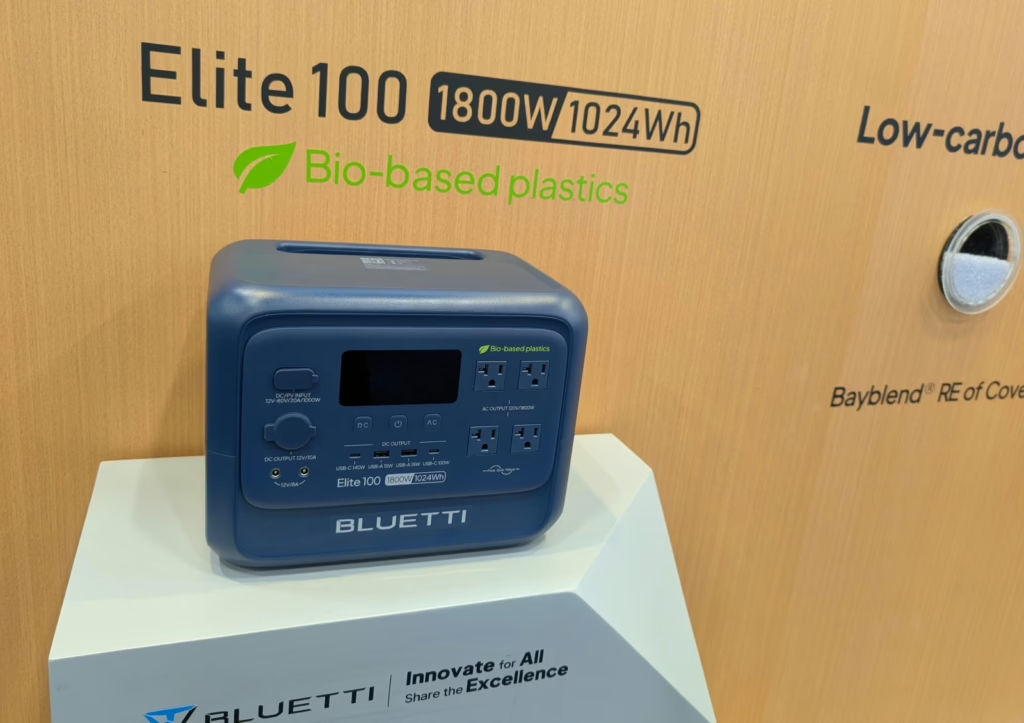
This flame-retardant polycarbonate is produced using renewable agricultural residues and bio-circular feedstocks, attributed via mass balance accounting (ISCC PLUS certified). Bluetti reports that this material substitution reduces the housing’s carbon footprint by approximately 25% compared to virgin petroleum-based plastics, without compromising the UL94 V-0 flame retardancy or thermal stability required for lithium-ion enclosures.
Alongside the material innovation adding a further variant, Bluetti introduced two capacity-focused Elite-branded models for 2026:
Elite 300: The new 3 kWh LFP unit is housed in a chassis size typically associated with 2 kWh models, a 19% reduction in footprint. It delivers a 2,400 W AC output, scalable to 4,800 W for resistive loads via “lifting” mode and integrates a UPS function with a 10ms switchover time.
Elite 320: Designed for mobility, the Elite 320 packs 3.2 kWh of LFP storage into a “suitcase-style” rolling form factor with a retractable handle. The unit offers 1,800 W AC output , with a focus on inverter efficiency, achieving an idle or standby power consumption of just 9 W to maximize runtime during long-duration outages.
While not directly attributed in press materials, representatives from Texas Instruments on site at CES 2026 explained to ESS News that developments to its power management and inverters, along with battery management advances, are helping support Bluetti and others in the market with reduced standby power draw.
Products are scheduled for release in Q1 2026, with the Charger 2 pricing starting at $499.
Written by
Comments




Popular Posts