Europe contracts nearly 24 GWh of BESS under flexibility purchase agreements in 2025

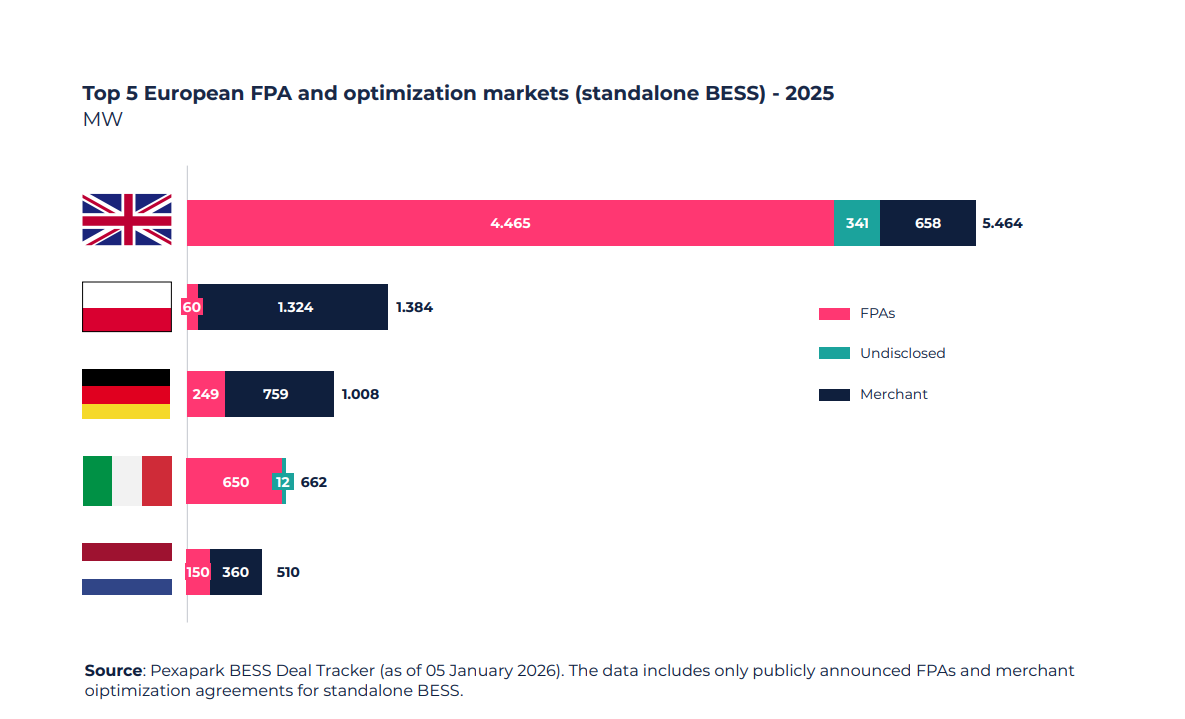
In a record-breaking year for flexibility in Europe, nearly 12 GW/24 GWh of BESS capacity was contracted under flexibility purchase agreements (FPAs) and optimization agreements, triple the volume recorded in 2024, according to Pexapark’s Renewables Market Outlook 2026. FPAs have emerged as the backbone of BESS bankability, unlocking infrastructure-style capital and enabling rapid expansion beyond Great Britain into Germany, Italy, and the Netherlands.
Contract innovation accelerated, with tolls, floors, and financial structures such as day-ahead swaps becoming mainstream, while new buyer profiles – including traders, insurers, and hedge funds – entered the flexibility market. By contrast, traditional European PPA momentum cooled in 2025 as markets adjusted to lower capture expectations. Total disclosed contracted PPA capacity fell to 13.1 GW across 247 deals, down from 15.3 GW in 2024.
“As volatility becomes the dominant market force, flexibility is becoming the real source of value. Storage, optimization and portfolio-level strategies are no longer just ways to improve returns – they are essential to remaining bankable and competitive in today’s power markets,” said Luca Pedretti, COO and Co-Founder at Pexapark.
Focusing specifically on fixed-revenue BESS offtake, the 6.5 GW of FPA capacity contracted in 2025 more than compensated for the roughly 2.2 GW decline in PPA capacity between 2024 and 2025, Pexapark finds.
Great Britain dominated the European BESS market, recording 4.5 GW of standalone BESS contracted under FPAs, representing over 75% of Europe’s total FPA capacity in 2025.
Of the 4.5 GW of FPAs with disclosed contract structures, floor arrangements represented more than 80%. Pexapark noted that this reflects lenders’ strong familiarity with BESS, a well-established track record of non-recourse project finance transactions, and a fully diversified revenue stack that incentivizes asset owners to pursue floor-type structures that retain merchant exposure. In addition the concentrated offtaker landscape in Great Britain – with nearly 80% of the flex buyer market held by EDF, Statkraft, and SSE – has led to a degree of standardization in the floor products offered to large-scale BESS assets.
This surge in FPA activity was driven by large-scale projects seeking contracted revenues to support higher leverage and enhance bankability under project finance structures in a low-revenue environment. Of the 19 FPA transactions disclosed in GB during the year, six involved assets exceeding 200 MW, with individual deals reaching up to 1 GW.
EU markets tell a different story. With merchant revenues largely unaffected by market saturation, asset owners continued to favor merchant optimization arrangements. Projects are generally smaller than in GB, supporting more equity-oriented capital structures. Nevertheless, 2025 marked a record year for FPAs in rapidly maturing markets such as Germany, Italy, and the Netherlands, Pexapark finds.
GB and EU markets also differ in terms of market concentration. While the GB BESS offtake market is highly concentrated, EU markets are more competitive. Even though the three largest offtakers still account for 66% of disclosed contracted volumes – Shell, BKW and Vattenfall – in markets such as Germany, Spain, and Southeastern Europe, a broader range of utility players is competing to establish a presence in the emerging FPA market.
Despite fundamentally strong market conditions, co-located BESS has continued to lag behind standalone projects in both capacity additions and contracted volumes. That said, 2025 marked a turning point, with co-location gaining prominence as contracted volumes surged under offtake and optimization agreements.
According to Pexapark’s BESS Deal Tracker, disclosed co-located BESS capacity contracted under FPAs, hybrid PPAs, or merchant optimization structures increased by 850% compared with 2024, reaching 3.8 GWh in 2025. While still a fraction of the nearly 20 GWh of contracted standalone BESS capacity, this highlights the growing momentum for co-location in European markets.
Written by



Popular Posts