Development fund commits $30 million to 600 MWh storage project, solar array in Egypt


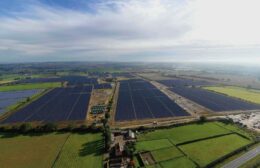
The Emerging Africa & Asia Infrastructure Fund (EAAIF) has committed $30 million in a senior secured corporate loan to Hassan Allam Utilities, primarily to support the Minya project in Egypt, which Hassan Allam Utilities and EAAIF describe as a 1,000 MW solar and 660 MWh battery energy storage system.
Infinity Power’s own project listing gives the plant’s full specification as 1,200 MWp of solar paired with 600 MWh of battery storage, identifying the asset as Nefer Minya. Project documentation from the European Bank for Reconstruction and Development (EBRD) lists the same transaction as Nubia West Minya.
The underlying transaction – the Sterling and Wilson Renewable Energy joint venture’s $560 million contract – has also been reported as a 1 GW solar and 600 MWh BESS project. Public reporting on Minya has used inconsistent capacity figures and project names across EAAIF, Infinity Power, EBRD, and other outlets, ranging from 1,000 MW to 1,200 MWp of solar and 600 MWh to 660 MWh of storage.
“The expansion of our partnership with Hassan Allam Utilities supports Egypt’s transition to localized renewable power,” said Martijn Proos, co-head of emerging market alternative credit at Ninety One, which manages EAAIF.
Ownership is split 51% to Infinity Power Holding and 49% to HAU Energy, according to Infinity Power. The project is co-developed by Infinity Power, a joint venture between Masdar and Infinity Egypt.
The loan builds on a $40 million project development facility EAAIF provided Hassan Allam Utilities in December 2024, supporting 2.3 GW of Egyptian renewable energy projects: the 1,100 MW Suez wind project co-developed with ACWA Power, 1.2 GW of solar at Benban and Wahat, and 720 MWh of associated battery storage.
Egypt sourced 89% of its electricity from fossil fuels in 2024, according to Ember, which cites the same figure EAAIF attributes to Enerdata. Egypt’s updated nationally determined contribution moved the country’s renewable electricity target date from 2035 to 2030, aiming for 42% of generation from renewables by then, according to Egypt’s State Information Service; EAAIF’s own release cites the same 42% target but retains the earlier 2035 framing.
“Scaling innovative financing structures alongside battery storage infrastructure strengthens grid stability and underpins sustainable growth,” said Proos.
He added that the deal offers a template other emerging and developing economies could use to decarbonize while generating high-quality green jobs.
More about
Written by


Popular Posts