PVFarm rolls out RE STACK software for utility-scale BESS planning

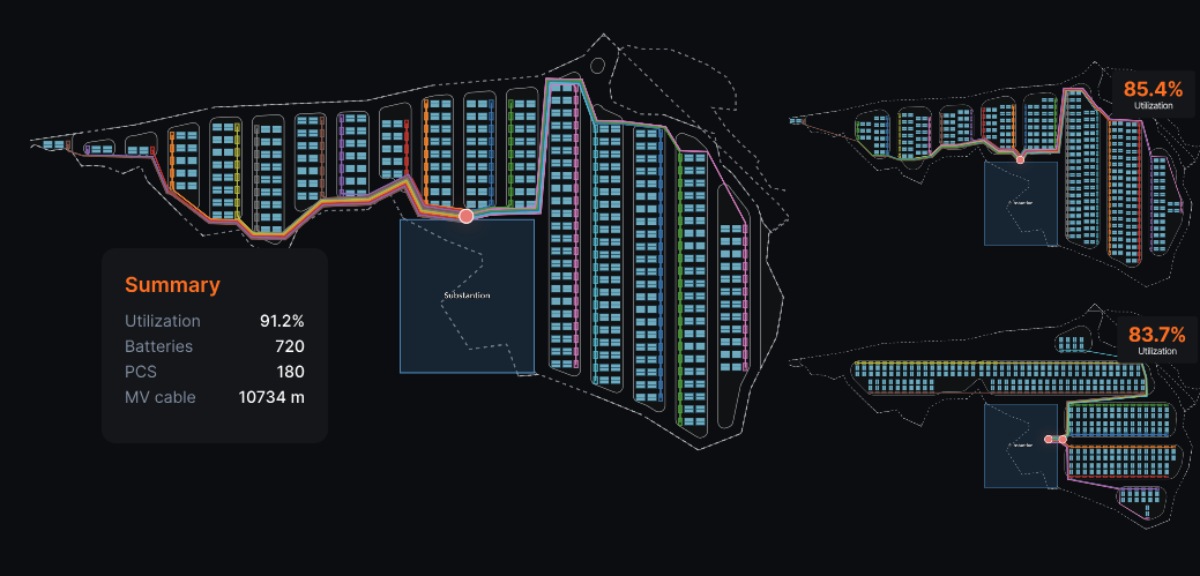
US-based PVFarm, which traditionally has offered large-scale solar PV project design and planning tools, has moved into the energy storage market with a new tool called RE STACK.
The new platform by the software company, founded in 2001, has now launched for commercial use and offers detailed utility-scale battery energy storage (BESS) layout exploration across manufacturers, sites, and locations.
Among the promised planning solutions for BESS projects, RE STACK tackles manufacturer specifications to explore site layouts, road concepts, and medium-voltage collection topologies before detailed engineering begins, which the company claims saves time and effort.
Maksim Markevich, chief technology officer at PVFARM, answered a range of questions from ESS News after the launch of the BESS tool.
ESS News: What common pain points is RE STACK aiming to solve, and are there real-world examples that may be of interest to ESS News readers?
Maksim Markevich: RE STACK addresses a simple problem: early-stage BESS design is still highly manual and fragmented.
Engineers often move between manufacturer specifications, spreadsheets, CAD, mapping tools and previous projects to answer interconnected questions:
How much equipment fits? Which block configuration works best? What clearances are required? How should roads be arranged? Where should auxiliary equipment go? How does MV collection change with the layout?
The challenge is not creating one layout; it is exploring enough credible alternatives, quickly enough, to make better early decisions.
One battery manufacturer recently tested RE STACK using customer-provided site boundaries to understand how much equipment it could fit and ultimately supply. Its existing workflow relied primarily on AutoCAD and considerable manual effort. With RE STACK, the team could configure its BESS blocks, test layouts quickly, and then export a layered DXF to continue working within its established engineering workflow.
In another test, a large irregular site showed how something as simple as road orientation could materially change the amount of equipment that fits. Instead of manually rebuilding alternatives, the software can explore road-grid angle and position together to find better-performing layouts.
That is the value we are trying to create: more credible options in less time, while keeping engineers in control of the assumptions.
Is this for a particular region or geography, or is it cross-region and therefore takes into account relevant standards and regulations?
Markevich: RE STACK is designed to work across regions rather than being tied to one geography.
The software is configurable. Engineers can define equipment dimensions, clearances, setbacks, road dimensions, block arrangements and other project-specific requirements. This allows the same platform to represent different manufacturers, clients, jurisdictions, and project requirements.
We deliberately separate this from automated compliance. RE STACK does not claim to interpret every applicable fire, building, or permitting code and certify that a design is compliant. Engineers remain responsible for selecting and validating the requirements appropriate to their project.
Our job is to make those requirements easier to represent, change, and test—and to keep the assumptions behind the layout transparent.
How does someone learn the software, and is dedicated training required?
We designed RE STACK as a self-service product, so dedicated training should not be required for the core workflow.
An engineer familiar with BESS can import a site, configure equipment and blocks, define roads and layout parameters, generate a layout, and start adjusting it interactively without first becoming a software specialist.
More advanced workflows naturally require some guidance—for example, creating custom equipment configurations, defining individual clearances, importing geolocated KML, KMZ or DXF boundaries, or representing phased deployment.
Our principle is simple: learning the software should be the easy part.
Has RE STACK already adapted to changing requirements during the development process?
Markevich: Constantly. The product has been developed alongside engineers, developers, EPCs, utilities and equipment manufacturers testing it on real projects. Many capabilities in RE STACK today came directly from cases where our original assumptions did not match how projects are actually designed.
Roads are a good example. Early versions were relatively simple. Real sites pushed us toward more flexible road-grid tuning, site zones, rotation controls and manual adjustments.
The same happened with BESS blocks. We initially thought a library of common configurations might be enough. Manufacturer examples quickly showed otherwise. Batteries, PCS units and transformers are packaged and connected in many different ways, and even a single project may require different arrangements across the site.
That led us toward a flexible block configurator where engineers can define and save their own equipment and configurations rather than being constrained by our assumptions.
This feedback loop is central to how we build RE STACK. BESS is evolving too quickly for engineering software to assume today’s requirements will remain fixed.
Does RE STACK work with any BESS manufacturer, a specific subset, or some other arrangement?
Markevich: RE STACK is manufacturer-agnostic.
Instead of restricting engineers to a fixed equipment catalog, users can define equipment dimensions, capacities, clearances and block arrangements themselves, then save those configurations for reuse.
This matters because BESS products are changing quickly. Different suppliers package batteries, PCS units, transformers and auxiliary equipment differently, and new configurations continue to enter the market.
We want engineers to be able to model the equipment they are actually evaluating rather than wait for a software vendor to add it to a catalog.
What does RE STACK cost?
Markevich: RE STACK has a free trial, so engineers can test it on a real project before deciding whether it is useful for their workflow.
The current subscription price is visible directly in the product. However, we are still early in the commercial rollout, and we expect pricing to evolve over the next six months as we learn more about how different customers use RE STACK and what pricing model best supports the market.
Our priority right now is: make it easy for developers and engineers to try the product, get value from it, and help us shape where it goes next.
—-
Following the interview, ESS News signed up to use RE STACK. Current pricing after the free trial is billed at $2,880/year, broken down into $240 per seat/month.
Written by