Storage-plus-renewables could save Indian state $1 billion over new coal, says think tank
Rajasthan could save up to INR 85 billion ($886.4 million) in power procurement costs in 2030 by meeting its emerging reliability needs through renewable energy and storage rather than new coal capacity, according to a new study by New Delhi-based CEEW.
The study, “How Should Indian States Choose New Power Generation Capacity? A Case Study of Rajasthan,” assesses a February 2025 proposal by Rajasthan distribution companies (discoms) to contract for 3.2 GW of new coal capacity to address projected shortages. CEEW finds that Rajasthan’s 2030 shortfall is fundamentally a timing and flexibility problem, not just a capacity one. Nearly 90% of the projected 5.5-billion-unit deficit occurs during non-solar hours, when solar generation is unavailable, and the system needs resources that can respond swiftly to demand.
Using 15-minute production-cost simulations for 2030, the study compares three pathways – business-as-usual, adding 3,200 MW of new coal, and an equivalent energy provided by an renewables-plus-storage combination of solar, wind, and battery storage – to determine which best meets Rajasthan’s needs at the lowest cost.
Replacing new coal with renewables-plus-storage in Rajasthan could generate net savings of INR 11.4 billion to INR 85 billion in 2030, and help discoms earn INR 35 billion in additional revenue by selling surplus power in the exchanges, the CEEW study finds.
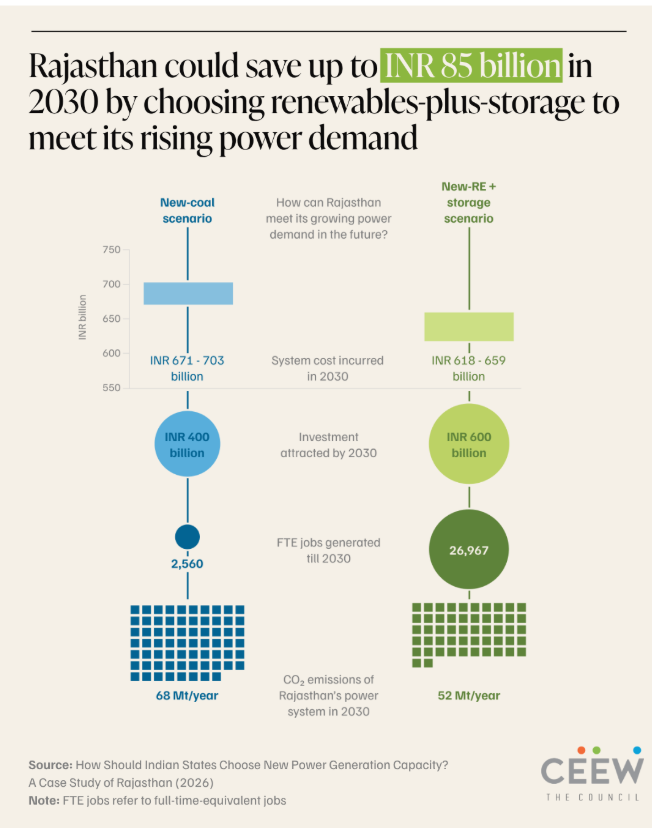
The clean pathway could create 27,000 full-time-equivalent (FTE) jobs by 2030, against 2,560 under new coal, while attracting INR 600 billion in clean energy investment. It would also cut the state’s power-sector CO₂ emissions by 24%, to 52 million metric tons (MT) against 68 million MT under new coal – relevant given Rajasthan’s electricity requirement grew at 8% CAGR between fiscal 2022 and fiscal 2025, with demand projected to reach 1.5 times fiscal 2025 levels by fiscal 2030.
“Discoms should evaluate options based on grid needs and overall system cost, rather than technology-level costs alone. Our analysis shows that RE-plus-storage can meet Rajasthan’s future reliability needs at lower cost than the proposed coal capacity,” said Disha Agarwal, fellow at CEEW. “SECI’s recent round-the-clock RE bid discovered a tariff lower than recently contracted or proposed new coal capacity in several states. Such studies establish the need for planning exercises that states must undertake continuously as technology capabilities and costs change rapidly and demand becomes more uncertain.”
The views and opinions expressed in this article are the author’s own, and do not necessarily reflect those held by ESS News.
From pv magazine India
More about
Written by



Popular Posts