California home batteries set VPP dispatch record during heat wave

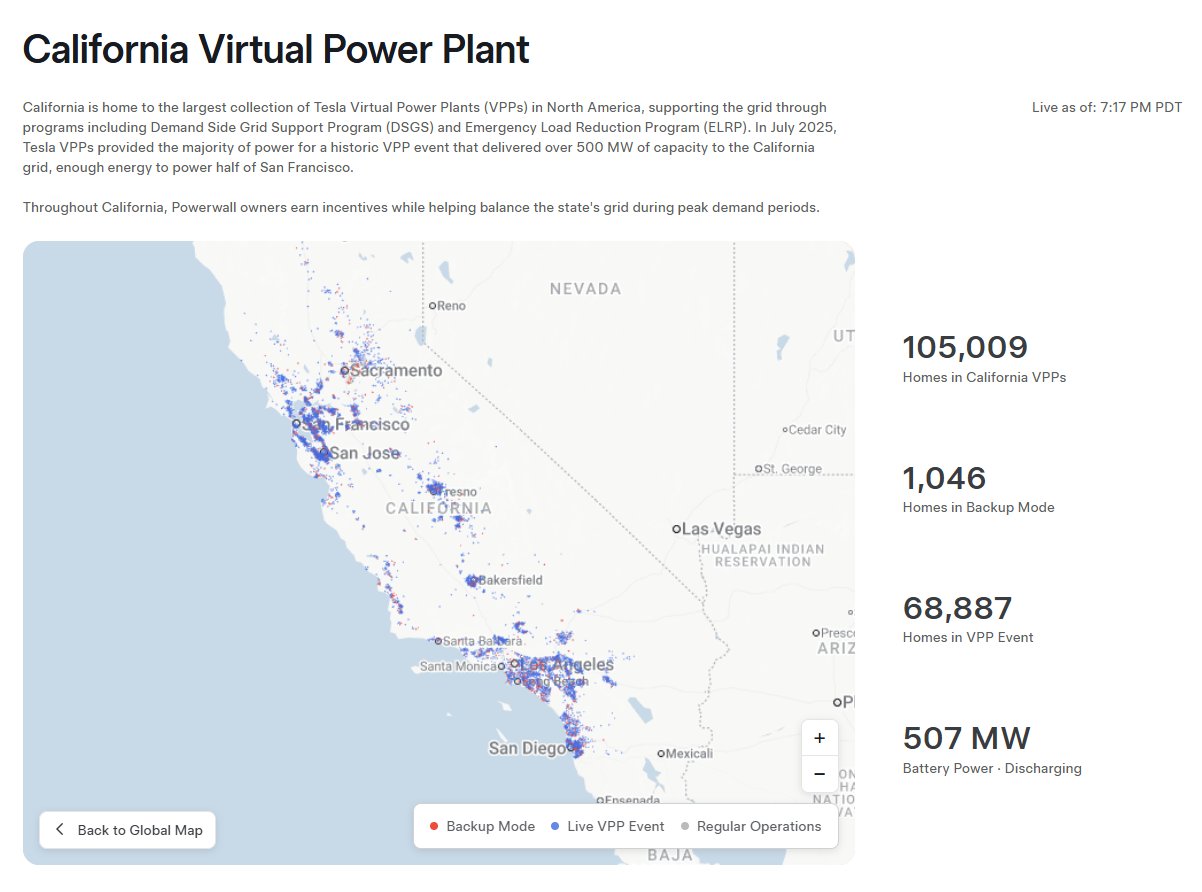
Some batteries across California discharged at a peak of more than 580 MW on the evening of Sept. 9, which Tesla and Sunrun said it was the largest residential VPP dispatch on record.
The California Energy Commission (CEC) called on the batteries as a heat wave pushed up demand and wholesale prices. Tesla Powerwalls accounted for 517 MW, while batteries from other manufacturers added 63 MW. About 110,000 Powerwalls took part, 55% of them owned and operated by Sunrun. Sunrun also dispatched more than 30,000 non-Tesla batteries in its fleet.
On the evening of the peak event, the CEC’s Demand Side Grid Support (DSGS) program triggered when the California Independent System Operator’s (CAISO) day-ahead price exceeded $200/MWh.
The following evening, Southern California Edison requested its own three-hour dispatch, and the two companies delivered more than 140 MW. Had both calls landed on the same night, Sunrun and Tesla said in a press release, the fleets could have delivered more than 720 MW.
During a statewide test on July 29, 2025, greater than 100,000 batteries sustained 539 MW of output for two hours. The Tesla units supplied 459 MW of that. A Brattle Group analysis of that event, commissioned by Sunrun and Tesla, found the program had enrolled 700 MW of battery capacity and could deliver up to $206 million savings by displacing gas peaker output during the highest-priced hours of the year.
Residential VPPs are scaling the ConnectedSolutions program to add EVs in Massachusetts. The Clean Peak Program runs in parallel to ConnectedSolutions, and is specifically designed to offset gas peaker plants in the state and region.
The announcement lands as two virtual power plant bills await action in Sacramento. SB 913, from Sen. Josh Becker, would direct the California Public Utilities Commission to establish a valuation methodology for customer-sited batteries exporting power during periods of system stress and allow aggregated behind-the-meter resources to count toward resource adequacy. Companion bill SB 905 would create a grid utilization metric to measure how much of the distribution system’s capacity is actually used.
Both cleared the Legislature this month. Last October, Newsom vetoed three VPP and load-flexibility bills citing budget constraints. Newsom’s administration also cut funding for DSGS, the program that triggered the Sept. 9 dispatch.
Sunrun and Tesla noted the event as proof their 16.8 GW VPP deal with Renew Home had future viability.
From pv magazine USA
More about
Written by


Popular Posts