Automated battery trading still runs within customer-set limits

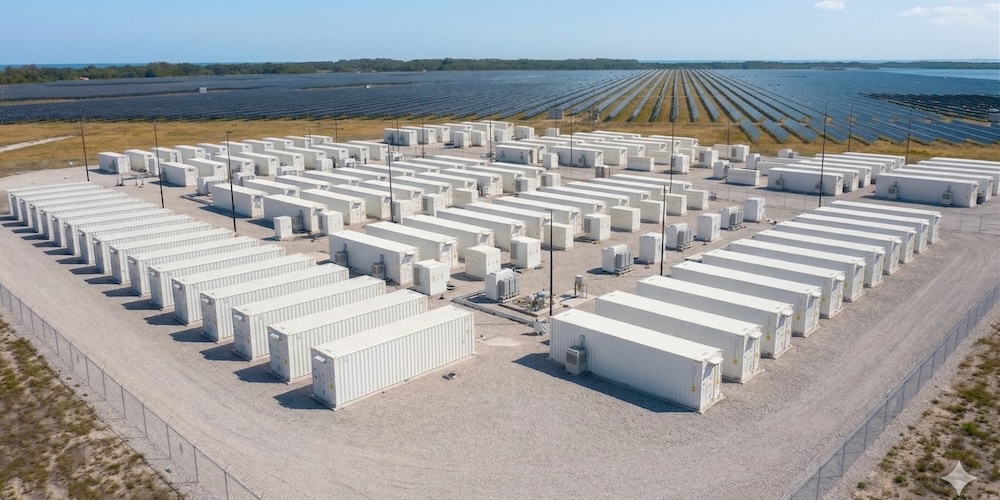
Arenko’s Nimbus platform handled more than 98% of traded volume automatically at one UK solar-plus-storage site in March, the company said, but customers still set the rules and hard limits the software works within, according to Arenko CEO Rupert Newland.
Newland, who founded Arenko in 2014, said that the platform manages close to 2 GW across about 62 grid-scale projects, including 14 co-located projects that pair batteries with wind or solar.
It covers the process from day-ahead positions to real-time delivery and can place bids in 14 markets, including the Balancing Mechanism, which Britain’s grid operator uses to balance supply and demand in real time, as well as day-ahead and intraday trading, imbalance, and ancillary services such as voltage and frequency support.
Newland separated automation, which he described as a rules-based way to run a process without intervention, from AI, which he called “a critical thinking layer that sits on top of it” and decides which path to take at each point. In Nimbus, neural networks forecast market conditions, and an optimization layer combines those forecasts with the asset’s technical constraints, re-optimizing roughly every second. That allows the system to place thousands of trades using “intelligence that wouldn’t be mathematically possible for a human being to do in real time,” he said.
Customer control
How a co-located battery shares a grid connection with a wind or solar plant depends on the customer, said Newland. At some sites the renewable plant always takes priority and the battery is curtailed, while at others the battery charges from the renewable generation. “But it’s the customer who decides on the configuration,” he said.
That includes Hornsea 3. Arenko announced in August that its software would operate Ørsted’s 300 MW/600 MWh Iceni battery, which shares a grid connection with the offshore wind farm and was in initial commissioning in October. Newland told told pv magazine that Ørsted sets the rules there and declined to discuss the configuration, citing confidentiality.
Operating limits can be fixed or variable, and some variable limits can be machine-learned, while warranty and temperature limits tend to be standard limits.
“We find that customers really like to have control of what the boundaries are,” Newland said.
When an asset hits a hard limit, trading stops. Traders can also place their own positions manually, and the optimization then trades around them.
If a site loses its connection to the platform, Newland said, a small on-site computer, installed in about 99% of cases, continues delivering positions that have already been placed, and a 4G link provides a backup connection. He said Arenko commits to 99.9% uptime under its service agreements and has run at 99.99996% over the past six months.
Constrained sites
Newland said batteries at co-located sites can perform strongly even when export capacity is constrained, because they are used more actively to manage the connection limit. Arenko calls the feature its constraints engine.
At the solar-plus-storage site, Arenko said, Nimbus has raised use of the grid connection from 8% to 29%, which the company said places the asset among the top 10% of UK battery projects for annualized revenue this year. At a co-located UK wind site where Arenko works with a utility, export availability is around 70%, and the company said the asset performs in line with industry benchmarks, with 88% of last year’s traded volume executed automatically. Arenko did not name either site.
Asked whether the platform had ever made a trade that cost a customer money, Newland did not give an example but said no optimization is perfect. “No asset, no optimization, no trade is always going to be perfect because you’re basing things on forecasts,” he said.
He added that batteries of the same duration should not be expected to earn the same, since location shapes the opportunity. “If you’re on the Scottish borders, you’ve got an opportunity, which is very different to if you’re in the Midlands somewhere,” he said.
Data first
Arenko installed a 1 MW trial system in 2016 and then the 41 MW Bloxwich battery near Birmingham, which the company said became, in 2019, the first battery in the UK to be traded in the Balancing Mechanism.
Newland said AI features are likely to come and go quickly as the market chases the latest tool, but the foundations stay the same.
“The consistent thing is you need to have really great data. You need to have really great automation. You need to have really great connectivity to actually use the data and operationalize the information that comes from the AI,” he said.
Trading strategy is taking on a larger role in battery returns as ancillary-service revenues in Britain and Germany have become saturated, according to software company Volue.
More about
Written by
Comments



Popular Posts