Enervis Battery Storage Index: October marks seasonal downturn, yet revenues remain relatively high
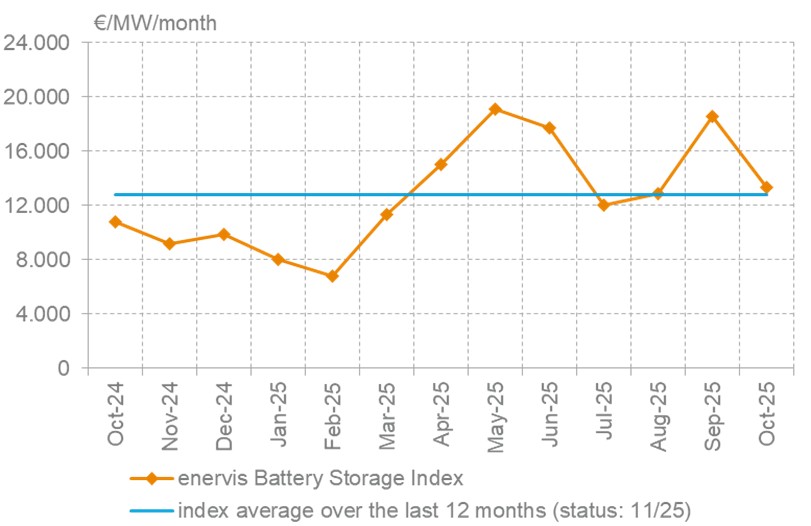
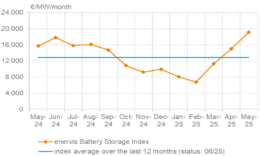
Energy economics consultancy enervis has been publishing a monthly “Battery Storage Index,” based on historical market data, since the first quarter of 2025. The index illustrates revenue opportunities for battery storage systems in Germany by accounting for participation in both the intraday and balancing power markets. It provides an overview of achievable revenues for each of the past 13 months.
New revenue figures for October 2025
Achievable BESS revenues in October amounted to around €13,400 per megawatt and therefore declined after the exceptionally high levels seen in September. This corresponds to a 28% decrease compared with September, while still standing 24% above October 2024. In October, wind generation once again dominated, while lower PV feed-in reduced volatility and kept spreads on the spot markets relatively low compared with other months in 2025. Prices for FCR and negative aFRR trended downward, but record-high positive aFRR prices supported revenues, leaving achievable BESS revenues above the 12-month average despite weaker arbitrage opportunities.
General trends
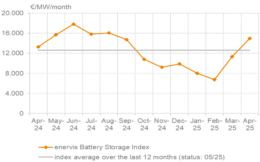
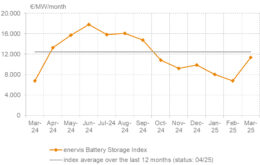
The monthly achievable revenues have fluctuated significantly over the past 13 months. They ranged from a low of €6,770/MW/month in February 2025 to a peak of €19,100/MW/month, reached in May 2025. Revenues tend to be higher during the summer months, largely due to strong PV generation combined with relatively low overall electricity demand. In addition, conventional generation capacity is typically lower during summer, partly because of scheduled maintenance and, in the case of gas-fired power plants, potentially reduced efficiency under high ambient temperatures. Wind generation availability also tends to decline in summer compared to autumn and winter. As a result, short-term fluctuations or forecast errors in PV feed-in lead to increased market volatility during these months reflected in more dynamic activity on the intraday market. On average, battery storage systems generated almost €12,830/MW/monthin the last twelve months, amounting to approximately €154,000 per megawatt annually.
New: expected revenues for 2026
So far, we have taken a forward-looking view by presenting the revenues for 2025 based on our modeling. As the year is now approaching its end, we are shifting our focus to the coming months and therefore present the modeled revenues for 2026. These are based on the same storage system and the market data forecast in our current power market scenario.
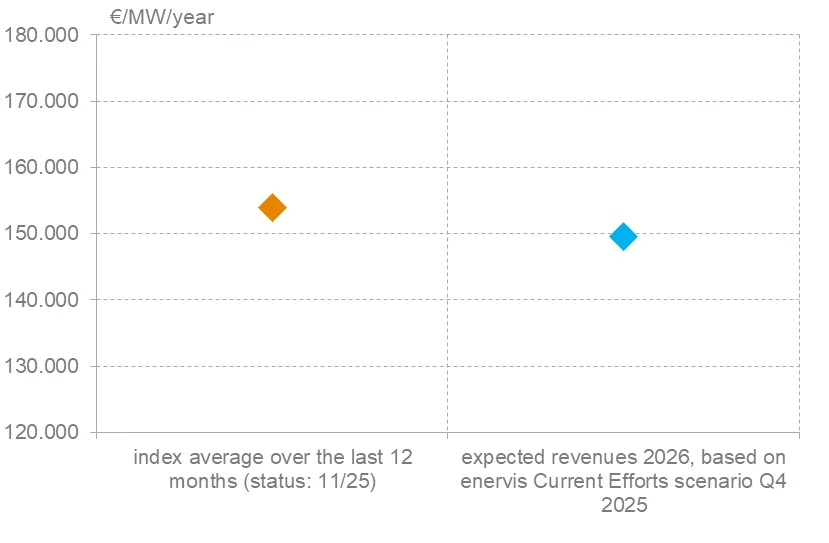
The expected revenues for 2026 in our Q4 2025 scenario amount to €149,600 per megawatt per year. This represents a slight decrease compared with the modeled revenues for 2025 (around €500 per megawatt). The market conditions relevant for storage in 2026 are very similar to those in 2025, both in terms of prices on the ancillary services markets and spreads on the spot markets. Accordingly, revenues are expected to stay broadly in line with 2025 levels.
However, the decline is somewhat more pronounced compared with the average index value over the past twelve months, rather than with the simulated revenues – about €4,400 per megawatt per year lower. However, the figure still remains within the same general range.
Methodological explanation: The Enervis Battery Storage Index shows the monthly net revenues that can be achieved historically and in the future in Germany for a 1 megawatt capacity and 2 megawatt hours storage volume (2 hours) battery storage system. The storage system was modeled with a use restriction of 1.5 cycles per day, a maximal depth of discharge of 90%, a technical availability of 97% and a round-trip efficiency of 87%. The index takes into account participation in the following markets: Intraday, Frequency Containment Reserve (FCR) and automatic Frequency Restoration Reserve (aFRR). Imperfect foresight and no revenues from aFRR energy are modeled. The respective prices of the markets for the historical analysis are taken from publications of the transmission system operators and EPEX-Spot. The future outlook is based on the same modeling and parameters and prices from the current Enervis power price scenario Current Efforts Q4/2025.
Further information:
If you are interested in a more detailed analysis and the full report, you can request it here.
Authors:
Mirko Schlossarczyk – Managing Director of enervis energy advisors is an experienced energy market expert. His consulting focus is on electricity price forecasts, electricity market scenarios and the asset valuation of BESS.
Jonas Anthonioz – Consultant at the energy economics consultancy enervis energy advisors, where he is responsible for battery storage-related topics. In addition to his usual tasks in revenue assessment and profitability analysis of battery storage projects, he developed the enervis BESS Index and the associated BESS Index Report.