Long-term storage grows by 49% in 2025 despite the financing crisis

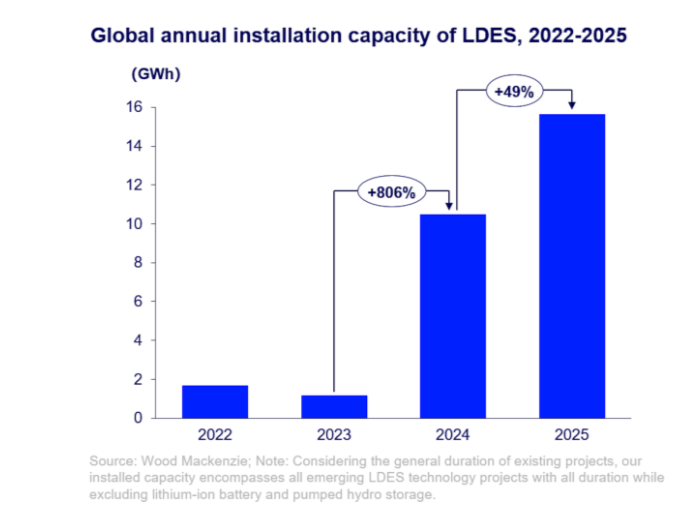
Global long-duration energy storage (LDES) installations are expected to exceed 15 GWh in 2025, representing a 49% year-on-year increase, according to the latest Long Duration Energy Storage Trends report by Wood Mackenzie. Despite the rise in installed capacity, however, the sector continues to face significant challenges, including declining investment, growing competition from lithium-ion batteries, and the lack of suitable market frameworks to support commercial deployment.
China dominates installations
Deployment of long-duration storage is highly concentrated in China, which accounts for roughly 93% of global cumulative installed capacity. The country’s leadership is largely driven by strong policy support, including the Special Action Plan for the Development of New Energy Storage (2025–2027) and provincial mandates encouraging the adoption of alternative storage technologies.
In terms of technology, three solutions accounted for most installations in 2025: compressed air energy storage (CAES) with a 45% share, thermal energy storage at 33%, and vanadium redox flow batteries (VRFB) at 21%. These technologies are typically positioned as alternatives to conventional electrochemical batteries in applications requiring longer discharge durations.
Competitive pressure from lithium-ion batteries
Despite the increase in deployments, analysts say the LDES sector is experiencing what they describe as a “strategic compression.” Lithium-ion batteries have strengthened their dominance in the most economically attractive segment of the market—four- to eight-hour storage—thanks to lower costs and well-established supply chains.
Currently, lithium-ion systems typically provide average runtimes of around two hours. By comparison, technologies such as VRFB and CAES can reach approximately four hours, while thermal storage systems may extend up to eight hours. However, these runtime advantages have not been sufficient to offset cost differences and limitations in revenue models.
Decarbonization scenarios suggest that long-duration storage will become increasingly important. According to Wood Mackenzie, achieving net-zero emissions targets would require the average duration of global energy storage to rise from around 2.5 hours today to nearly 20 hours. At present, however, LDES accounts for only about 6% of global energy storage installations.
The report notes that revenue certainty for long-duration storage projects is relatively strong in markets such as the United Kingdom, Italy, the United States, and Australia, where dedicated regulatory mechanisms or contracting frameworks are already in place.
Meanwhile, countries including Spain, Ireland, and Germany have begun introducing technology-specific tenders aimed at promoting these solutions.
Nevertheless, many markets still lack adequate capacity mechanisms or price signals to support investment. In many cases, the potential revenue from multi-day energy arbitrage remains insufficient to justify project costs.
Falling investment and financial pressure
Funding has also become a major concern for the sector. Global investment in LDES technologies declined by 30% year on year in 2025, excluding a $1.76 billion commitment from the US Department of Energy for projects by Hydrostor.
Venture capital funding has been hit even harder, falling by 72% in 2025. Between 2021 and 2025, only three companies – Hydrostor, Eos Energy Enterprises, and Form Energy – managed to raise more than $1 billion each, together securing over $4 billion. Even so, these companies continue to face significant financial pressures.
Analysts attribute the deterioration in the investment environment to several factors, including high interest rates – which penalize projects with long payback periods – as well as growing competition for capital from rapidly expanding sectors such as artificial intelligence data centers and electricity grid infrastructure.
Cost differences remain one of the main barriers to LDES competitiveness. In China, for example, lithium-ion battery projects with four hours of storage cost around $107 per kWh. Thermal storage systems reach roughly $190 per kWh, while CAES projects cost around $201 per kWh, representing premiums of 78% and 88%, respectively.
Vanadium flow batteries could see substantial price reductions in the coming decade. Estimates suggest costs could fall by more than 30% by 2034. Even in that scenario, however, they would still remain around 240% more expensive than lithium iron phosphate (LFP) battery systems in four-hour applications.
Market outlook to 2034
Looking ahead, lithium-ion batteries are expected to maintain their dominant position in the global storage market. Wood Mackenzie forecasts that these technologies will retain around 85% of market share through 2034, while VRFB and CAES are projected to reach only 5% and 3%, respectively.
Lithium-ion manufacturers are also moving into longer-duration products, strengthening their position in the four- to eight-hour segment with supply chains that already exceed 1,000 GWh of global capacity.
Demand for multi-day storage remains limited. In most power systems, events requiring more than a full day of discharge occur fewer than ten times per year, while systems with durations between two and eight hours can cover roughly 90% of storage needs.
Nevertheless, several flagship projects continue to move toward demonstration or commercial deployment. These include the 50 MW/300 MWh liquid air energy storage plant being developed in the United Kingdom by Highview Power, and the 20 MW/200 MWh CO₂ battery project under development in Italy by Energy Dome. Multiple gigawatt-hour-scale projects based on CAES and thermal storage technologies are also under development in China.
Analysts broadly agree that moving from pilot projects to large-scale commercial deployment will depend largely on regulatory reforms and market designs capable of recognizing the systemic value of long-duration storage in power systems with high shares of renewable energy.
From pv magazine Spain
More about
Written by




Popular Posts