Study: Copper doping unlocks stability in manganese cathodes for sodium-ion batteries

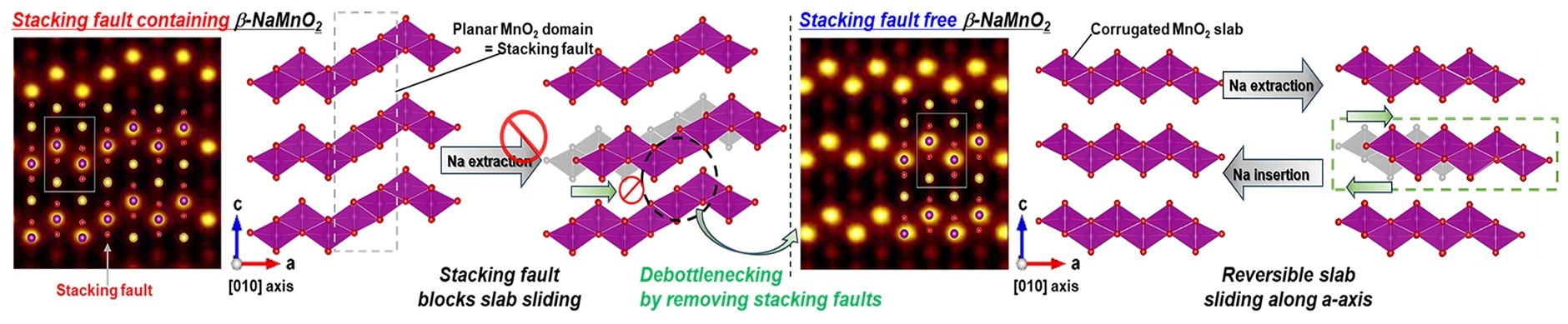
Researchers at the Tokyo University of Science have found that adding copper to a sodium-ion battery cathode material improves stability and therefore, lifespan. The study, published in Advanced Materials, demonstrates a method to overcome a key defect in β-sodium manganese oxide (β−NaMnO2), a promising low-cost alternative to lithium-based materials.
The NaMn material exists in two primary crystal forms, an α-phase and a β-phase. While the β-phase is of particular interest, its synthesis process often introduces structural defects known as stacking faults (SFs). These faults are microscopic slips in the material’s atomic layers, creating undesirable structures within the cathode. This structural problem has been persistent, and actively causes the battery capacity to degrade rapidly during charging and discharging cycles, making practical use difficult.
The research team, led by Professor Shinichi Komaba, systematically created and tested samples of sodium manganese oxide with varying levels of copper doping. The Tokyo-based team synthesized several samples with varying amounts of copper and found that a 12% doped version, NaMn0.88Cu0.12O2, reduced the stacking fault concentration to a negligible 0.3%. In subsequent electrochemical tests, this optimized material showed excellent stability, exhibiting no capacity loss for over 150 cycles. In contrast, the undoped material failed in under 30 cycles.
The work appears to resolve a long-standing stability issue and could lead to more durable sodium-ion batteriess. At the same time, this more stable structure provided an opportunity to study the material’s core mechanics, revealing a previously obscured phase transition involving a drastic gliding of internal layers during operation.
The potential for using abundant and inexpensive materials like sodium and manganese for energy storage is high. The lab results help in one key area of these battery types, though challenges remain: proving the copper-doping method is viable and cost-effective for large-scale commercial manufacturing and validating its long-term performance in real-world conditions are next steps.
Written by






Popular Posts