5 GW of grid-forming batteries and synchronous condensors to underpin transition for network operator TransGrid in Australia

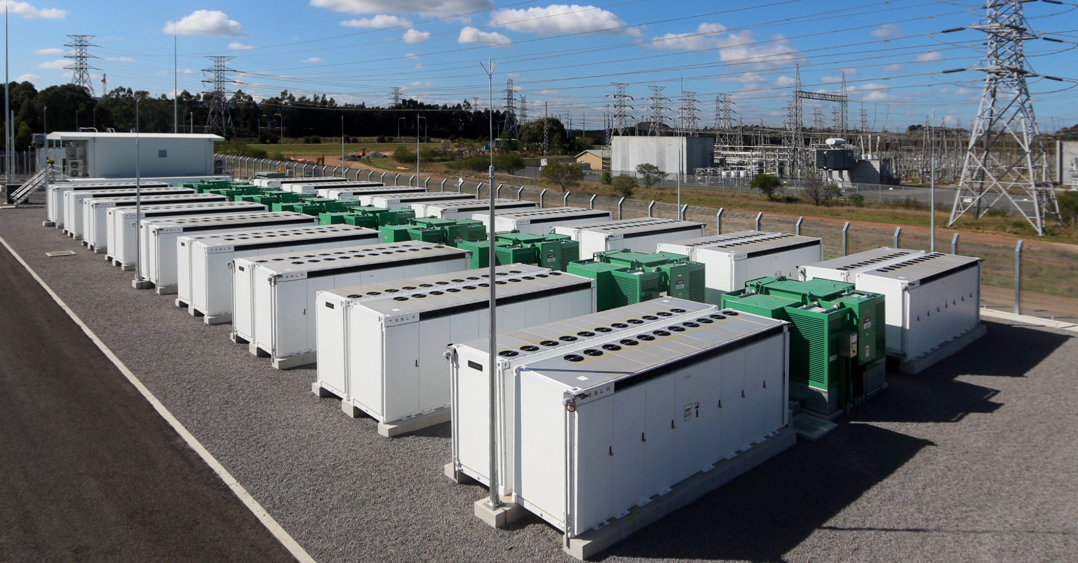
New South Wales (NSW) transmission network operator system strength service provider (SSSP) Transgrid has chosen grid-forming batteries and synchronous condensers as its preferred technologies to underpin the company’s portfolio of system strength solutions.
From a potential 100 individual solutions considered, it now plans to roll out 10 synchronous condensers to support system strength, inertia and system voltage, and 5 GW of grid-forming battery energy storage systems (BESS), providing the equivalent strength to another 17 synchronous condensers.
Specifically, the Project Assessment Conclusions Report (PACR) used to evaluate options noted, “Our modelling identifies that 5 GW of grid-forming batteries (by 2032/33) provides the equivalent stable voltage waveform support as approximately 17 synchronous condensers.”
The estimated cost for the battery component alone sits at AUD$2.65 billion in capital costs (USD $1.7 billion) and AUD$476 million (USD $307 million) operating costs for grid-forming BESS including newbuild and upgrades of both committed and anticipated solutions to enable grid forming capability.
Transgrid also intends to modify 650 MW of synchronous generators to enable synchronous condenser-mode, plus consider additional targeted solutions to support new renewables within the New England and Hunter-Central Coast Renewable Energy Zones (HCC REZ).
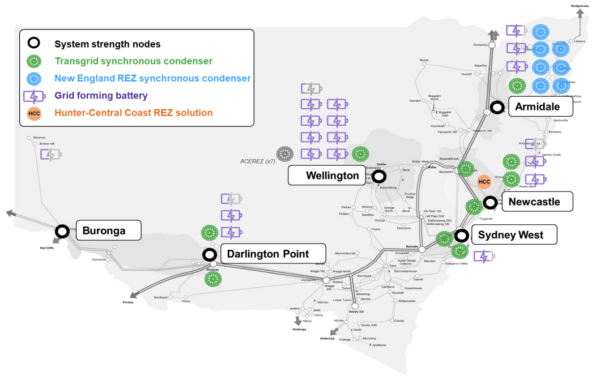
Transgrid Acting Executive General Manager of Network Jason Krstanoski said the preferred portfolio utilizes “innovative grid-forming batteries to provide almost half of NSW’s system strength requirements, with synchronous condensers providing the other half.”
“Together, these solutions are expected to deliver $8.8 billion (USD 5.7 billion) in net market benefits by ensuring the safe and reliable operation of the grid and accelerating the transition to more affordable, cleaner renewable energy,” said Krstanoski.
Krstanoski said the report also demonstrates that additional net market benefits of $1.2 billion could be delivered if Transgrid accelerates deployment of synchronous condensers, and the company is currently investigating options to fast-track the project.
PACR is part of Transgrid’s System Security Roadmap, a 10-year plan to transform the state’s power system and ensure the secure operation of the grid at up to 100% instantaneous renewables.
Transgrid published its preferences in its Project Assessment Conclusions Report (PACR), which is the final step in a three-stage regulatory process to ensure the best outcome for the market and consumers.
Written by





Popular Posts