BBDF 2025: Co-location, hybrid PPAs reshaping the European energy market

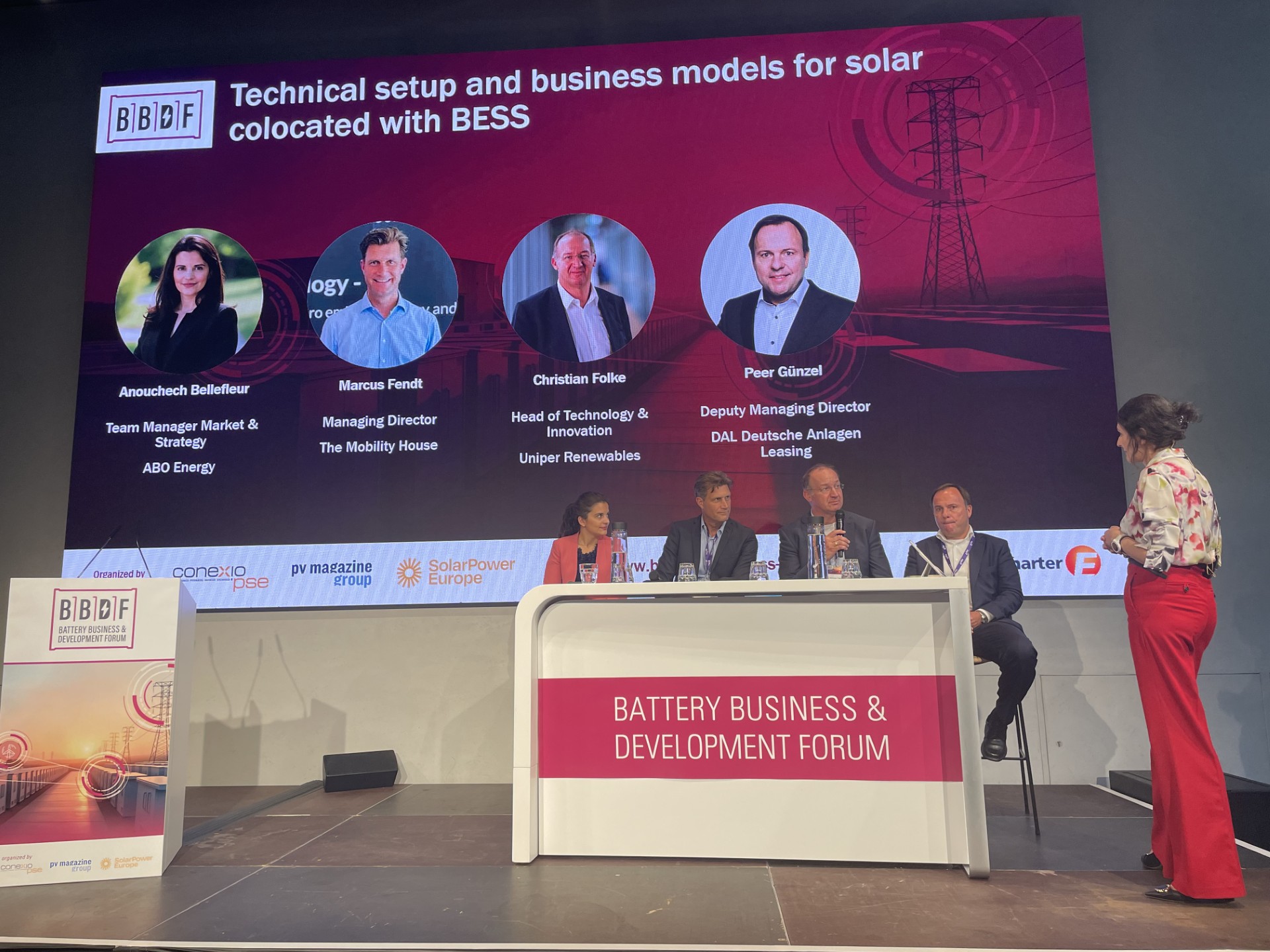
The final session of the Battery Business & Development Forum 2025, held this week in Frankfurt, Germany, showed the increasing interest across the European battery storage landscape in co-located projects.
“Around 80% of the market is dominated by standalone systems. But this is expected to change going forward,” said the session’s moderator and Director of ESS News, Marija Maisch. “Due to the growing number of hours with negative electricity prices in some key European energy markets, however, standalone battery projects are losing ground. But this is not necessarily bad news for project developers.”
Hybrid power purchase agreements (PPAs), although still uncharted territory, offer the advantage of combining wind, solar, and battery storage.
According to Rodrigo Lopez, Head of Revenue at Spanish independent power producer BNZ, traditional PPAs are becoming less frequent in the European markets, as there is uncertainty about how energy prices will evolve. “Buyers currently seek deals with shorter durations and smaller volumes,” he said. “This makes hybrid PPAs, including wind-plus-solar or PV-plus-flexibility [storage], more interesting. These deals are completely new, but off-takers are beginning to understand how they work.”
Technically speaking, hybrid PPAs can be executed for either onshore wind or solar energy assets that include a co-located BESS. This combination of sources offers advantages when it comes to negotiating prices and in terms of volume commitments for both sellers and buyers, according to Lopez. “What we get is a kind of natural hedging between the different technologies,” he stated. “So that is a good point for the seller and also for the buyer.”
“With ancillary services, we get an additional revenue stream that can be shared between both parties, so both parties will be happier,” he added, noting that negative prices are less of a concern with a hybrid PPA because of its flexibility. “It is more or less similar to a traditional PPA but with specific features that provide for proper risk allocation.”
Christian Folke, Head of Technology and Innovation at Germany’s Uniper Renewables, stressed the importance of proactive energy management for hybrid approaches involving renewables and storage, as they must take into account different revenue sources.
Karl-Heinz Remmers, CEO of Remmers Solar, presented a case study on how to develop a co-located project in Germany. “It is a 230 MW solar project planned to operate with storage, and it is the second-largest PPA project in Germany,” he said. “It uses grid-forming central inverters, which are crucial for hybrid co-located systems. If you are not deploying them now in these projects, you are making a big mistake,” he added, noting that despite their higher price, they offer more advantages for energy shifting. “In hybrid PPAs, every kWh matters.”
He also stressed the importance of the proper design and construction of the transformer station at the solar plant. “To allow for future enhancement, install a slightly larger transformer. Then you can add wind at the substation, or you can add batteries, or you can add both,” he said.
“The grid operators also have to learn, and we need to give them some time,” said Folke. “They are increasingly receiving both small-sized and large-sized co-located projects.”
“In May of this year, we saw negative prices from 10:00 AM to 5:00 PM on a single day, and this was, of course, a massive change in the market’s perception,” said Anoucheh Bellefleur, Team Manager of Market and Strategy at ABO Energy. “Now, when we talk to financing parties, they are more aware of co-location, even for old projects under incentive schemes.”
According to Bellefleur, lenders are “very keen” to finance these co-located batteries on the debt side because this not only enhances the existing project itself, but it also safeguards the project’s ability to service its debt.
Developers, however, will have to deal with different conditions depending on the geography. “They will need to understand how different grids function and operate,” she explained. “This also applies to the entire permitting process. You have so many stakeholders that you need to bring around the table.”
Remmers suggested that developers opt for DC coupling instead of AC coupling. “DC coupling is just more efficient,” she said.
More about
Written by


Popular Posts