South Korean researchers develop nanoscale zinc-anode coating to boost stability in water-based zinc-ion batteries

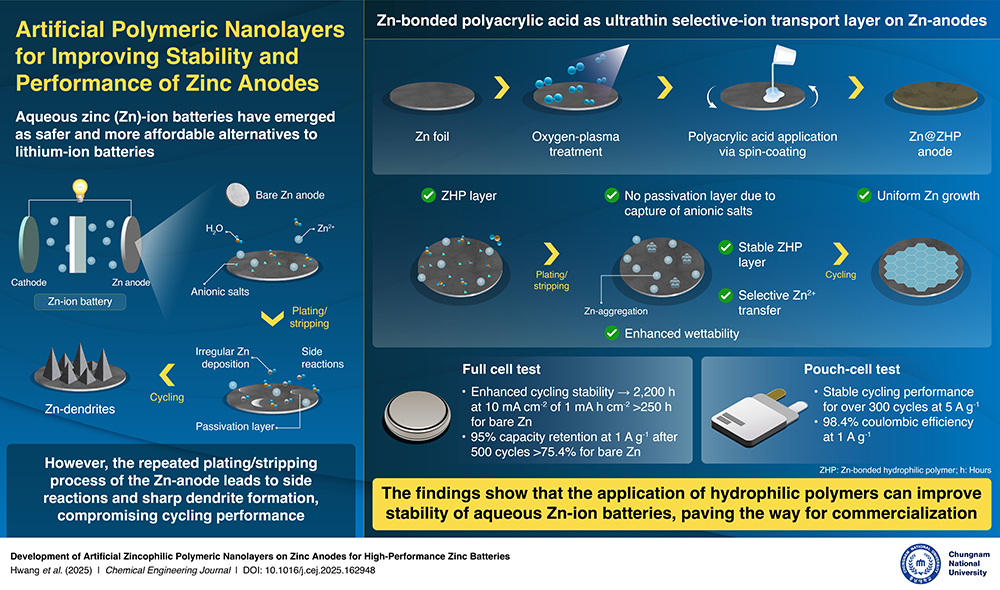
Researchers at Chungnam National University in South Korea have developed a thin protective coating that improves the performance and lifespan of aqueous zinc-ion batteries (ZIBs). ZIBs are a candidate as a safer and cheaper alternative to lithium-ion cells, but significant work is still required to challenge the lithium supremacy.
ZIBs use water-based electrolytes instead of the flammable liquids in lithium-ion batteries. This makes them safer, but zinc anodes can still form needle-like dendrites, a common problem for many battery technologies, as well as experiencing unwanted side chemical reactions during charging and discharging, reducing a battery’s lifespan and reliability.
Existing coatings can block zinc-ion movement, and newer selective-ion transport layers (SITLs) can be expensive and difficult to make.
The research team, led by Associate Professor Woo-Jin Song, developed a zinc-bonded polyacrylic acid (ZHP) layer that is nanoscale in thickness, easy to produce, and strongly bonds to the anode. The layer resists dissolving in the electrolyte, allows zinc ions to move freely, and reduces corrosion, hydrogen gas formation, and surface passivation.
In tests, ZHP-coated zinc anodes ran for more than 2,200 hours in symmetric cells without significant performance loss, compared with much shorter lifespans for uncoated zinc. In full cells, they kept 95% of capacity after 500 cycles at 1 A g⁻¹. In pouch cells, they lasted over 300 cycles at a high current of 10 mA cm⁻². The coating also reportedly encouraged zinc to deposit in a uniform crystal structure, which improves efficiency.
Song said the combination of safety, durability, and low cost compared to SITLs, could make these ZIBs suitable for a wide-range of applications including grid energy storage, sensors, and portable electronics.
“In this study, we developed a nanoscale zinc-bonded polyacrylic acid (Zn–PAA) protective layer for zinc anodes via oxygen plasma treatment,” explains Song. “Unlike conventional thick and complex coatings, our approach offers a simpler fabrication process and is scalable for large-area applications.”
While lithium-ion remains the main battery technology and sodium-ion is growing in interest, developments like this are important to help zinc-ion compete in markets where safety and cost are priorities. The duration and cycle lengths in lab conditions are encouraging, but still short of mainstream li-ion.
The study was published in Volume 515 of the Chemical Engineering Journal on July 01, 2025 with DOI 10.1016/j.cej.2025.162948
Written by



Popular Posts