Wärtsilä completes integrated explosion control system tests in Quantum2 battery enclosure

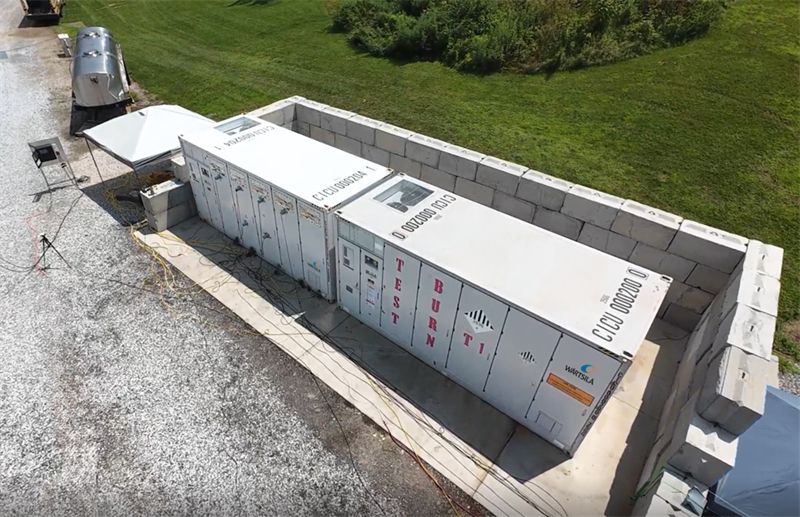
Finnish energy storage company Wärtsilä has announced that its new integrated explosion control system has been tested across three scenarios, while demonstrating that it prevented major failures.
The tests, conducted in the United States, were overseen by the company itself, along with three unnamed partners, which included a US-based utility, a fire alarm vendor, and a third-party consultant.
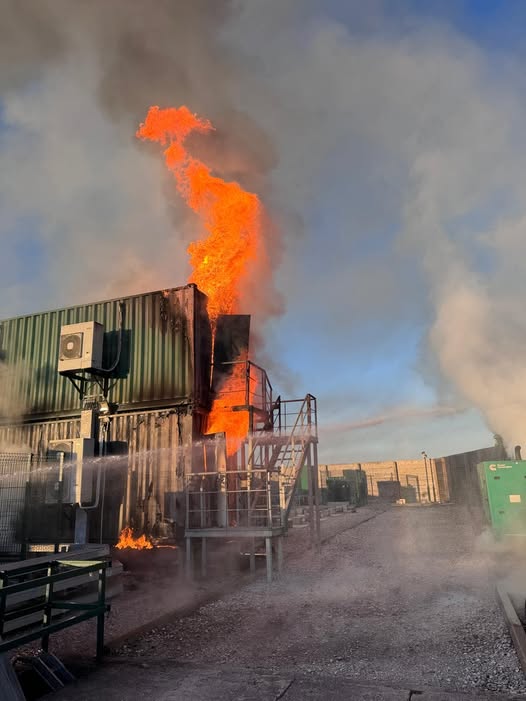
Each test was said to simulate worst-case thermal runaway scenarios within Wärtsilä’s Quantum2 containerized battery energy storage systems (BESS).
Wärtsilä calls its integrated explosion control system an Active Ignition Mitigation System (AIMS). It is said to be engineered to “mitigate potential flammable gas build-up during an abnormal thermal scenario” within the BESS enclosure itself.
The system deliberately ignites flammable gases before they accumulate to dangerous levels, using “sparker systems in combination with door-mounted deflagration panels,” to ignite flammable gases at the earliest stage of a thermal event. This then attempts to prevent significant levels of gas from accumulating, while reducing the chance of explosions.
This early intervention prevents significant off-gas build-up and reduces the likelihood of “deflagration panel activation,” a technical term detailing a rupture or panel bursting open. By using targeted deflagration, the enclosure has a more deliberate approach to safety.
Testing outcomes
Each of the three tests aimed to explore how well the AIMS tech was working. The tests initially involved the release of a flammable gas blend, representative of UL 9540A CATL 306Ah cell-level testing, at internal locations over two minutes.
According to Wärtsilä, the three tests showed AIMS prevented these issues. The company also stated that it collected visual, temperature, static, and dynamic pressure, as well as UV/IR data, which will be used to continue understanding and possibly evolving the solution.
Tamara De Gruyter, President of Wärtsilä Energy Storage and Executive Vice President at Wärtsilä, said it was a first-of-its-kind in the BESS industry, adding “We’re not only rethinking how storage systems are built, we’re also actively collaborating with first responders, emergency personnel, customers, consultants, and other stakeholders to engineer a robust system and best equip our partners to act when it matters most.”
Mishaal SyedNaveed, Product Manager, Fire Protection at Wärtsilä Energy Storage, added, “We believe true safety starts well before gases build up as a result of thermal runaway. With AIMS, we are pioneering technology to help our customers manage BESS risks before they escalate.”
Written by




Popular Posts