Competition in Italy’s future MACSE auctions could be just as fierce as in the first

pv magazine Italia has discussed the MACSE auction program with Maddalena Cerreto, lead expert for Italy at Aurora Energy Research. Cerreto, who noted successful MACSE bidders can retain up to 20% of positive grid service revenue, stressed future MACSE auctions – to allocate up to 50 GWh of new storage capacity by 2030 – will also be highly competitive.

pv magazine: On Sep. 30, Italy will hold the first MACSE auction, for delivery in 2028. The MACSE auction could be very competitive, with prices likely to drop significantly from the initial cap of €32,000 ($38,000) per megawatt-hour, per year – later raised to €37,000/MWh/year. There’s even talk of €25,000/MWh. What’s the rationale behind the move from €32,000/MWh/year to €37,000/MWh/year? Is it significant? Why?
Maddalena Cerreto: During the consultation, many stakeholders, including Aurora, warned that the €32,000 cap risked not leaving adequate room for competition in the auction. Taking this feedback into account, the premium was increased to €37,000 to reflect the higher costs of greenfield projects, such as higher grid connection costs and the extension of guarantees over the entire delivery period, as well as risks not explicitly considered. While the adjustment is a positive sign, the higher cap is not expected to significantly impact the outcome of the auction as it is expected to be highly competitive.
What might an average price be?
Given the expected level of competition, we expect prices to be far from the cap of €37,000. Obviously, since the auction is “pay-as-bid,” we expect some variety in the contracted prices but the majority of bids submitted at the auction will be in the €20,000s.
The number of BESS projects approved increased significantly in August, with more than 10 GWh worth approved. The pipeline now stands at more than 30 GWh, right? What’s happening now, in September? Is that trend continuing?
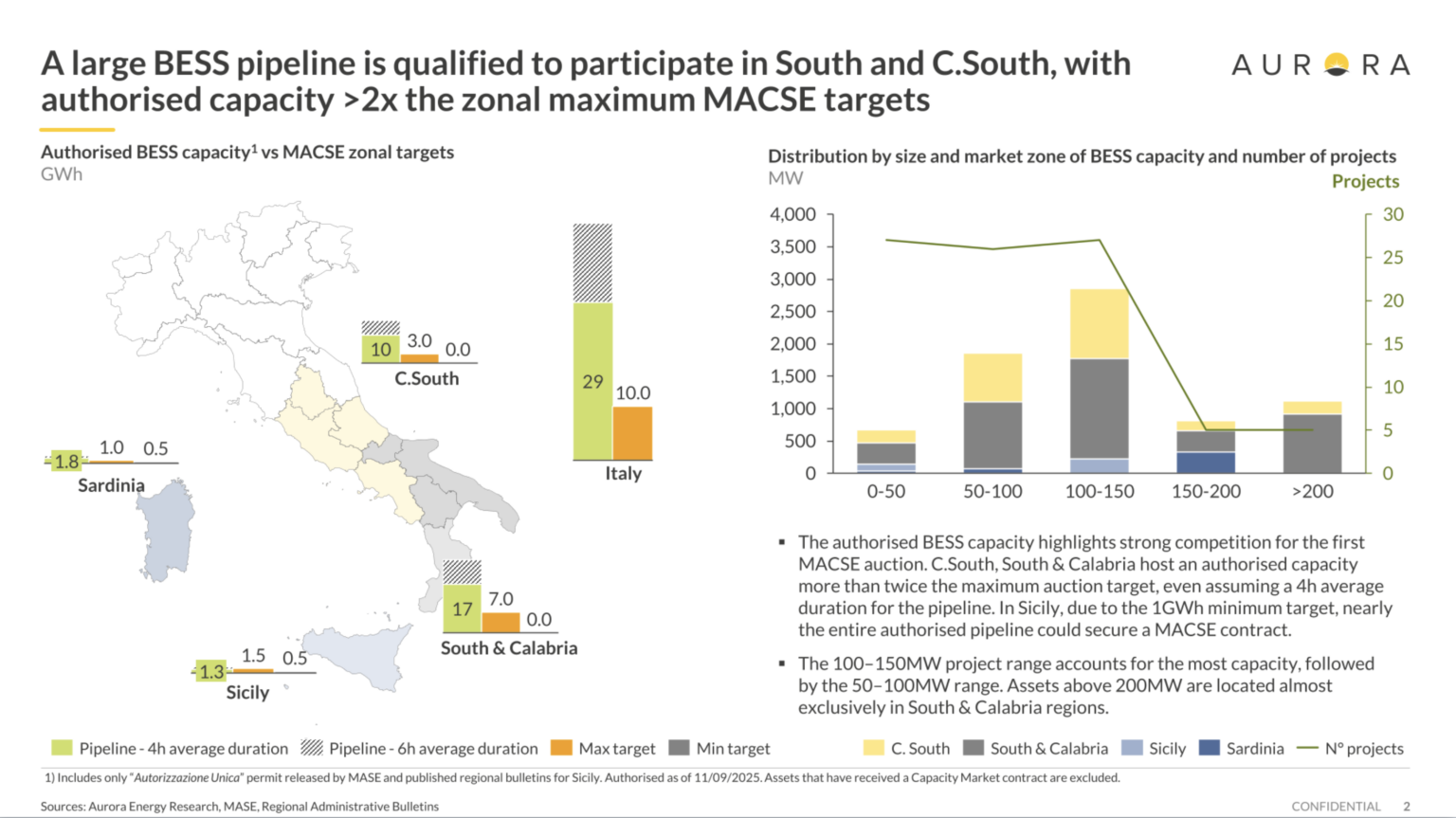
In August, we saw a sharp increase in authorizations: Single authorizations issued by MASE [the Ministero dell’Ambiente e della Sicurezza Energetica] alone totaled 1.5 GW, the highest monthly figure of the year, likely driven by the upcoming MACSE auction. As of Sep. 15, 2025, the authorized pipeline is approximately 40 GWh, considering an average asset storage duration of six hours, equal to four times the national target set for the first MACSE auction.
But the increase in permits isn’t relevant, at least for the first MACSE auction, right?
This is, however, a significant element for the first auction, since many developers expressed interest in participating as early as June, “betting” on obtaining the permits during the summer.
Returning to the first auction, two out of three projects should not enter the MACSE (given the 10 GWh cap), correct?
Of the 30 GWh to 40 GWh authorized to date, only a third will be successful in the first MACSE auction. Further MACSE auctions will be held in the coming years, until the 2030 target of 50 GWh of new storage is reached. Those not selected in the first auction will be able to bid in subsequent auctions, where higher demand is expected. However, if the authorization rate continues, fierce competition is expected in future rounds as well.
Which geographical areas will benefit most? One gigawatt-hour is earmarked for Sicily and Sardinia, with the remainder for central and southern Italy. What role could regions such as Umbria, Lazio, Abruzzo, and Campania play? Or will the focus be entirely on Calabria and Puglia?
Assets in Sardinia and Sicily benefit from the MACSE auction design, which requires a minimum requirement to be met in each of the two islands. This means that local plants compete only with each other until the thresholds are reached – 1.5 GWh in Sicily and 1 GWh in Sardinia – effectively guaranteeing the selection of at least these volumes in the first auction. Conversely, assets located on the mainland (Calabria, the South, and central-southern Italy) do not benefit from minimum targets and will compete with each other, resulting in a quasi-national bidding dynamic.
What are the maximum revenue limits for ancillary services? And, in general, what role do ancillary services play in the BESS projects that will be included in the MACSE?
The MACSE is a mechanism designed to cover the entire investment cost, not just “missing money” that cannot be recovered from market revenues. This results in limited exposure to revenues from ancillary services. The possibility of entering into 15-year contracts for the construction of new batteries significantly reduces investment risk compared to a scenario with full exposure to the electricity market. However, this lower risk translates into limited access to market revenues: The asset can retain a maximum of 20% of the positive revenues from grid services.
What are the main risks? Are there any potential sanctions?
The main risks of a regulated mechanism like MACSE are regulatory: The contract requires a series of guarantees, as well as the requirement to ensure Terna meets certain technical performance requirements, such as a maximum performance degradation of 1% per year, a challenging target for all currently mature technologies. Failure to meet these performance requirements results in penalties.
What will happen to the many projects that will not be included in the MACSE?
The capacity market could be a viable alternative but it is limited by demand, which is driving closing prices to record lows in recent auctions. We may see more innovative forms of investment, which are increasingly gaining ground in Europe and are beginning to see examples in Italy as well, such as merchant operation supported by private revenue-trading instruments, such as tolling agreements or price volatility swaps.
From pv magazine Italia.
Written by



Popular Posts