Beyond revenue potential: Navigating the technical complexities of BESS optimisation

1. Understanding Network Charges and Grid Costs
Network charges, whether set by Distribution System Operators (DSOs) or Transmission System Operators (TSOs), represent one of the most underestimated factors in BESS profitability. These costs, which include fixed, capacity, and volumetric components, are designed to reflect the true cost of maintaining and securing the grid. Yet their variability and evolution across regions can materially shift the financial case for a project.
Regional differences are often substantial. In some areas, grid costs can approach the magnitude of annual CAPEX repayments, significantly reducing ROI. Developers face ongoing trade-offs between upfront capital expenses and operational costs, with certain locations offering lower connection fees but higher ongoing DSO charges. Uncertainty about how these tariffs will evolve adds another layer of risk. For instance, rapid cost increases for high-voltage connections in parts of Europe illustrate how congestion and regulatory changes can quickly alter project economics.
Conditional grid connections are another consideration. DSOs may limit hours of operation or impose power caps during peak periods, constraining revenue opportunities but sometimes providing the only viable path to connection. Looking forward, new contractual models could emerge—such as off-market agreements between BESS operators and DSOs or Power-to-X companies—creating mutually beneficial mechanisms to manage grid congestion while securing stable long-term income streams.
Key takeaway: Network costs can fundamentally shape a BESS project’s viability. Anticipating tariff changes and exploring collaborative opportunities with grid operators are essential for protecting long-term profitability.
2. Navigating the Complexities of Pre-Qualifying BESS
Speed to market is one of the most decisive factors in BESS success. Before a system can participate in ancillary service markets, it must complete a technical pre-qualification process with the TSO – demonstrating its ability to meet strict performance requirements. While the technical tests may last only a few days, administrative delays, evolving rules, and unclear communication can stretch this phase into weeks or even months, resulting in lost revenue.
Pre-qualification is not a one-time hurdle. Changes in market design or the addition of new programs often require repeating or updating the process. In some markets, such as Sweden, pre-qualifications expire after several years, adding another cycle of technical and administrative work. Each delay represents foregone earnings, as a BESS cannot capture market opportunities until it is fully certified.
To minimise risk, a structured and well-documented process is essential. Teams that combine strong project management capabilities with established TSO relationships can significantly reduce friction. Proven technical solutions, good communication channels, and familiarity with testing procedures help ensure that feedback loops are efficient and requirements are met the first time. Equally important is maintaining a strategic overview – anticipating how evolving market rules or stacking opportunities may affect future re-qualifications.
Key takeaway: The pre-qualification process is a complex, ongoing requirement for market participation. A disciplined technical and administrative approach is critical to avoid costly delays and accelerate market readiness.
3. Addressing Imbalance Costs
Imbalance costs, resulting from discrepancies between forecasted and actual supply or demand, are becoming increasingly significant in the Nordic markets. The integration of intermittent renewables amplifies these mismatches, creating sharp swings in imbalance prices and challenging the economics of energy storage and production assets.
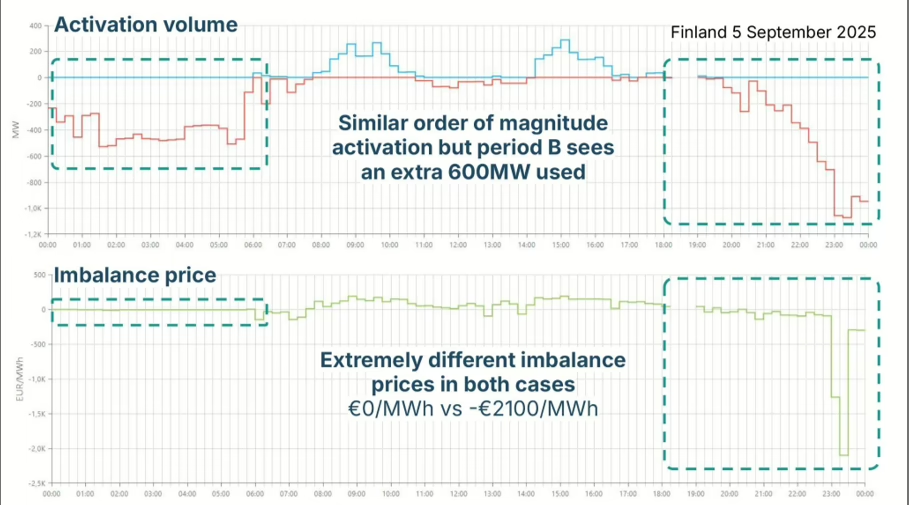
The example above illustrates how the ‘hockey stick’ shaped bid ladder creates exponential changes in the resulting price. The bid ladder in this case is mainly for mFRR (manual Frequency Restoration Reserve) activations, as that is the market that predominantly responds to imbalances and largely dictates the imbalance price. Additional procurement on that bid ladder from a slightly bigger imbalance can push the imbalance price into some extreme prices.
There are many predictions of where imbalance prices will go in the future. Extreme prices are expected to stay over the short to medium term, however incoming BESS are expected to shift the ‘hockey stick’ further to the right, offering more flexibility to respond to large imbalances. This should reduce the severity of imbalances on the grid and thus reduce extreme imbalance prices. Uncertainty does come from the impact of incoming solar and wind assets in the region, but we believe that the amount of BESS units will have a more significant impact over the medium to long term.
Key takeaway: Imbalance costs are a defining challenge for flexibility assets in renewable-heavy systems. Active participation in balancing markets and robust forecasting are key to mitigating exposure as market dynamics evolve.
In conclusion, technical and regulatory complexities – from grid tariffs to market pre-qualification and imbalance exposure – can erode profitability even in projects with strong revenue potential. A disciplined, technically informed approach that anticipates these challenges is essential for sustainable BESS performance and long-term value creation.
Written by