Residential installations lead Dutch storage boom

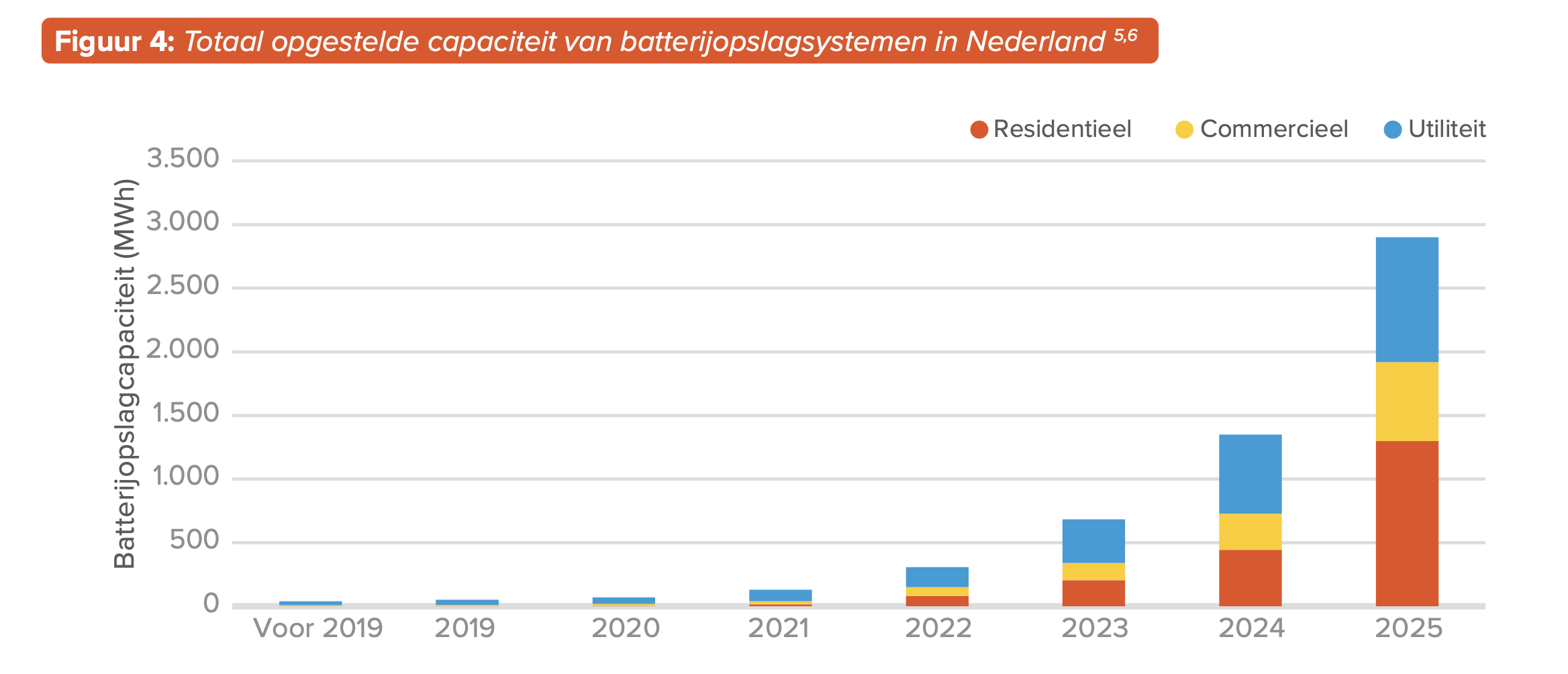
Total installed battery capacity in the Netherlands could reach 2.9 GWh by the year end, a 115% increase compared to 2024, according to a new report.
The Solar & Storage Trend Report, from research agency Dutch New Energy (DNE) Research and news site Solar365, says the Netherlands is on track to add 1.55 GWh of storage capacity this year. The residential market is expected to account for 860 MWh of this growth, while the C&I and utility-scale segments are set to add 330 MWh and 360 MWh respectively.
This growth rate is expected to accelerate further in the coming years. The report projects that based on current market trends, battery capacity additions could reach 1.7 GWh in the residential market, 650 MWh in the C&I sector and 550 MWh in the utility-scale market in 2026, increasing further to to 4.5 GWh, 1.4 GWh and 1.1 GWh by 2027.
By the end of the decade, Dutch storage capacity is forecast to reach 36.8 GWh, comprising 14.6 GWh from the residential market, 12.1 GWh in the C&I segment and 10.1 GWh of utility-scale batteries.
The report says the exponential growth of battery storage systems is primarily driven by the end of net-metering for PV schemes, scheduled for 2027, which is incentivizing customers to add batteries to their home systems to support increased self-consumption.
The number of new battery installations is expected to reach 89,200 this year, a 140% increase year-on-year, with the residential sector accounting for 87,600 of these installations. By the year’s end, the Netherlands is expected to have approximately 166,800 battery systems, 163,500 of which will be in the residential sector.
These installation figures coincide with a slow down in the number of solar panel installations, which have been in decline for seven consecutive quarters. In the report, DNE Research Principal Investigator, Hrvoje Medarac, writes that developments in the solar and storage sector are causing the two technologies to become increasingly intertwined.
“While the solar market stabilizes, the storage market is actually starting to move; integration, self-use and flexibility are the heart of the energy system of the future.” Medarac said. “It’s up to companies active in this sector to see opportunities in the stagnant solar market and the growing storage market.”
The report predicts solar installers will be tasked with shifting from simply installing photovoltaics to enabling energy management. “Storage, smart control, and collaboration between devices, from heat pumps to charging stations, will soon determine the value of a solar system,” it adds. “Solar panels form the foundation, but the real benefit lies in how that power is integrated into daily use.”
A price analysis in the report highlights that the cost of residential batteries in the Netherlands varies significantly by technology and storage capacity. The average price of a ‘regular’ battery is listed at around €470 ($541.92)/kWh, with a range from €206/kWh to over €1,200/kWh, while the average price of a smart battery stands at around €565/ kWh. Large-scale residential systems above 15 kWh have typically lower costs per kWh, the report adds, while smaller systems often exceed €500/kWh.
The boom of the Dutch residential storage market is underway despite no broad national subsidy program for homeowners in place. A spokesperson for Holland Solar told ESS News that the only regulation in place is that home batteries are free of taxes, meaning more is needed to support residential installations.
“Holland Solar is calling for a flexbonus which enables citizens who buy solar panels to receive subsidies on products such as batteries, in turn helping them increase their self-consumption,” the spokesperson said.
Written by





Popular Posts