Western Australia plans 10-hour flow battery to boost power reliability

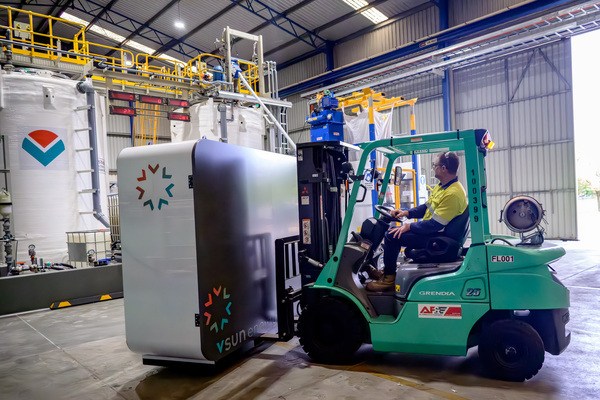
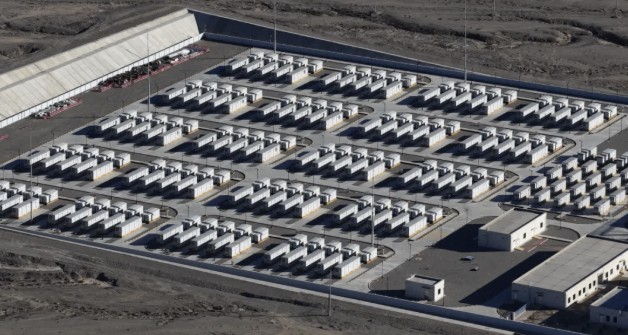
The Western Australian (WA) government is calling for expressions of interest (EOI) for a locally made vanadium flow battery energy storage system to be installed at Kalgoorlie to bolster energy security in the Goldfields and support the state’s broader renewable energy transition.
Backed by $150 million (USD 96.8 million) in state government funding, the Kalgoolie vanadium battery energy storage system is planned to be the largest of its kind yet deployed in Australia.
The state government said the project will involve the installation of a 50 MW / 500 MWh battery energy storage system capable of discharging for up to 10 hours.
“This EOI kicks off a major project that will boost power reliability in the Goldfields and support our clean energy transition,” WA Energy Minister Amber-Jade Sanderson said, adding that “long-duration storage projects like this will play a bigger role as we build a more resilient energy system for the future.”
The battery is to be manufactured in Western Australia using locally sourced and processed vanadium, a move designed to help grow the state’s advanced manufacturing industry and support the development of a new local supply chain around vanadium mining, processing and flow battery technology.
“We want to partner with industry to deliver local content, great jobs, and real value for WA,” Sanderson said. “A locally made and sourced vanadium flow battery will create jobs during construction, deliver improved energy resilience for the region and complement other planned upgrades in the Goldfields region.”
Perth-based Australian Vanadium Limited (AVL) has already confirmed that it will lodge an EOI, saying its submission will leverage the company’s “pit-to-battery” integrated capability, spanning mining, processing, vanadium electrolyte production and VFB deployment, and will be prepared in collaboration with leading energy sector partners to maximise sovereign capability and local content.
“The opening of the EOI process marks an important milestone for Western Australia’s ambition to establish a sovereign long-duration energy storage solution leveraging the state’s developing vanadium industry,” AVL Chief Executive Officer Graham Arvidson said.
“AVL and its wholly owned subsidiary, VSUN Energy, welcome the opportunity to participate and to put forward a strong proposal that reflects the capability we have built across mining, processing, vanadium electrolyte production and VFB deployment. Pleasingly, the EOI affirms the state government’s key objectives for the Kalgoorlie VBESS include establishment of a local upstream supply chain.”
The first part of the two-stage EOI process will remain open through until 30 January 2026 to help identify and understand existing capabilities in the market. It is not part of a procurement process.
The second stage of the EOI process, to be held in early-to-mid 2026, will evaluate detailed business cases, with the aim of selecting a preferred proponent to deliver the vanadium battery project.
Written by