Rystad: 15-minute trading intervals boost BESS profits in Europe by 14% on average

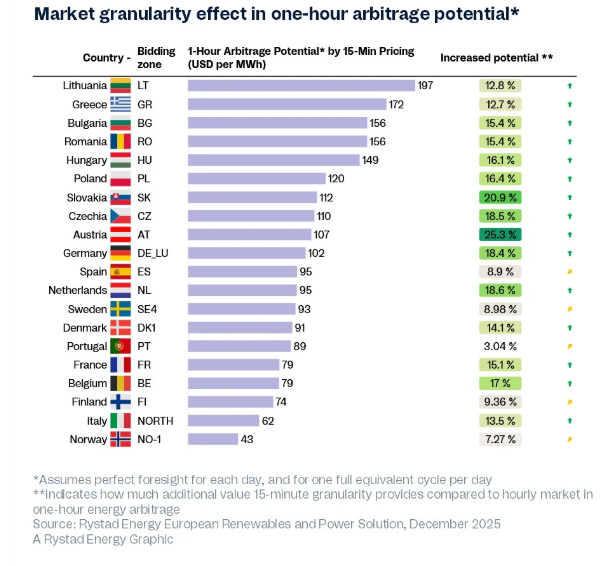
The economics of battery energy storage systems (BESS) in Europe have improved markedly following changes to the European Union’s power pricing structure in October. According to Rystad Energy, several countries now offer the potential for BESS profits to rise by more than 15% and even beyond 20%.
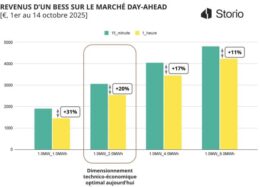
Under the revised system, electricity prices are set every 15 minutes instead of hourly, giving storage operators more frequent opportunities to buy power when it is cheap and sell it when prices spike. Since the shift, arbitrage potential has increased by an average of 14% across Europe’s power markets. Some countries – such as Austria and Slovakia – have seen gains exceeding 20%, while others, including Portugal, Norway and Sweden, have experienced only marginal improvements.
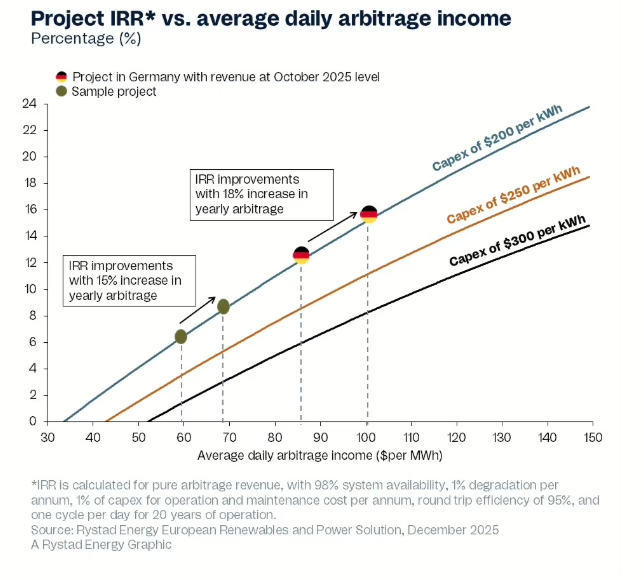
If a battery earns roughly 20% more revenue per year from these price swings, its total return on investment could rise by about 3% over a 20-year lifespan, Rystad calculates.
“In countries with less flexibility in power generation and consumption, high share of intermittent renewables can cause large price swings,” says Sepehr Soltani, Senior Analyst, Energy Storage, Rystad Energy. “Rapid changes in wind or solar generation mean electricity prices can shift noticeably even within a single hour. Shorter 15-minute trading intervals capture these quick shifts, creating more opportunities for flexible assets. In contrast, in places with a flexible electricity supply, such as Norway with hydropower and Portugal with hydropower and gas, prices are more stable over an hour. As a result, the difference between profits from 15-minute and hourly trading is much smaller.
Rystad Energy’s analysis compared the potential profits from one-hour energy arbitrage in European power markets under two scenarios. In a 15-minute market, completing a full arbitrage cycle requires four charging and four discharging steps, while in a 60-minute market the same cycle involves just one charge and one discharge. The findings indicate that shorter trading intervals could meaningfully increase revenue opportunities for European storage operators.
However, there is an important caveat. Today’s unusually high arbitrage margins – about +$150 per MWh – are unlikely to be sustained over the next 10–20 years. A more realistic long-term average is closer to $60 per MWh, which corresponds to an internal rate of return (IRR) of roughly 6% from energy arbitrage alone. Greater market granularity could lift average revenues to around $70 per MWh, adding an estimated three percentage points to IRR.
“The biggest challenge for earning money through arbitrage is that price volatility is unpredictable. In Europe, 15-minute markets only started two months ago. Australia, however, switched from 30-minute to 5-minute markets in 2021 and since then, the finer time intervals have consistently increased arbitrage profits.,” says Soltani.
For example, in Australia’s New South Wales, the shift to 5-minute pricing has delivered roughly 20% higher annual arbitrage revenues compared with the previous 30-minute system. In Victoria, 5-minute prices have generated about 15% higher revenues for one-hour arbitrage over the past four years.
Arbitrage potential is a useful indicator of the upper limit of what a BESS project might earn. In practice, however, real-world day-ahead arbitrage revenues will be lower once factors such as efficiency losses, system availability, market liquidity, and hedging strategies – designed to reduce exposure to rare price spikes – are taken into account.
Written by




Popular Posts