Stacking value in a changing market: BESS revenue in October

October marked the official start of quarter-hourly trading in the day-ahead market in Germany. For battery storage operators, the new cadence brought more granular price signals and arrived in parallel with weather-driven shifts in renewable output, altering both arbitrage opportunities and reserve market behavior.
October in Numbers
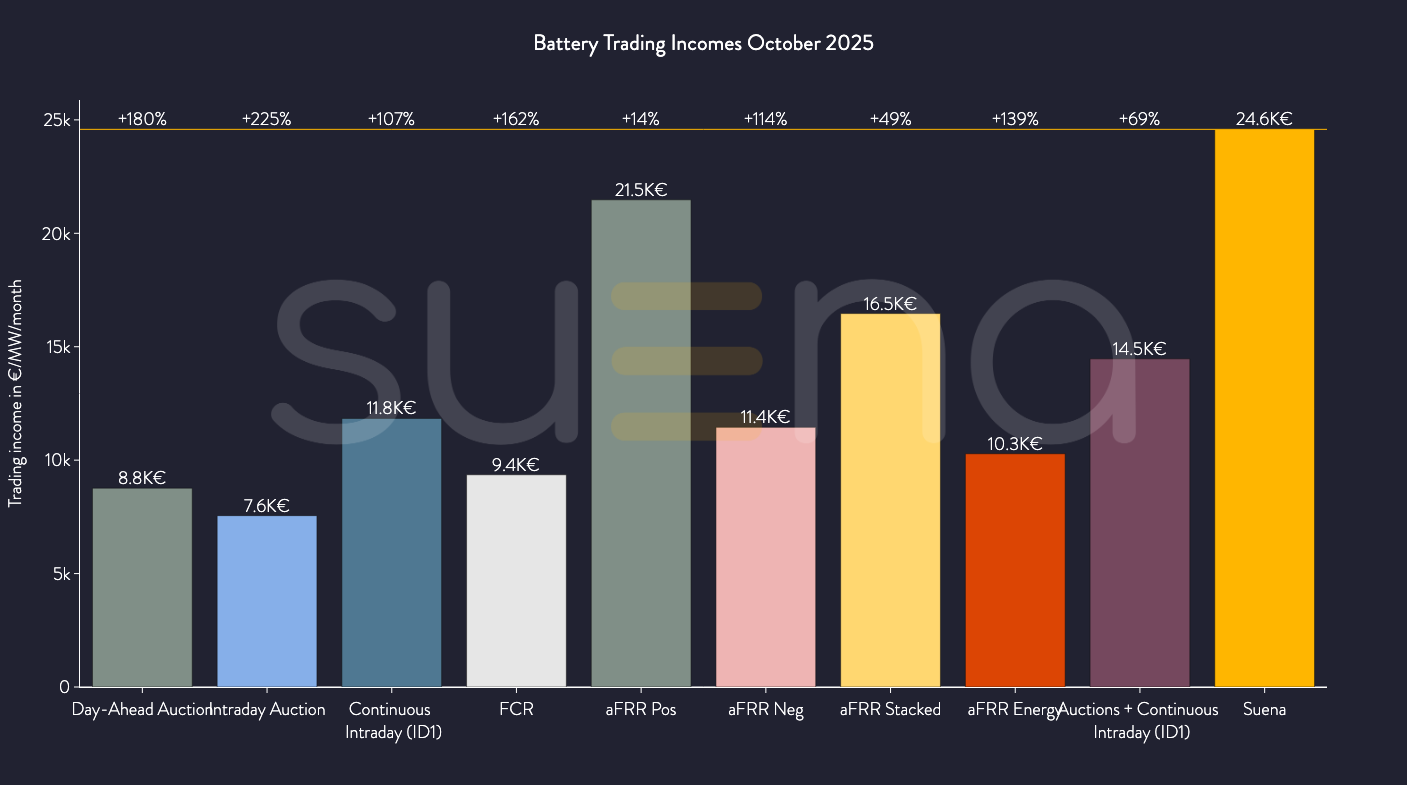
The effects of these shifts across spot and ancillary markets are also reflected in our October benchmark simulation. Revenues from isolated spot strategies ranged from €7.6k to €11.8k per MW on the day ahead and intraday markets. When coordinating across auctions and continuous trading layers, the combined spot strategy reached €14.5k per MW – slightly below September’s €18.4k peak, but still indicative of solid arbitrage conditions across the month.
Ancillary services delivered more mixed results. FCR delivered up to €9.4k per MW, while aFRR capacity earnings ranged from €11.4k for negative reserve to €21.5k for positive reserve – with stacked aFRR configurations yielding €16.5k per MW. On the energy side, the Picasso benchmark for aFRR activations came in at €10.3k per MW, down from September’s €19.1k.
In this new market structure, the suena Energy Trading Autopilot achieved €24.6k per MW – a strong result given the shift in price cadence and evolving market dynamics. While this marked a step down from September’s €29.4k, it still represented a clear outperformance: exceeding the spot market benchmark by up to 225%, ancillary service revenues by up to 162%, and the Picasso benchmark by 139%. These results underscore the importance of adaptive, real-time coordination in responding to increasingly granular market structures.
Structural meets seasonal change
Yet the outcomes were influenced not only by this structural shift to quarter-hour trading, but also by evolving seasonal conditions. Although Germany recorded the highest number of negative price hours on the European electricity exchange in October, with 51 hours, this still represented a clear decline from the previous month – falling from 78 hours in September. This trend was mirrored at the quarter-hour level, with 199 negative quarter-hours recorded – down from 240.
The key driver behind this reduction was the seasonal drop in solar output, which fell by over 40% compared to September. At the same time, wind generation increased by more than 30% resulting in a different intraday price structure. Rather than concentrated midday troughs driven by solar and increased demand due to falling temperatures, October featured deeper and more frequent low-price phases during overnight hours, driven by sustained wind surges.
This shift in renewable supply patterns reshaped the temporal volatility of the market. Intraday prices experienced sharp, short-lived swings in response to wind ramps and steeper evening peaks. While average prices remained stable, maximum spreads within the day decreased. The arbitrage windows became narrower, but more frequent – favoring trading systems capable of high temporal precision and rapid reallocation.
Meanwhile, ancillary services saw declining capacity prices – most notably aFRR down, which dropped by nearly 40% compared to September, as the demand for downward reserve diminished with falling solar output. The result: a notable reduction in fixed revenue potential from capacity-based reserve products.
A new operating environment for batteries
For battery operators, this combination of conditions marked a significant departure from the relatively predictable solar-driven regimes of previous months. Strong but volatile wind output, shifting demand patterns, and the transition to 15-minute trading intervals created a fundamentally different operating environment.
In this new environment, the value of coordinated, multi-market optimization becomes even more apparent. Battery storage systems that can respond with high temporal precision, dynamically allocate capacity across markets, and continuously adapt to evolving price signals are far better equipped to perform under these conditions.
Winter is coming
If October marked a structural shift with the rollout of quarter-hourly trading, November is shaping up to test operational agility. As the system transitions into winter mode, price formation will increasingly hinge on the interplay between heating demand, variable wind output, and grid stability pressures.
Rising load due to falling temperatures will likely reinforce evening peaks and tighten the margins for error in day-ahead forecasts. At the same time, wind generation typically becomes more dominant in the seasonal mix, while solar generation drops.
However, with winter approaching, the risk of Dunkelflaute conditions – prolonged periods of low wind and solar generation – also rises. In November last year, for example, Germany experienced such a Dunkelflaute, during which spot market prices surged above €800/MWh for several hours – a sharp contrast to the seasonal average of €50–100/MWh in the preceding months. These rare but extreme conditions challenge grid stability, while also creating targeted revenue opportunities for flexible assets.
In this environment, capacity products such as FCR and aFRR may gain relevance again as system operators prepare for tighter reserve margins. Yet the key challenge will lie in execution: capturing value precisely when volatility strikes.
Strategic flexibility will therefore be essential. With predictable spread patterns giving way to event-driven spikes and scarcity pricing, success in November will hinge on tactical responsiveness – and the ability to coordinate across markets without missing a beat.
About the author:
Dr Lennard Wilkening is co-founder & CEO of suena energy, a green energy marketer for battery storage and renewables. suena offers marketing solutions that enable profit-maximizing multi-market trading and implement them through powerful trading algorithms. Lennard holds a PhD in grid-oriented use of battery storage systems from the Technical University of Hamburg and has more than nine years of experience in battery storage optimization and energy trading.
Written by





Popular Posts