Enphase on how distributed energy assets could boost data centers

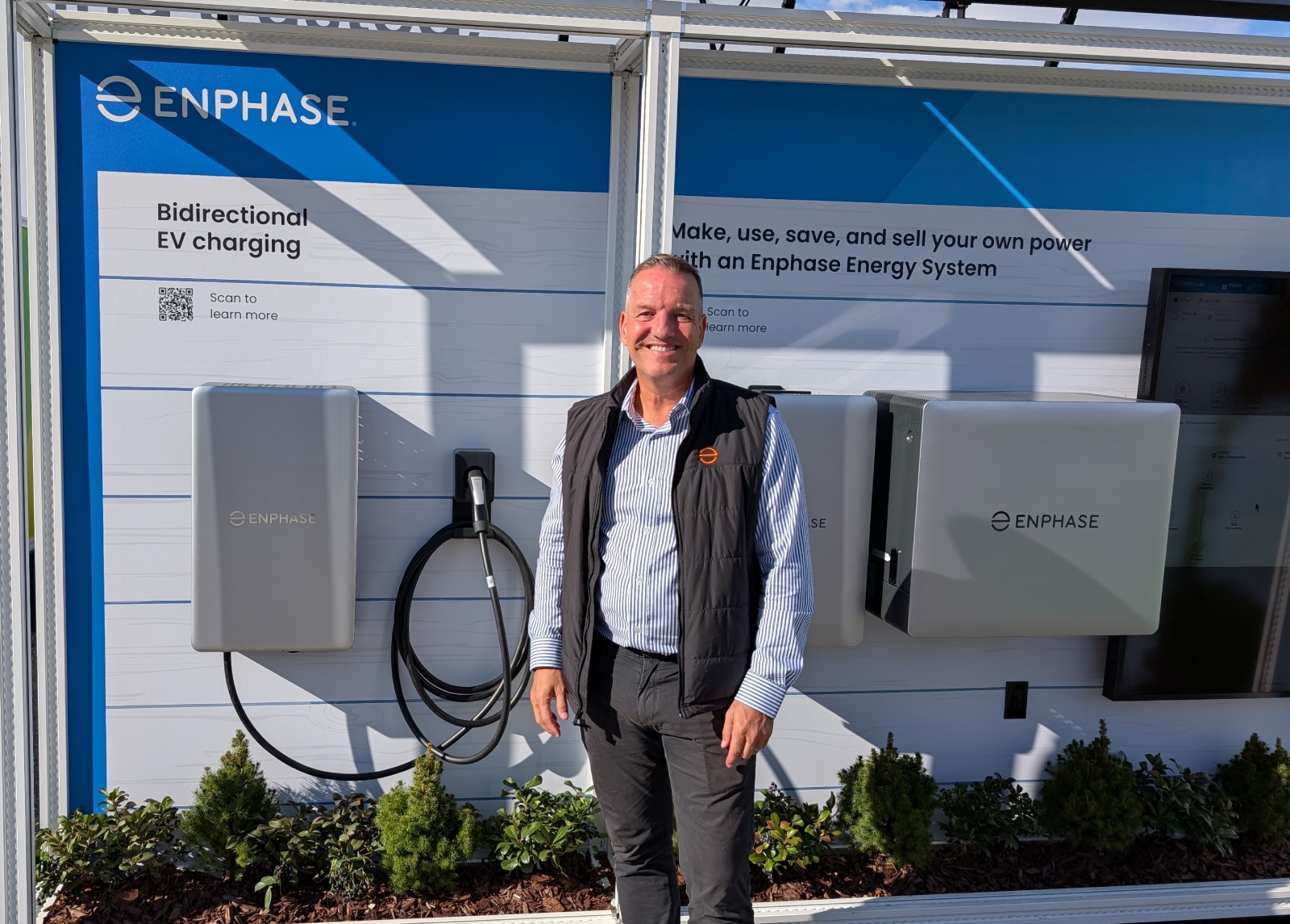
At CES 2026 in Las Vegas, Marco Krapels, SVP and Chief Marketing Officer at Enphase Energy, stood with ESS News in front of Enphase’s new bidirectional EV charger to discuss the topic of distributed energy generation and data centers, the “sleeping giant” of EVs, and why bankability can underpin confidence in grid flexibility.
First layer of the “Jensen Cake”
For Krapels, there exists an enormous opportunity within close reach as he identifies the connection between Silicon Valley’s AI ambitions and the data center buildout and distributed solar. He cites a framework used by Nvidia CEO Jensen Huang at his press conference held a day earlier.
“When Jensen Huang talks about the ‘five-layer cake’ to make AGI (Artificial General Intelligence) happen, the first layer he always talks about is energy,” Krapels says. “Energy is the number one layer in the five-layer ‘Jensen cake.’ I think it’s underappreciated by many, and what’s also underappreciated is that we can do a lot with aggregated, distributed, flexible assets to help fill that gap.”
The context is the arrival of gigawatt-scale loads from data center developers, with names like Stargate building out facilities closer to the trillion dollar mark than billion. These facilities face a dual challenge: the physical constraints of the grid and growing community resistance.
“You’ve got these massive loads, and they’re going to come onto the grid,” Krapels notes. “What the data center developers are seeing is resistance in communities. Communities are saying, ‘NIMBY, not in my backyard, my power price is going to go up.’ You can’t just burn a bunch of gas that some are using as a way to get power fast with gas turbines … those communities will say: ‘I’ve got pollution because you’re burning a bunch of gas,’ you know? And they’re pissed.
“So could we reduce the need for onsite fossil fuel generation? Maybe not eliminate, but reduce? Yes. And we can do that at scale with our distributed capacity.”
The math of distributed flex
Enphase sees a solution in harnessing the millions of interconnection points it already controls. Krapels argues that aggregating residential assets can smooth the integration of these massive industrial loads.
“We have about two and a half million homes with PV-only in the US,” Krapels explains. “If we add two of our Enphase 5P batteries, which is 10 kilowatt-hours of batteries, you can unlock tens of gigawatts of flexible capacity. That becomes so valuable in so many ways, and can get owners paid.”
And, the real game-changer lies in the electrification of transport.
“If you add the EV, then you 7x that,” Krapels says. “You have this car, say 70 kWh, versus one stationary battery at 10 kWh. So you 7x that capacity. Imagine swapping out the mundane, dumb EV charger for a bidirectional charger. Imagine what we can do!”
From ‘Save’ to ‘Get Paid’
With the end of net metering policies in many parts of the world, homeowners with solar or looking to add solar have an economic impetus to add storage. But in the US, the driver will be virtual power plants (VPPs) and grid services.
“I think where we’re moving to is going to be: ‘Get Enphase, get paid.’ It used to be ‘save money with solar.’ Now, if you have a battery and you allow a utility, like San Diego Community Power, to access that battery from time to time to dispatch capacity, the upfront payment to the homeowner is in the thousands of dollars.”
Krapels envisions a scenario where data center developers actively subsidize this distributed flexibility to smooth their own interconnections, as friction increases. Within days of the conversation with Krapels, Heatmap Pro published a report that shows at least 25 data centers were canceled last year in the US due to local opposition, over concerns over the intensive need for energy and water.
Krapels makes the key point, “If I were a big tech company right now… I’d look at the public pushback to data centers and switch how I think. What if the community where a data center is planned actually gets paid for installing a battery? They have resiliency, at a highly discounted rate, and they get paid for providing capacity to help enable the deployment of a data center. With that, you may start to see very different behaviors.”
The exact strategy and roadmap to make this happen wasn’t the point of Krapel’s discussion with ESS News at the start of 2026, as Enphase aims to be part of the ‘Jensen Cake’ by working with its existing partners and strategic players in the market. But it does have some unique advantages beyond tech: money in the bank.
Bankability as a Grid Asset
Utilities transitioning from centralized plants to more distributed resources requires a leap of faith. Krapels stresses that this shift relies on trust and financial stability, highlighting Enphase’s balance sheet and record, from those less proven.
“Imagine I’m a utility executive and I’ve been forever relying on owning my own equipment,” Krapels illustrates. “The leap to go from relying on company-owned equipment… to relying on a third party with whom you source aggregated, distributed, flexible capacity. You really have to trust who you’re dealing with,” making a case for Enphase’s bankability and tech.
Krapels added that Enphase is rolling out capacity forecasting, a feature designed to give utilities a “P80” (80% probability) confidence interval on available power in rolling 15-minutes blocks. But beyond the software, Krapels argues the balance sheet is the ultimate backstop.
“If for whatever reason, in a very unlikely event, we fail to respond, Enphase is a multi-billion dollar company. We’ve got over a billion and a half dollars of cash,” Krapels asserts. “You’ve got a lot of ‘fly-by-night’ guys saying, ‘Oh yeah, me too.’ But that stuff’s not bankable. The utility should only transact with parties where, if something goes wrong, there’s a balance sheet to back the warranty.”
The strategy for Enphase has remained fixed in its unified architecture and its microinverter, now deployed across rooftop solar, stationary batteries, and bidirectional EV chargers.
“We’ve created an ecosystem around one architecture… We have it on the roof, we have it in the battery, we have it in the bidirectional EV charger,” Krapels says.
This integration allows for a distinct approach to the market. Unlike Tesla, which Krapels (a former Tesla VP) notes has “aspirations to be the utility,” Enphase positions itself as a partner..
“We are merely an enabler of an aggregated flexible system,” he concludes. “We’re not a threat to the incumbents. That’s important.”
Written by
Comments


Popular Posts