Battery Atlas 2026 launches with comprehensive map of Europe’s cell, pack and battery manufacturers

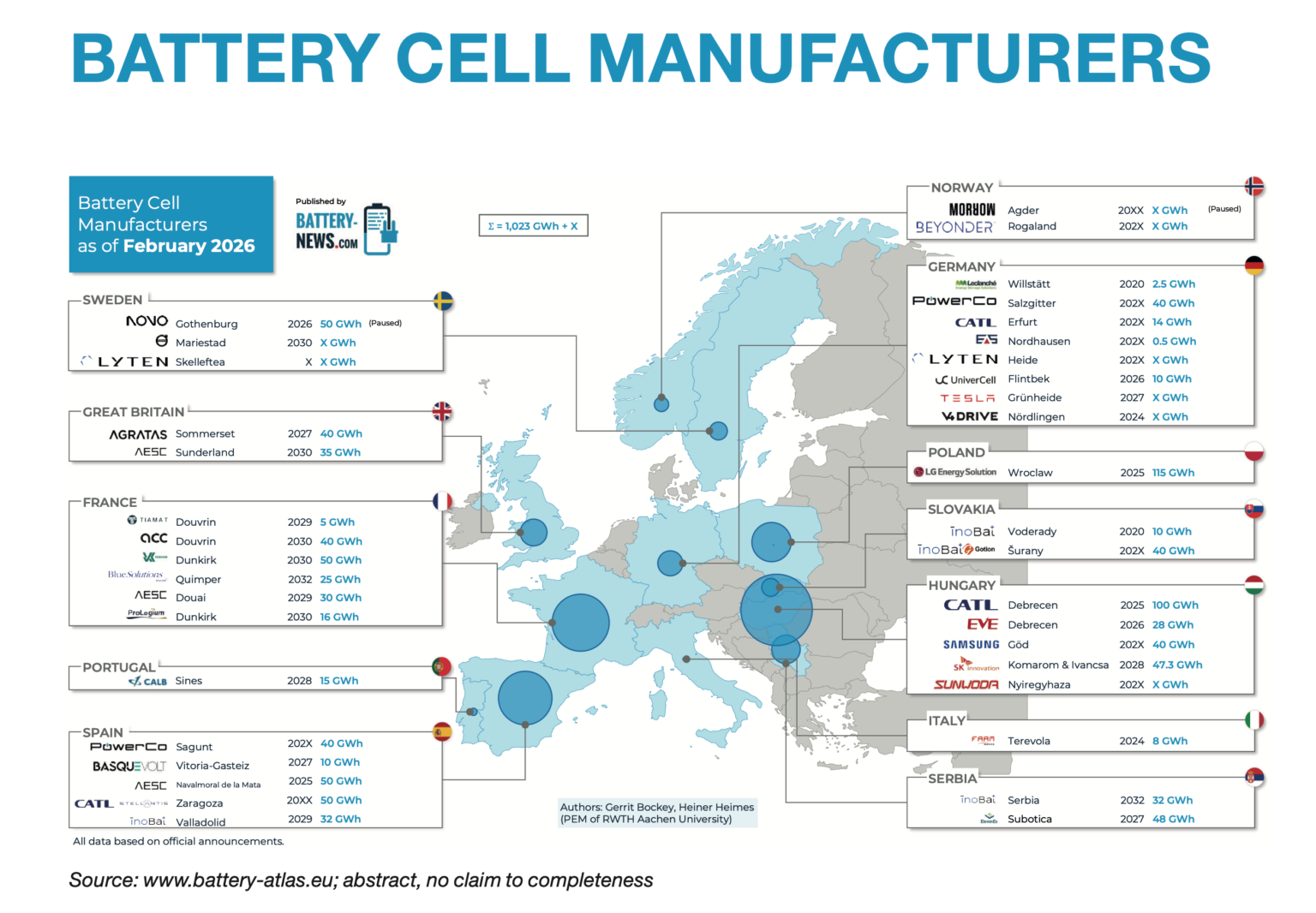
RWTH Aachen University has published the third edition of the “Battery Atlas 2026,” produced by the Production Engineering of E-Mobility Components (PEM) Chair. The free online report maps the European lithium-ion battery value chain.
Titled “Mapping the European Lithium-Ion Battery Industry,” the publication provides a data-driven overview of the sector, covering the entire industry landscape from cell production to modules and packs. It also examines related segments such as machinery, materials, quality control, recycling, and the development of next-generation battery technologies.
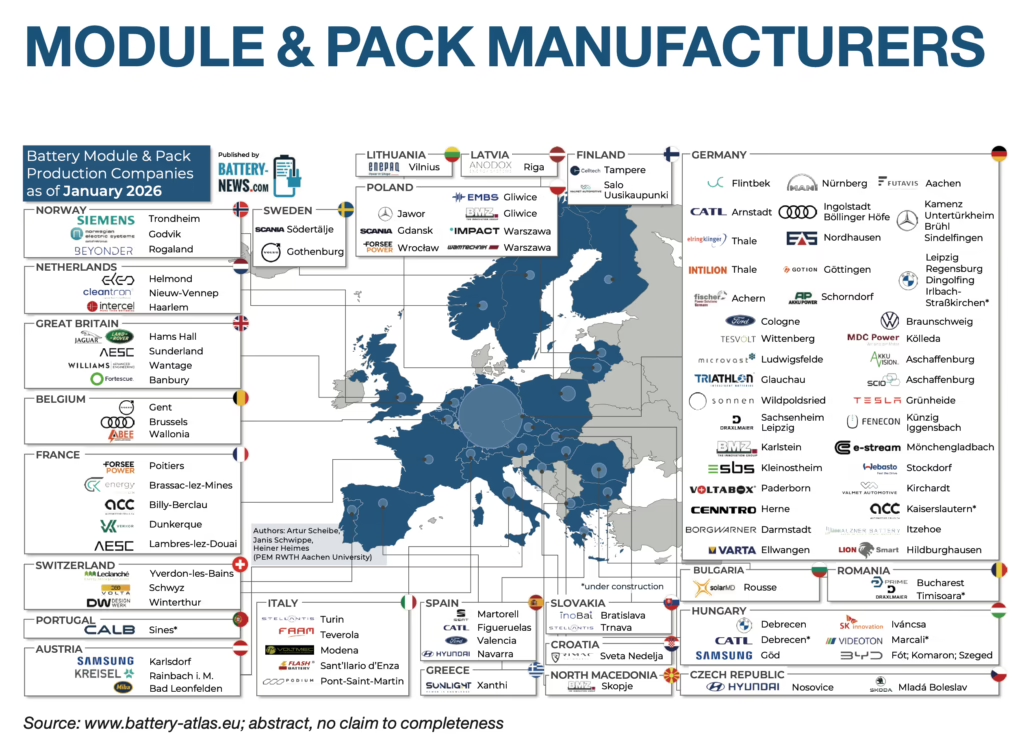
The report features detailed listings of companies across the battery ecosystem, including battery cell manufacturers, module and pack producers, equipment suppliers, battery quality control firms, active material suppliers, recycling companies, battery testing facilities, passive component suppliers for battery cells and battery systems, as well as solid-state battery developers.
The report also reflects the consolidation phase the European battery market is undergoing. While over 2,000 GWh of cell production capacity was announced in 2023, the realistic forecast for early 2026 is around 1,190 GWh, of which approximately 673 GWh is led by Asian companies. This market correction is further illustrated by the frequent use of vague dates such as “202X” or “20XX” in numerous projects, highlighting delays and a lack of concrete schedules.
Given this scenario, the report proposes a strategic shift: rather than competing in the mass production of conventional lithium-ion batteries, Europe could focus on next-generation technologies such as lithium-sulfur, solid-state, or sodium-ion batteries, which are not yet produced on a large scale and offer advantages in energy density, safety, and sustainability. Some of the currently unused industrial capacity is already being repurposed for these technologies, allowing Europe to leverage existing infrastructure and potentially position itself at the forefront of battery development over the next decade.
For the first time, the atlas incorporates an analysis of next-generation battery technologies, highlighting their potential for higher energy densities, improved safety, and reduced dependence on critical raw materials. The study also identifies broader industry trends, including the modernization of production lines, the increasing use of artificial intelligence for quality control, the adoption of fully traceable digital systems, and the expansion of recycling capabilities, which are becoming increasingly integrated into circular economy models to secure strategic materials.
In parallel, the European Commission has approved €200 million in state aid for the electric vehicle industry in Spain. This funding, provided as direct subsidies, is available to companies across the country until June 30, 2026, supporting strategic investments that expand manufacturing capacity within the electric vehicle value chain.
From pv magazine Spain
Written by
Comments


Popular Posts