Researchers make significant advancement into thermal runaway-free sodium-ion batteries

A team of researchers from the Chinese Academy of Sciences’ Institute of Physics has published a paper in Nature Energy showing a potentially game-changing development in electrolytes for sodium-ion batteries that may accelerate the commercial use of sodium-ion technology.
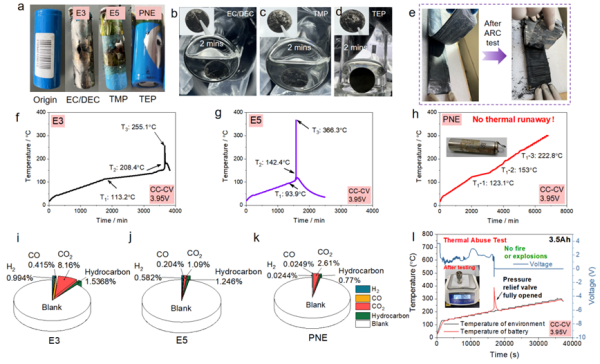
The team, led by Professor Hu Yongsheng, claimed the world’s first “zero thermal runaway” in ampere-hour-level sodium-ion batteries. The breakthrough is the development of a self-protecting Polymerizable Non-flammable Electrolyte (PNE), which appears to have largely solved a core safety aspect of batteries.
The breakthrough centers on a transition from passive fire retardation to active thermal blocking from the PNE material, which as a system, employs a three-in-one defense to what the researchers claim eliminates fire and explosion risks:
First, the electrolyte is engineered with specific decomposition characteristics that absorb heat during the early stages of a thermal event, effectively neutralizing the exothermic reactions that typically drive runaway.
Next, the PNE exhibits phase-change properties. In a process dubbed in situ thermal polymerization, at temperatures exceeding 150°C, the liquid electrolyte undergoes a phase change into a solid polymer network. This creates a physical barrier that prevents separator melting and internal short circuits, and halts gas generation.
In the third mechanism, a dual-salt system forms protective layers on both the cathode and anode. This maintains structural integrity under high-voltage operation and extends cycle life.
A translation of the press release via China.com claims “The electrolyte system uses only commercially available, conventional raw materials, making it cost-effective, easy to scale up, and highly valuable for industrial application. In the future, this technology will provide a novel solution for high-energy-density, high-safety batteries.”
The paper in Nature Energy also claims the PNE-based battery has “successfully passed the nail penetration test and the 300℃ hot box test, demonstrating its ultimate safety and reliability. At the same time, this breakthrough safety performance has not sacrificed electrochemical performance; the battery possesses a wide temperature adaptability from -40℃ to 60℃ and high-voltage stability exceeding 4.3V, balancing high safety and high energy density.”
“Thermal runaway-free ampere-hour-level Na-ion battery via polymerizable non-flammable electrolyte,” was published in Nature Energy, DOI: 10.1038/s41560-026-02032-7.
Written by




Popular Posts