Flexibility Pays: Battery revenues in April 2026

April 2026 demonstrated in striking fashion why flexibility is becoming one of the most valuable commodities in Germany’s power market.
What had previously appeared as recurring midday volatility evolved into a much broader structural pattern: prolonged periods of renewable oversupply, increasingly persistent negative prices, and a growing decoupling between fossil fuel costs and wholesale electricity prices.
Despite geopolitical tensions and elevated gas prices linked to developments in the Middle East, Germany’s electricity market increasingly moved according to a different logic: solar-driven oversupply. Strong photovoltaic generation, combined with moderate spring demand and rising wind output, created a market environment defined less by scarcity and more by excess generation during large parts of the day.
For battery storage systems, this proved highly attractive. Lower average prices did not reduce revenue opportunities. Instead, increasingly pronounced spreads, longer negative-price periods, and sharper ramp phases created ideal conditions for flexible assets capable of reacting dynamically across multiple markets.
April in Numbers
To assess how these market dynamics translated into battery revenues, we evaluated simulated earnings for a representative 10 MW / 20 MWh stand-alone battery system in Germany. As always, isolated strategies were benchmarked against a forecast-based multi-market optimisation approach.
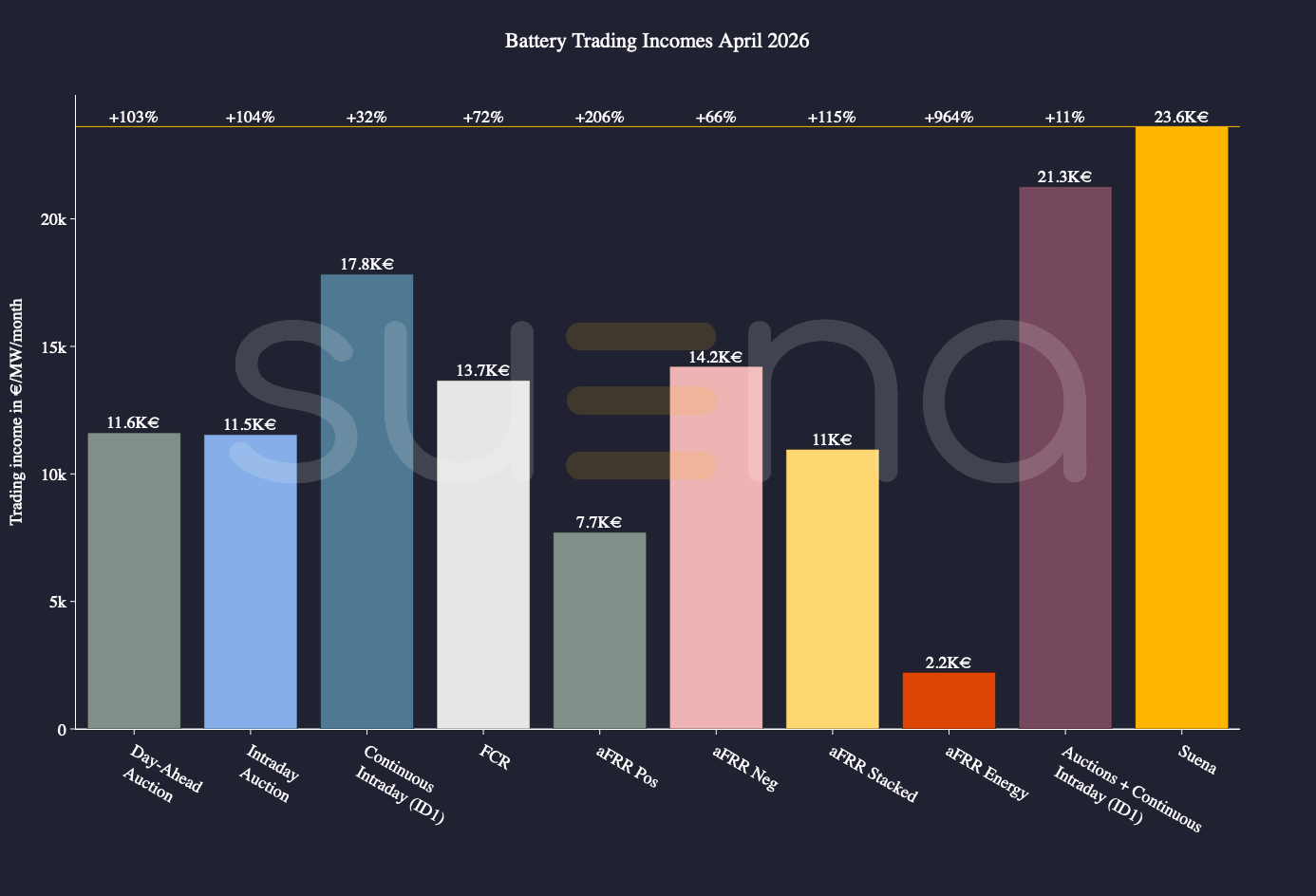
Continuous intraday trading once again delivered the strongest standalone wholesale performance, reaching €17.8k per MW/month, up from €13.0k/MW in March. Day-ahead trading increased from €10.9k/MW to €11.6k/MW, while intraday auctions rose from €10.5k/MW to €11.5k/MW.
Ancillary services also strengthened significantly. FCR rose to €13.7k per MW/month, its highest level since last autumn. Within aFRR capacity markets, negative reserve clearly outperformed positive reserve, reaching €14.2k per MW versus €7.7k per MW respectively. This reflected the increasing value of absorbing excess renewable generation during prolonged oversupply periods. A stacked aFRR strategy averaged €11k per MW, while aFRR activation energy increased sharply to €2.2k per MW – still relatively modest in absolute terms, but a clear indication of more frequent balancing interventions.
Yet, as in previous months, the strongest results came from combining markets. A stacked wholesale strategy integrating intraday auctions and continuous intraday trading reached €21.3k per MW/month. The suena energy Trading Autopilot ultimately achieved €23.6k per MW/month with an average of two cycles per day, outperforming individual market strategies by between 11% and more than 200%.
When Negative Prices Become Structural
The defining feature of April was not simply volatility itself, but the duration and persistence of oversupply events.
Germany recorded 123 negative-price hours during the month, compared to just 35 in March. Particularly notable was the rise in prolonged oversupply events: while April 2025 saw only two negative-price periods lasting longer than six consecutive hours, April 2026 recorded eight such events. The most extreme case occurred on Easter Sunday (5 April), when negative prices persisted for 17 consecutive hours. In total, 22 negative-price events lasted longer than one hour.
The same trend was visible on quarter-hourly markets. After 139 quarter-hours with negative exchange prices in March, April recorded 492 negative quarter-hours. This increasingly reflects a broader structural shift in the German power market, where solar generation is beginning to dominate midday price formation more persistently, at times overwhelming residual demand even while renewable curtailment is already taking place.
At the same time, fossil generation did not disappear from price formation entirely. During periods of lower renewable output – particularly in the evening hours and on days with weaker solar irradiation – gas-fired generation continued to set prices, often maintaining price levels around €90-100/MWh even during midday hours. The result was a market environment characterised by increasingly pronounced intraday swings between deep midday troughs and elevated evening ramps.
For battery operators, these dynamics created highly attractive trading conditions. Longer and more frequent negative-price windows improved charging opportunities, while steep evening ramps continued to support profitable discharge spreads. In parallel, balancing markets increasingly rewarded flexible assets capable of absorbing excess renewable generation, particularly within negative aFRR products.
Outlook for May 2026
The market conditions observed in April are unlikely to disappear anytime soon. Rising photovoltaic capacity, continued renewable expansion, and seasonally moderate demand levels are expected to sustain elevated levels of intraday volatility and recurring negative-price periods, particularly during a holiday-heavy May, where lower demand around Labour Day, Ascension Day, and Pentecost often coincides with strong photovoltaic generation.
At the same time, balancing markets are likely to continue reflecting growing demand for flexible assets capable of absorbing excess renewable generation during periods of midday oversupply. As negative price events become more frequent and increasingly prolonged, the importance of flexibility within the power system continues to grow as well.
For battery storage systems, this should continue to create attractive trading conditions, especially for assets capable of dynamically coordinating participation across spot and ancillary markets. But beyond revenue optimisation, these developments increasingly underline the broader system value of storage. Germany is entering a phase in which renewable generation capacity is expanding faster than the flexibility infrastructure needed to efficiently absorb, shift, and integrate it into the system. In this environment, batteries are becoming far more than a trading asset. They are increasingly becoming critical infrastructure for enabling renewable expansion without overwhelming the power system.
About the author:
Dr Lennard Wilkening is co-founder & CEO of suena energy, a green energy marketer for battery storage and renewables. suena offers marketing solutions that enable profit-maximizing multi-market trading and implement them through powerful trading algorithms. Lennard holds a PhD in grid-oriented use of battery storage systems from the Technical University of Hamburg and has more than nine years of experience in battery storage optimization and energy trading.
Written by




Popular Posts