Jinko ESS partners with UCB Power to localize BESS production in Brazil

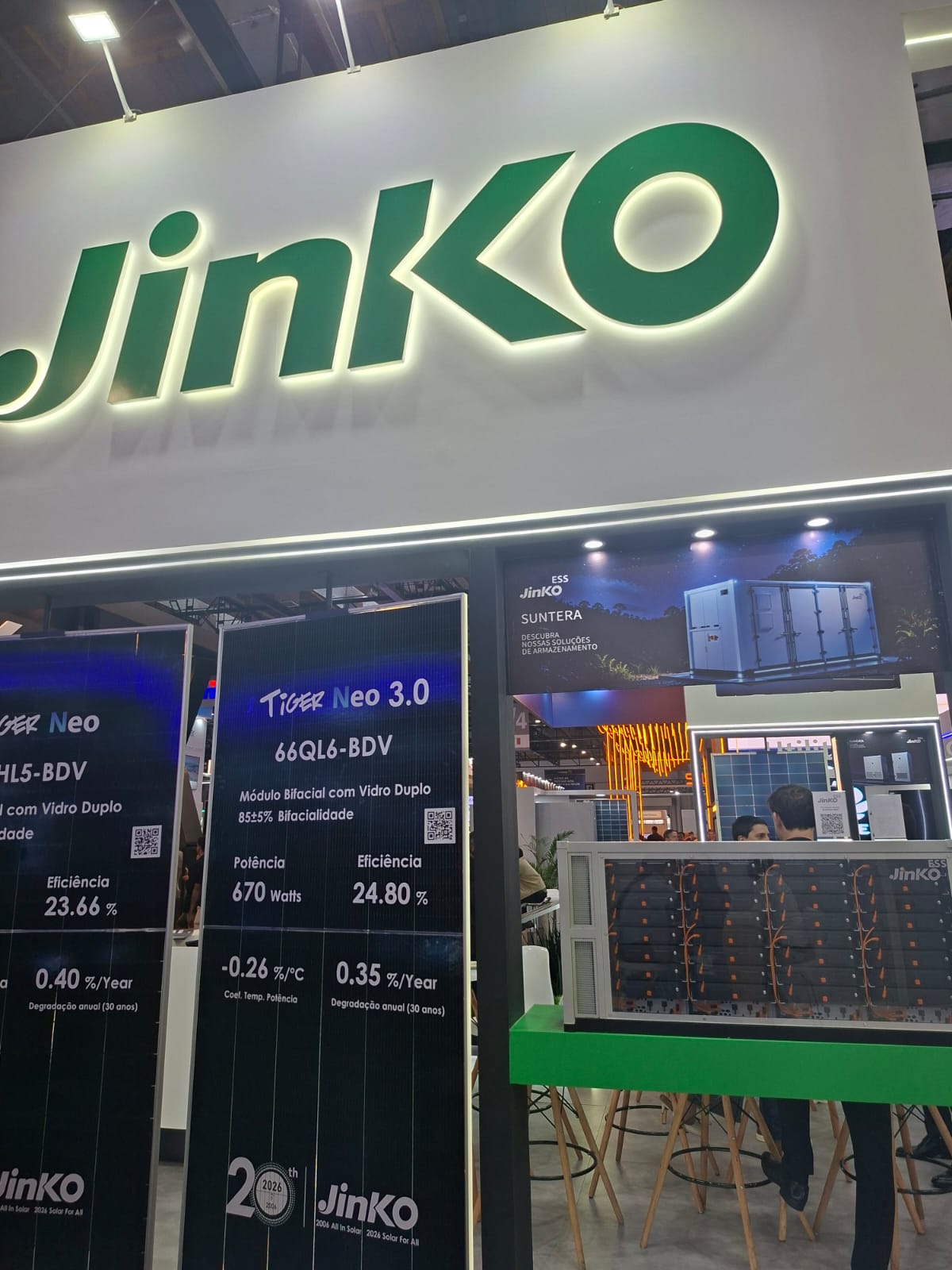
Jinko ESS has partnered with UCB Power to serve Brazil’s battery energy storage system (BESS) market, initially focusing on the first capacity reserve auction scheduled for December.
Under the agreement, UCB Power will assemble the equipment in Brazil, allowing Jinko ESS to compete both in the local-content auction on Dec. 2 and the following auction on Dec. 4, which will allow imported equipment.
According to Jinko ESS Brazil BESS Sales Director Mauro Scarpato, the company already has a presence in Latin America, with 2 GWh of systems installed and operating. The partnership with UCB combines the manufacturer’s technology and products with the Brazilian company’s local industrial capacity.
“For the local-content requirement, we partnered with UCB to have them assemble our equipment, bringing their expertise here in Brazil,” Scarpato told pv magazine Brasil.
UCB Power, meanwhile, plans to use more than five decades of experience manufacturing lead-acid batteries to incorporate local content into Jinko ESS’s solution. The company’s Chief Revenue Officer, Vinícius Berná, said UCB already manufactures low-voltage batteries in Brazil, carrying out local processes ranging from receiving cells to assembling the final product.
The company also operates as an original equipment manufacturer (OEM) and supplies batteries to major electronics manufacturers. Its customers include Samsung, Motorola and Lenovo, according to Berná.
“Our next step is really to produce BESS in Brazil. This partnership gives us significant production capacity to participate in the auction,” he said.
Expansion plans
The first localization route under the Brazilian Development Bank (BNDES) methodology, known as Route 1, will be carried out at UCB Power’s facility in Extrema, Minas Gerais. The company also has a factory in Manaus, Amazonas, where the two companies could jointly assess other production options in the future as market demand develops.
According to Berná, production capacity will depend on the selected localization route and the volume of equipment contracted. Potential use of the Manaus facility would allow different production levels, with estimated output ranging from 1.5 GWh to 4.5 GWh per year depending on the number of shifts.
The decision, however, remains dependent on actual auction demand and the number of projects that progress to the contracting stage. The partnership currently covers the first route, with production in Extrema, while other options will be evaluated later.
Jinko ESS is already in talks with developers and investors interested in auction projects. According to Scarpato, discussions over imported equipment supplies are well advanced, while the partnership with UCB now allows the company to move forward with proposals using local content.
“We are already talking to all the developers and investors, and discussions are quite advanced. We are now well advanced on the imported-content side, and we need to move forward on the local-content side with this partnership,” he said.
New 6.25 MWh container
For the projects it plans to supply, Jinko ESS is preparing a new container with a storage capacity of 6.25 MWh. The equipment is in the final stages of certification and is expected to replace the 5 MWh configuration currently established in the market.
The new solution uses higher-capacity cells, increasing from 314 Ah cells in the 5 MWh model to 587 Ah cells in the 6.25 MWh equipment. The change increases energy density without altering the container’s external dimensions, although the unit will be heavier.
“This same product, with 6.25 MWh, is what will be localized. It is our SunTera G3,” Scarpato said.
The deployment schedule has been structured around the deadlines expected for projects awarded in the auction. Once contracts are confirmed, the first units produced in Brazil are expected to leave the assembly line approximately eight months later.
UCB Power is already preparing its production lines and assessing the adaptations required for the different production routes. The strategy is to begin equipment shipments in the first half of 2027 and make the first deliveries in the second half, according to the schedule for signing contracts and preliminary agreements.
Projects contracted through the auction will have to be operational by Aug. 1, 2028, requiring the supply chain and construction schedules to be planned backward from that deadline.
Beyond the auction
Although the capacity reserve auction is the company’s main short-term focus, Jinko ESS plans to expand its presence in Brazil’s BESS market to the commercial and industrial (C&I) segments. Residential applications are not a priority, with the company instead targeting larger energy consumers.
Scarpato cites agriculture as one area with potential, particularly rural properties without grid connections. Hospitals are also among the target segments, where energy storage could replace or complement conventional generators.
The company has already established partnerships with distributors to expand its presence in Brazil and has systems operating in the country. Its partners include Fortlev and JSN/SB Solar.
The strategy is to gradually expand the company’s operations in Brazil, using its distributor network to reach new commercial and industrial customers.
At the same time, Jinko ESS is expanding its global manufacturing capacity. The company plans to build a 48 GWh factory in China by the end of 2027, which should increase its ability to supply the Brazilian market as energy storage demand grows.
The partnership with UCB Power therefore represents a first step toward combining Jinko ESS’s global supply capabilities with the local manufacturing required for certain opportunities in Brazil. Expansion of domestic production will depend on market demand, particularly the outcome of the capacity reserve auction and investors’ appetite for the projects.
From pv magazine Brazil
Written by
Comments


Popular Posts