Global battery storage failure rate down 98% since 2018

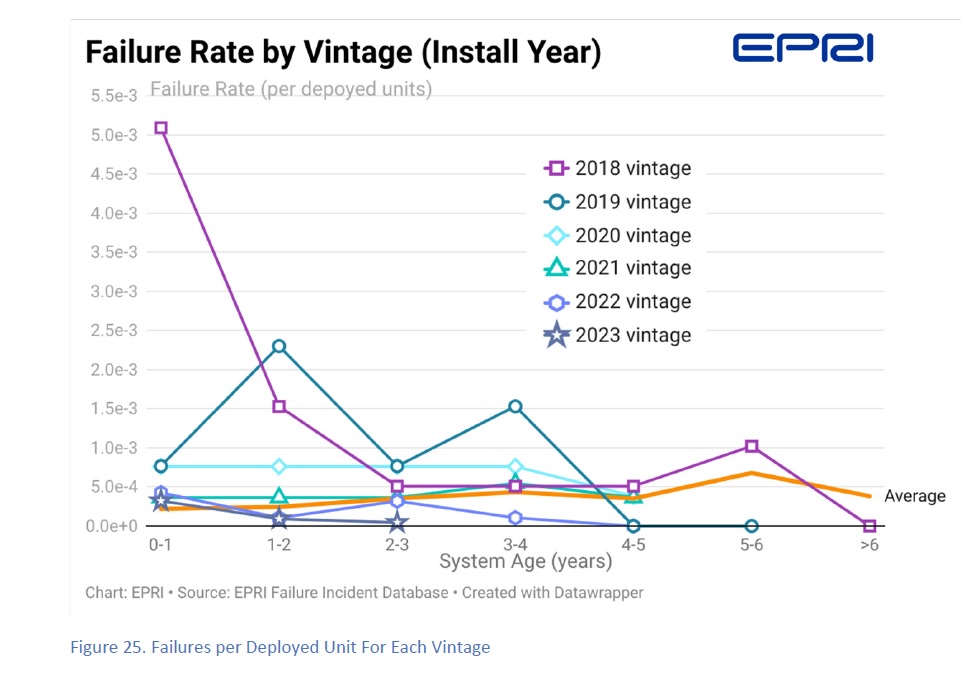
The Electric Power Research Institute (EPRI) has reported that global annual failures for lithium-ion battery energy storage systems (BESS) per deployed GWh have declined 98% from 2018 to 2025.
EPRI defines a failure incident as a large-scale thermal event involving arc-flash, fire, or explosion of a BESS unit. EPRI counted only failures caused by an issue internal to the BESS, rather than an outside cause such as wildfire.
There have been no reported injuries or fatalities in the United States related to BESS failures since 2019, EPRI said. That year, a BESS failure and explosion in Surprise, Arizona left eight first responders hospitalized. EPRI credits the U.S. safety record since then to “dissemination of the lessons learned.”
Much of the decrease in the BESS failure rate results from improvements between 2018 and 2020 in BESS design, codes and standards, as well as battery management and operating practices, EPRI said. But the failure rate continued to drop 50% from 2024 to 2025, with the 2025 rate at 0.04 failures per GWh deployed.
In the last few years, grid-scale lithium-ion BESS deployment “has shifted predominantly” toward LFP chemistry (lithium, iron, phosphate) from the previously dominant NMC chemistry (nickel, manganese, cobalt), the report shows.
But with the BESS failure rate declining during a period characterized by both industry learning and a shift in battery chemistry, EPRI said it did not have evidence to determine whether battery chemistry in isolation was a risk factor for system-level BESS failures.
Noting that “all energy infrastructure carries inherent risks,” EPRI said that the current BESS failure rate is “comparable” to that of large oil-filled transformers.
In terms of responding to a BESS incident, EPRI found that “many principles of incident command, site control, and emergency response used for transformer fires are also applicable to BESS incidents,” adding that there has been no report of a fire spreading beyond a utility-scale BESS facility.
EPRI found that indoor BESS facilities are “overrepresented” in failure incidents, and recommended that fire walls or other barriers can be used to segment large indoor facilities and limit propagation between BESS units.
EPRI suggested a potential ongoing opportunity for safety reviews and retrofits of “early-vintage systems” to “help ensure they include the latest codes, designs, and practices.”
EPRI based its analysis on data the institute has collected for its BESS Failure Incident Database. That database includes primarily publicly reported events but also 33 non-public incidents, which accounted for 22% of the total incidents analyzed in the report.
Despite EPRI’s ability to collaborate with other entities to gather data on non-public incidents, the institute said that “limited transparency and data gaps remain a major challenge to a complete database.” EPRI said that “increased transparency from failures is necessary for continued improvement on BESS risk and safety.”
The EPRI report is titled “Risk factors and failure statistics of lithium-ion BESS.”
From pv magazine USA
More about
Written by
Comments



Popular Posts