China’s Mengxi grid tops 20 GW of storage as renewables approach 60% of capacity

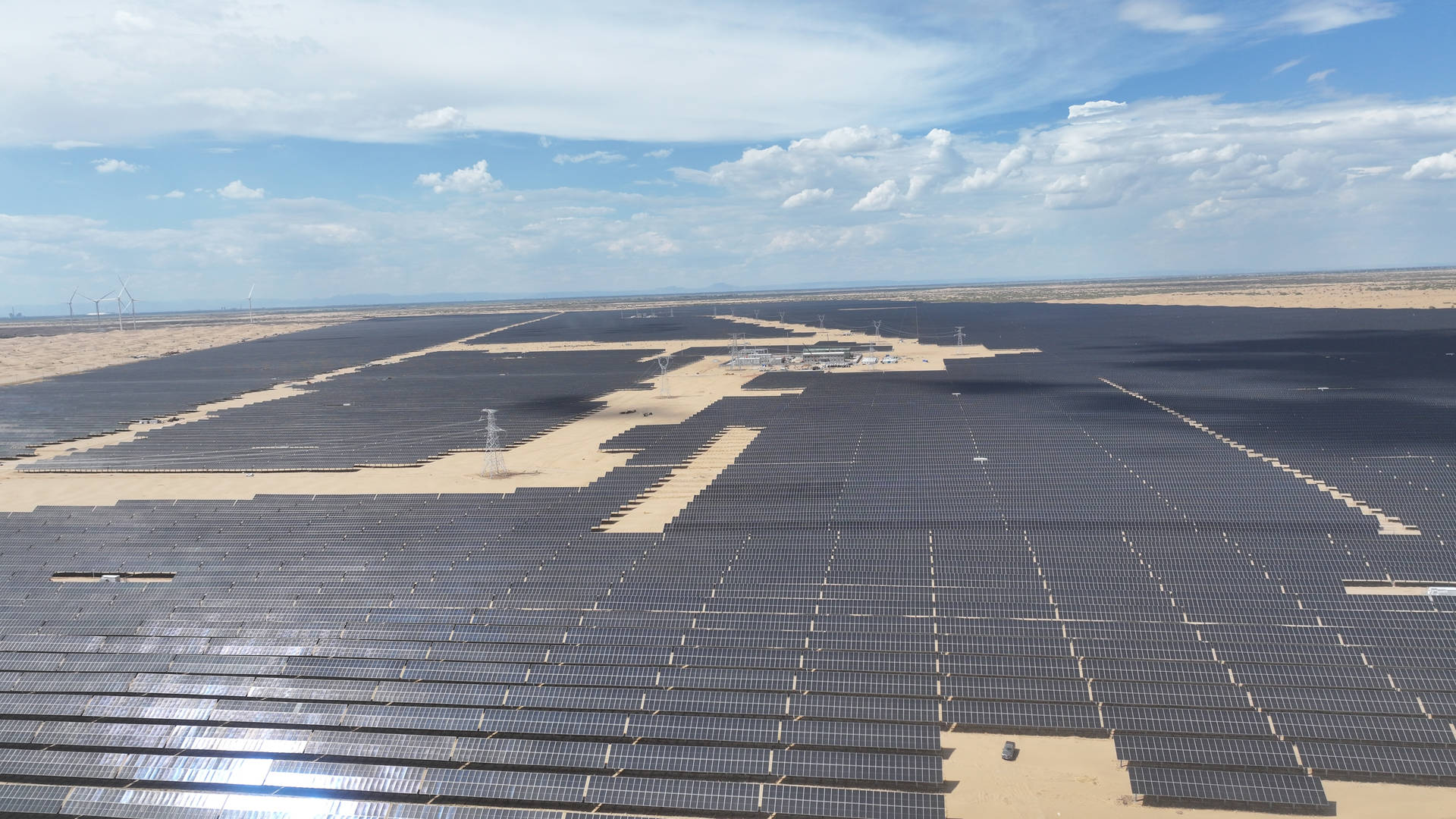
China’s western Inner Mongolia power grid has surpassed 20 GW of operational new-type energy storage capacity, as rapid growth in wind and solar generation increases the need for flexible electricity resources.
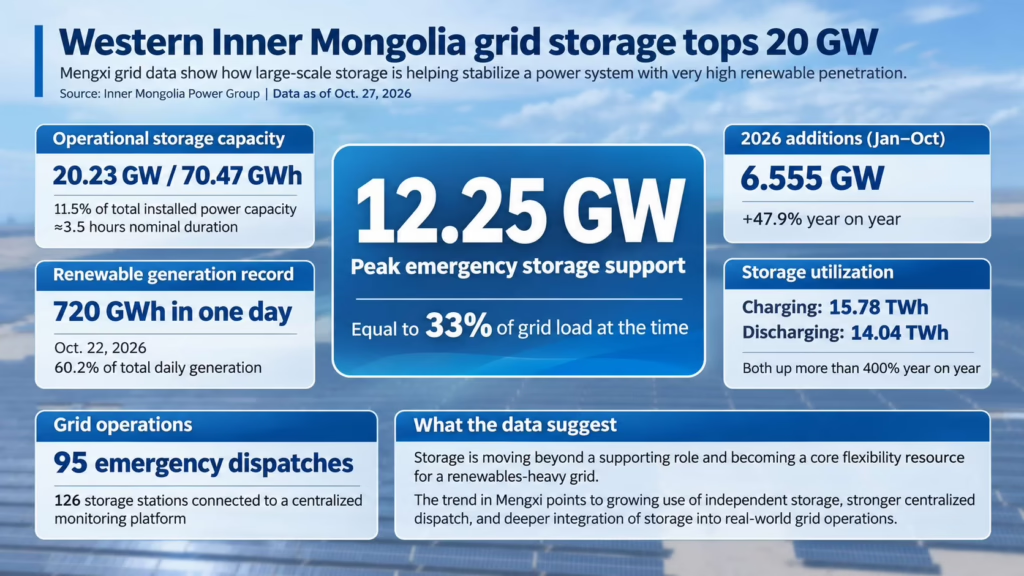
According to data released by Inner Mongolia Power Group on October 28, the grid had 20.23 GW/70.47 GWh of operational storage capacity as of October 27, accounting for 11.5% of its total installed power capacity. The figures imply an average nominal storage duration of approximately 3.5 hours.
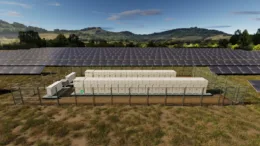
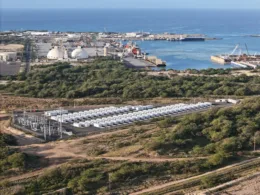
New installations reached 6.555 GW during the first ten months of 2026, up 47.9% year on year, supported by the commissioning of several large independent storage projects, including facilities in Wuchuan and Baotou.
The western Inner Mongolia grid, also known as the Mengxi grid, is operated by Inner Mongolia Power Group and serves eight prefecture-level areas in central and western Inner Mongolia. It operates separately from the eastern Inner Mongolia grid, which is managed by State Grid.
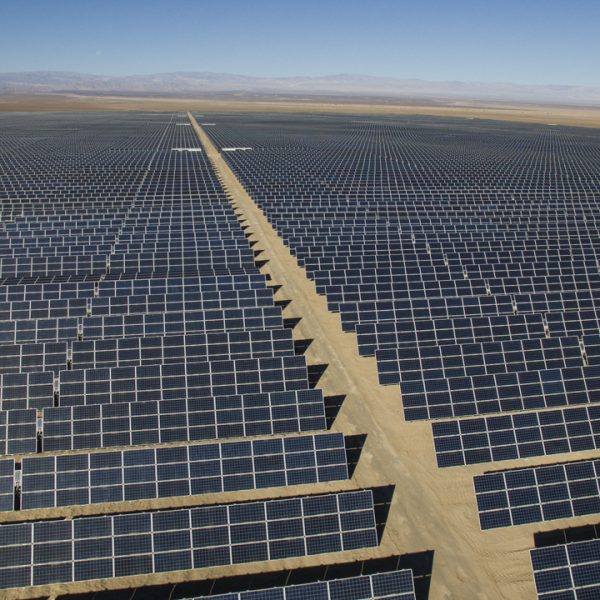
Wind and solar power account for nearly 60% of the Mengxi grid’s installed generation capacity, making the region an important test case for operating power systems with high renewable penetration.
On October 22, renewable generation on the grid reached a record 720 GWh, representing 60.2% of total electricity generation that day. Wind power contributed 560 GWh, also setting a daily record.
The increasing role of energy storage is reflected in operational data. According to the grid operator, cumulative charging and discharging volumes reached 15.78 TWh and 14.04 TWh, respectively, by October 27, with both increasing by more than 400% year on year.
Storage has also become an important resource for emergency power supply. During the first ten months, the grid conducted 95 emergency storage dispatch operations. The maximum reported power contribution reached 12.25 GW, equivalent to 33% of the grid’s electricity load at the time.
To coordinate these operations, Inner Mongolia Power Group has connected 126 storage stations to a centralized intelligent monitoring platform, enabling operators to monitor and control facilities across the grid.
The operator said it has adopted a dispatch approach combining market-based optimization with centralized emergency interventions. Under normal conditions, electricity market mechanisms guide charging and discharging decisions, while grid operators can call on storage resources when supply shortages arise.
This approach reflects an obvious shift in China’s storage sector, as independent and market-participating facilities increasingly complement batteries installed alongside individual renewable energy projects.
Inner Mongolia Power Group is planning to advance six self-invested storage projects, including developments at Chunkunshan, Hanhai and Erzihao, while supporting grid connections for nearly 10 GW of new storage capacity during 2026. The rapid expansion highlights the growing importance of large-scale storage in China’s renewable-rich regions.
Written by
Comments

Popular Posts