California state grant advances 2 GWh iron flow battery deployment plans

While most long-duration energy storage (LDES) technologies are still early stage, flow batteries have already had significant commercial success due to their long cycle life, excellent recyclability, and low fire risk.
In one of the biggest developments in the field, the Sacramento Municipal Utility District (SMUD), the sixth-largest community-owned electric service provider in the US, has partnered with iron flow battery spcialist ESS Tech, Inc. to deliver up to 200 MW/ 2 GWh of iron flow long-duration energy storage systems.
With the partnership closed in 2022, the project reached a new milestone last week with the approval of a $10 million grant from the California Energy Commission. The funding will be used for developing a 3.6 MW, eight-hour iron flow battery project, which is expected to set the foundation for future large-scale battery deployments and manufacturing at energy centers in Sacramento.
The project aims to showcase the capability and reliability of iron flow battery technology in supporting grid distribution and transmission systems as SMUD transitions to a carbon-free power portfolio by 2030.
Founded in 2011, ESS manufactures iron flow batteries using widely available materials such as iron, salt, and water. Designed for applications that require up to twelve hours of flexible energy capacity, the batteries are used in utility-scale renewable energy installations, remote solar-plus-storage microgrids, solar load-shifting and peak shaving, as well as other ancillary grid services.
“It’s a technology that’s needed to harness excess renewables for use during peak demand and overnight, especially as we work toward a goal of 100 percent clean electricity,” said California Energy Commission Chair David Hochschild.
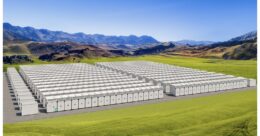
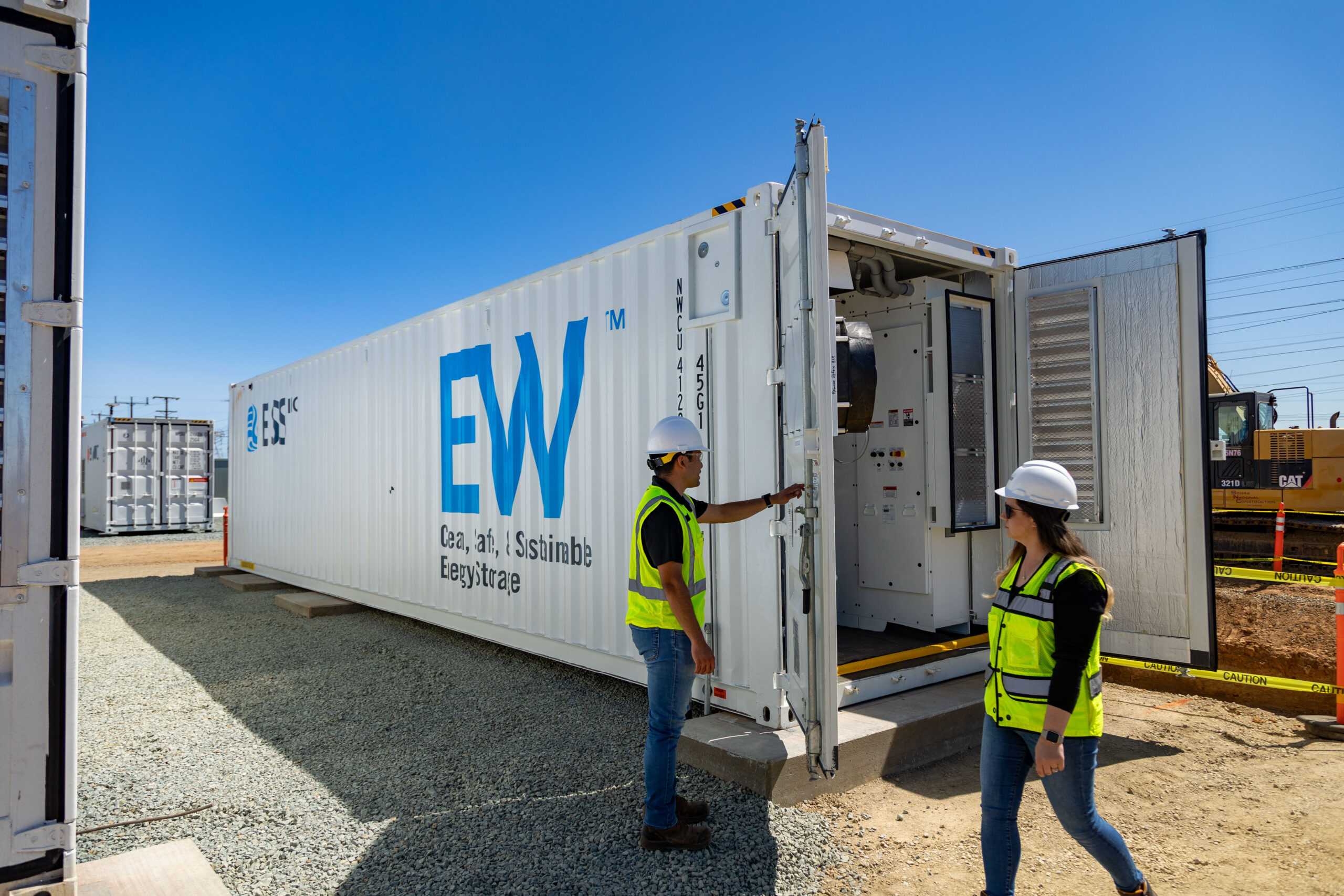
ESS Tech, Inc. currently offers two products: the single shipping container Energy Warehouse and a string of warehouse units in an Energy Center. Both products are said to offer 25-year design life with no degradation and more than 20,000 cycles. The Energy Center provides up to eight hours of discharge at rated power and is marketed as customizable up to gigawatt-scale.
Last September, the company completed commissioning of six Energy Warehouse systems delivered to SMUD. The existing 450 kW / 2,400 kWh Energy Warehouse system at SMUD’s Sacramento Power Academy continues to provide SMUD and ESS with insights through risk and benefits analysis, use case studies, and performance testing.
According to SMUD, these efforts will ultimately determine the optimal applications for iron flow battery technology, aiming to achieve cost and performance competitiveness relative to lithium-ion batteries for eight-hour durations and longer.
Over the the past year, ESS has reported progress in enhancing its system design and scaling its manufacturing in the US. It said it has reduced the cost of building an Energy Warehouse by nearly 60% and the overall build cycle time by 73%, as well as boosted energy density by 25%. The company has also earned certifications including UL 1973, UL 9540A, and IEEE 693 and commissioned its first fully automated production line.
While the energy density of iron flow batteries remains well under that of lithium-ion systems, their safety credentials can improve the use of available land. “As the technology is inherently safe, this allows for stacking containers and a greater energy density on the system level. Stacked vertically, iron flow batteries can exceed the density of standard lithium-ion batteries on the same footprint,” Alan Greenshields, Director EMEA at ESS told ESS News in a recent conversation.
According to Greenshields, the industry is approaching a breaking point in terms of LDES deployment in the light of deep decarbonization and market dynamic signals.
“The next big thing for the renewable energy sector are hourly matching power purchase agreements. This is already signaled by tech majors such as Amazon, Microsoft and Meta, which seek to reconcile the electricity demand of their AI-driven data centers with their net zero targets,” Greenshields says.
“This trend will grow strongly over the next couple of years and as the industry learns how to model this 24/7 clean energy procurement from the business point and seeks to define monetization models.”
More about
Written by


Popular Posts