California battery dominance coming into view


The California Energy Commission (CEC) regulator estimates 52 GW of energy storage capacity will be needed by 2045 to help clean the state’s power grid. As of October, the state had 13.4 GW. One California physicist has said batteries are outpacing even the astounding growth rate of solar power, which begs the question: How quickly will the 2045 goal be reached?
Daniel Snowden-Ifft, a physicist at Occidental College, and regular reader of pv magazine USA, reviewed the CEC website and arrived at a striking conclusion.
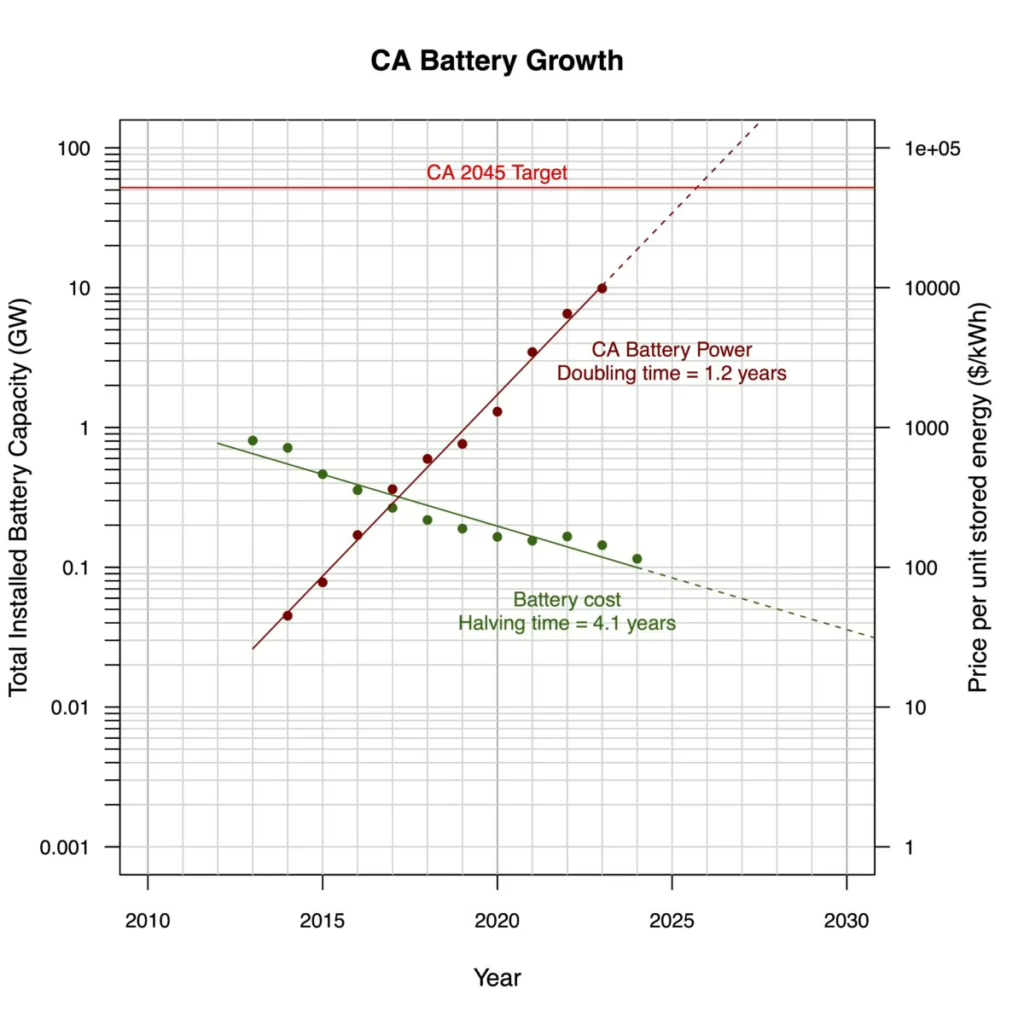
He drafted the graph below, which shows the total of California’s battery energy storage capacity, in dark red, over the last 10 years. “On a log-linear plot, the data are well fit with a straight line indicating exponential growth, with a doubling time of 1.2 years,” said Snowden-Ifft. “Extrapolating that line to 52 GW suggests California will meet its [2045] goal around 2026, nearly 20 years ahead of time.”
The physicist continued, “Exponential growth has become a hallmark of renewable energy. The driver, in this case, is an exponentially decreasing battery cost.” Referring to the graph, he added, “Shown in green (use the axis on the right) is the price per unit of stored energy (in dollars per kilowatt-hour). It is fit by a straight line with a halving time (the time for the cost to fall by a factor of two) of 4.1 years.”
There is little doubt that the world is in the midst of a battery-building boom, and California, along with Texas, has emerged as one of its epicenters. As Snowden-Ifft noted, this surge is being driven by plummeting battery costs as well as ongoing technological advances.
California began accelerating its battery efforts after a 2019 report warned that evening peak hours could jeopardize grid stability unless new capacity was added. Since then, batteries have replaced a significant portion of evening generation, helping stabilize the power grid in what is now the world’s fifth-largest economy.
So, will California hit its goals 20 years early? Will it continue its exponential growth? China did just double its deployed battery capacity. If you were to only take your clues from the energy storage developers, you might think so.
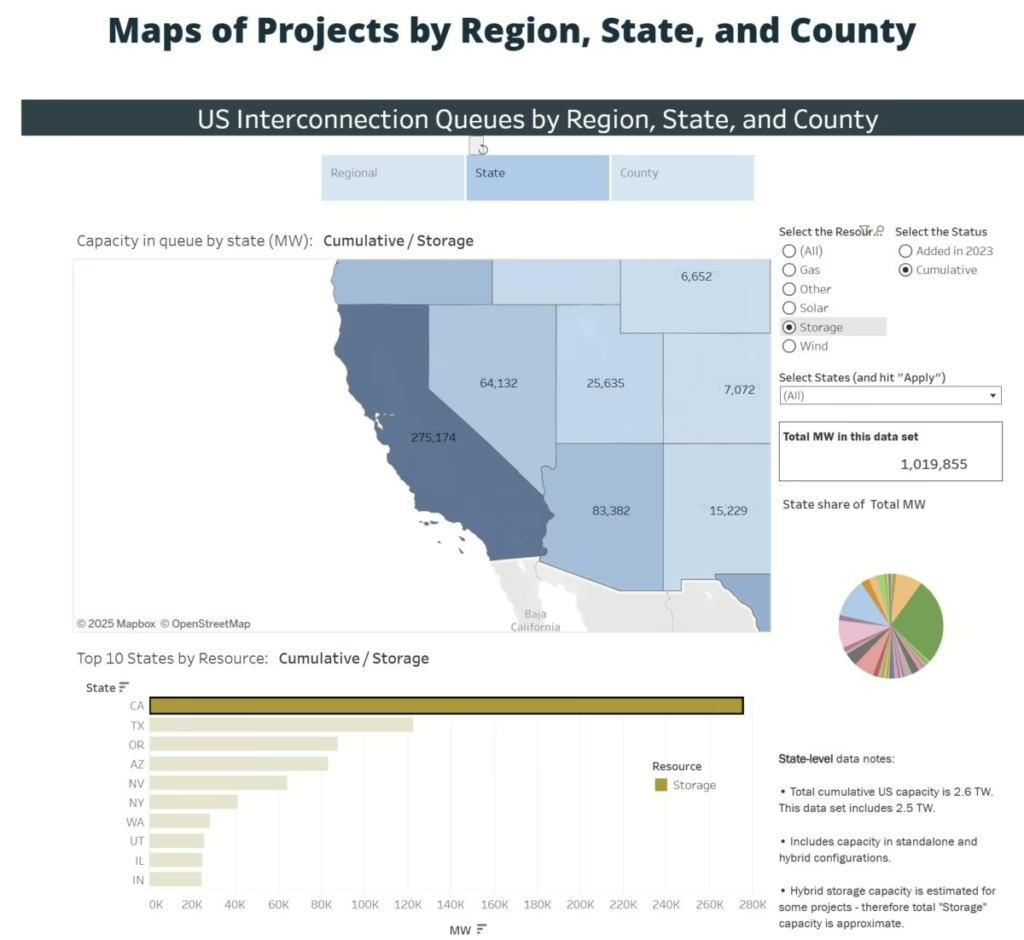
As of its most recent update, Lawrence Berkeley National Laboratory’s interconnection queue lists more than 275 GW of proposed energy storage projects at various stages of readiness in California. This figure is more than five times what is needed to meet the 2045 goal, with room to spare. All of this capacity has already been submitted for connection, and much of it was submitted as early as last year.
Unfortunately, permitting bottlenecks, supply chain delays, and broader regulatory complexity mean most US agencies do not expect exponential deployment to continue without interruption.
At the start of this year, the US Department of Energy’s Energy Information Administration (EIA) projected that the nation would deploy just over 18 GW of energy storage, which would be enough to keep California on its current doubling track. However, only 4.3 GW of that total was anticipated in California, or about one-third of what would be required to double the state’s existing capacity.
Looking ahead, the EIA’s latest “Form 860-M” report projects that California will add just over 2.1 GW of energy storage between now and the end of 2026, and only 600 MW in 2027. That would bring the state to a respectable 20 GW, representing an increase of about 50% from current levels but still falling short of two full doublings. Of course, these figures for 2026 and 2027 are likely to grow over the next two years, so they are not final.
This author, who leans pessimistic, and the professor, an optimist, have placed a friendly wager. A new battery-powered gadget of the winner’s choice is on the line to see whose projection prevails.
A second question raised by Snowden-Ifft: With most of this capacity designed for four-hour duration, how soon can California shift enough electricity to fully cover the night?
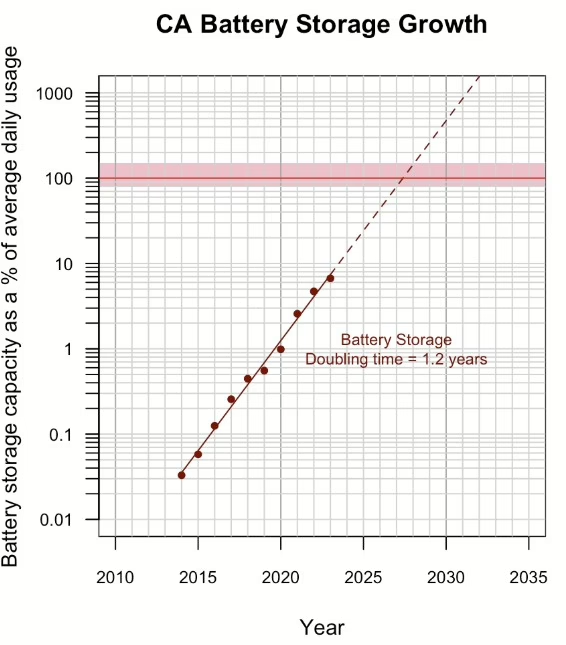
The plot to the left shows the state’s battery storage capacity (assuming four-hour duration) divided by average daily usage, charted by year. Because California’s overall usage hasn’t changed much, the capacity-to-load ratio has the same doubling time. A horizontal red line indicates the point at which California’s batteries would be able to shift 100% of the average daily load, estimated to occur in 2027. The pink bar marks a range of minimum and maximum energy usage based on daily fluctuations observed in 2024, suggesting that meeting the absolute peak daily use might require waiting until 2028.
That’s just a few more years before California could, in theory, run for a full day on solar power and batteries.
From pv magazine USA.
Written by






Popular Posts