New real-time measurement process can determine State of Charge and battery operational safety

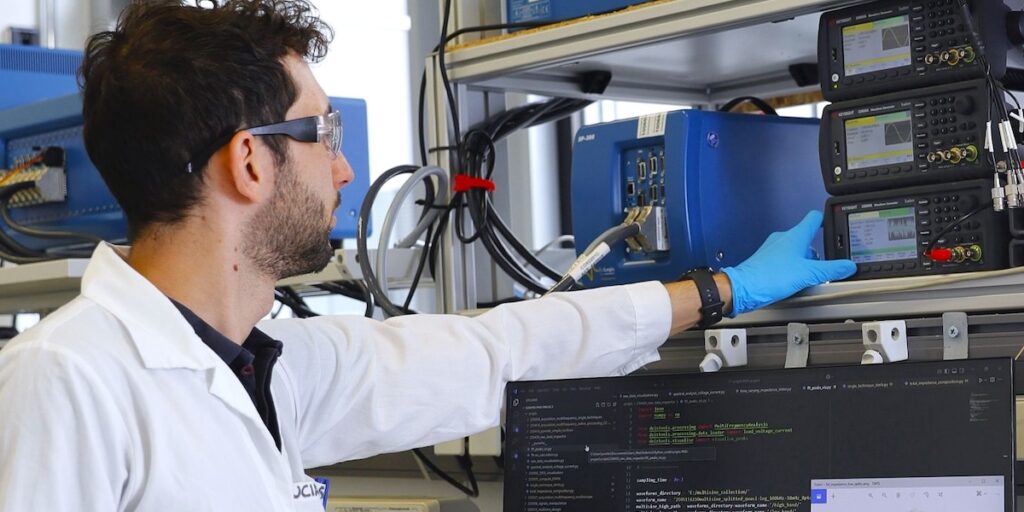
Impedance measurements are crucial for understanding the capacity and health of batteries, but until now, they could only be performed when the battery was at rest. Due to complex measurement and analysis procedures, characterizing a single battery cell could take up to 20 minutes. This limitation, as described by the Fraunhofer Institute for Manufacturing Technology and Advanced Materials (IFAM), was the driving force behind the development of a faster, more flexible method designed to deliver data in real-time.
A battery’s impedance cannot be measured directly; it is calculated from the relationship between current and voltage. The resulting data can determine the battery’s State of Charge (SOC) and allows for “conclusions to be drawn about the internal State of Health (SoH), including the condition of the cathode, anode, and electrolyte, as well as its overall safety status,” the institute’s announcement states.
Impedance spectroscopy is a versatile technique, suitable not only for lithium-ion batteries but also for “solid-state, sodium-ion, lithium-sulfur, and other future battery technologies.”
A research group at IFAM, led by Fabio La Mantia, has advanced this technique into what they call “dynamic impedance spectroscopy.” This enhancement makes it “possible for the first time to determine measurement values for the battery’s status during ongoing operation and make them available in real-time.” This allows for a continuous stream of information that goes beyond just charging capacity or remaining operational time, painting “a precise, in-depth, and differentiated picture of the battery’s internal workings.” Consequently, the potential lifespan of an individual battery cell can be predicted with greater accuracy.
Compared to existing state-of-charge indicators, such as those found in electric cars, this new method offers more comprehensive and precise data with shorter response times. According to project leader Hermann Pleteit, it “opens up new possibilities for optimizing battery management, thereby extending the lifespan of batteries.”
The process works by superimposing a multi-frequency test signal onto the discharging or charging current. The different frequencies allow for insights into the status of specific components and processes within the battery. The resulting current and voltage response signals are measured and processed simultaneously up to one million times per second. Specially developed algorithms reduce the immense volume of data generated, enabling software to calculate the impedance values in real-time and draw conclusions about the condition of each battery cell.
According to IFAM, this method would allow a battery management system in an electric vehicle, for example, to quickly identify and deactivate overheating cells. At charging stations, it could ensure that no cell reaches dangerous temperatures, even during rapid charging.
The developers also see significant potential for this technology in battery storage systems paired with renewable energy installations, providing users “with stable and continuously monitorable battery systems using the Fraunhofer technology.” IFAM also identifies a need for this capability in “safety-critical scenarios,” such as in electric aircraft.
From pv magazine Germany.
Written by






Popular Posts