Swiss startup’s subscription model offers lifetime guarantee for second-life batteries

Established in 2024 and backed by the Swiss Innovation Association, Evolium Technologies is a Swiss second-life battery startup with its own unique approach to battery recycling. It’s a modular approach, as Evolium’s founder and CEO, Alexandre Staub, told ESS News.
Evolium runs a subscription-based module exchange program, whereby (mostly) residential customers can exchange used and old modules for fully functional second-life modules. All cells used in its batteries are tested in-house by the company, which Staub claimed is another USP as cell testing is an area where a lot of second-life battery providers tend to struggle, he said.
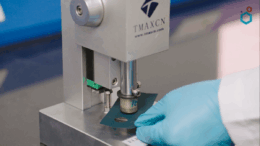
“Most of our team are robotic experts, and they develop robots more than they develop batteries,” he said, explaining that the team develops robots to test the cells at scale. “The robots are fairly cheap, and they are able to execute this task of testing the cells and assessing which cell can go into a second life and which cell cannot.”
Evolium mostly works with INR18650 cylindrical cells and once these cells have been approved by testing, they can be reassembled into second-life batteries.
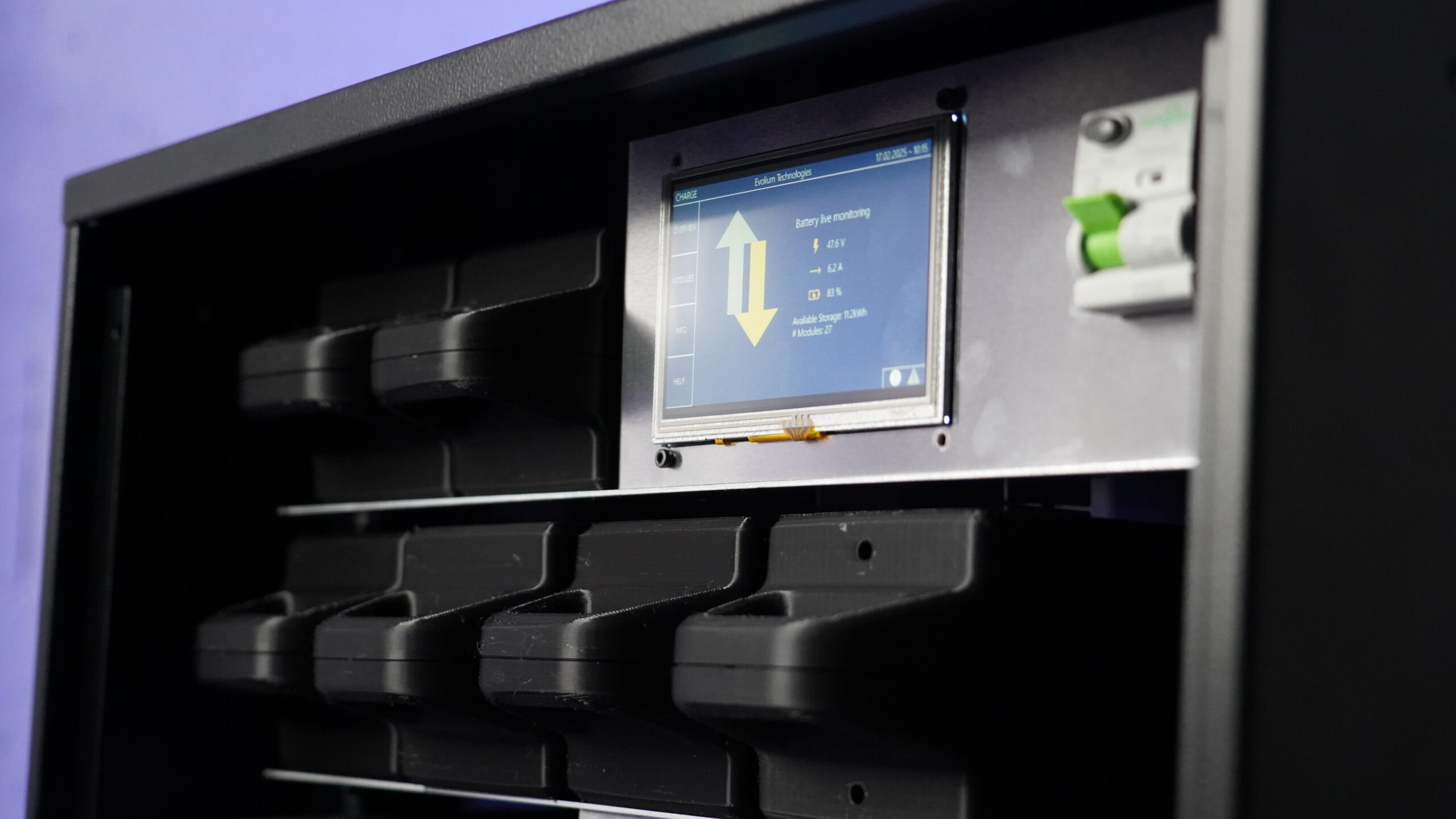
Once deployed, the cells are monitored continuously and remotely via the internet, and the performance data is stored so Evolium can notify the battery-owner if a module is failing or about to reach end of life. When this happens, the company posts a new module to the client free of charge. According to Staub, all the client has to do is remove the under-performing module by pulling out the drawer that is blinking red on the battery and replacing it with a new drawer.
The client pays a subscription in exchange for a lifetime capacity guarantee. It’s a circular system based on exchange. Staub said that cells are tested to see if they are fit for a third life or a fourth life. Every cell is tracked using a “unique identifier,” which Staub likens to a QR code that is stuck to the cell and stored in Evolium’s server.
The cell’s identifier is used to track its performance during tests throughout its entire lifecycle.
“Our goal is to test the cells and to push every single cell until it cannot store energy anymore” Staub said, adding it is working towards a target of five million cells tested per year by 2027.
If circularity is the principle, automation is the practical grounding behind how Evolium’s model actually works. Its staff of experienced robotics engineers gather the data coming in from every battery in Evolium’s operational network to train its testing algorithms to recognize cell aging patterns in second life.
The strong robotics emphasis is informed by Staub’s experience at the Swiss University of Applied Sciences, ETH Zürich, where he specialized in additive manufacturing and had his own research team. “We continue to work with the University of Applied Science on different topics,” he said, adding that Evolium has several partnerships with micro-mobility companies like Dott and Tier.
It also works with sports brand Decathlon and several Swiss partners, including Solarmaa GmbH, a PV installer based in the German-speaking part of Switzerland. “And we have quite advanced discussions with partners in Japan,” Staub said, adding that “Japan is very similar to Switzerland in many respects and so for us it was quite easy to transform the business model for the Japanese market.”
Higher capacity battery model in progress
Staub said that from Evolium’s perspective, targeting the solar storage market with its solution makes sense because the charging cycle and the discharging cycle are very low, as a system is likely to charge all day and discharge all night. While the company’s current battery model goes up to 1.8 kW of power and 10 kWh of storage capacity, the team is working on a new, higher-capacity model scheduled for 2026. The current model has its own inverter and won’t work if a company or household has a power blackout, but the newer model will be able to connect to other inverter models and its ability to provide power during a blackout will depend on the inverter model.
The current battery model measures 570 x 540 x 600 millimeters and weighs 110 kilograms. Each module weighs three kilograms. Of course, the system is not manufactured in Switzerland, and Europe is far behind China and even the United States on battery manufacturing.
For Staub, Evolium’s business is about creating value for products that are used in Europe but not made in Europe. “As soon as we start to use something in our country that is not manufactured here, we need to push the life cycle longer so that we can create new jobs and new added value on these products when they are inside the country because we don’t have the original value from manufacturing.”
The founder lamented the lack of strategic thinking around circular economy in Europe, although he acknowledged he is one of many people pushing for the industrial case for a circular economy for batteries in Europe. It’s an economic vision that can include all types of people, not just highly skilled engineers. Manual workers are better suited than robots for disassembling the batteries, said Staub, adding: “We try to automate only what is meaningful to automate, and disassembling the battery is very difficult to automate.”
Written by
Comments





Popular Posts