Battling battery imbalance
If you operate large-scale batteries, understanding and addressing imbalances should be part of your core tool kit.
Since 2020 our team has supported over 15 GWh of battery energy storage system (BESS) projects across North America, Europe, and Australia. Imbalance is a challenge we’ve encountered at every single site. BESS imbalances are widespread, and significantly impact project timelines, performance, and longevity – ultimately undermining financial returns.
Modern BESS facilities comprise hundreds of thousands of battery cells. The individual cells are connected in series to reach a certain system voltage – for example, 416 cells in a 1,500 V system. In a perfect world, all cells would have identical properties and behave in complete synchronization. Any time the cells, modules, or racks in a system do not act in flawless unison, we call that an imbalance.
Operational headaches
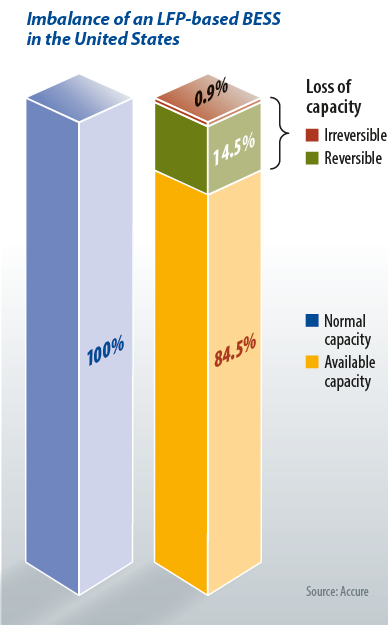
Imbalance within a battery system has far-reaching consequences for operations and project returns. If not well managed, it can lead to reduced usable energy. If some cells reach their voltage limits sooner than others, the entire battery string or container has to stop charging or discharging prematurely. This leads to decreased capacity utilization, meaning the storage system operates below its full potential and generates less revenue. For a striking example of the magnitude such “stranded energy” can reach, see the chart above.
Accelerated degradation is another possible consequence of imbalance. Battery cells that hit their voltage limits first are often further along the degradation curve. Spending more time at maximum or minimum voltage accelerates their aging.
Imbalance can also impact system safety. We have encountered rare but critical situations involving weak cells and sensor errors that allowed individual cells to discharge below 1.5 V without being detected by the battery management system. Such extreme low-voltage conditions pose significant safety risks: low anode potential triggers copper dissolution, one of the strongest precursors of thermal runaway in lithium-ion batteries.
All cell chemistries face the challenge that no two batteries can be produced 100% identically and that small differences at the start of life inevitably widen over time. On top of that, lithium iron phosphate (LFP) batteries are particularly susceptible to imbalances due to their flat open-circuit voltage (OCV) curve. Issues during manufacturing are among the most common causes. Quality assurance is also struggling to keep up. Many manufacturers today only guarantee a “minimum” capacity for their cells, giving them the freedom to ship any cell that meets or exceeds this threshold. As a result, some of our customers received batches with more than 6% capacity variance – a guarantee for operational headaches.
Shipping and project delays are also a factor. As 85% of all batteries are produced in China, they usually spend several months traveling by truck and freighter – and waiting in storage. During this period, lithium-ion cells naturally self-discharge at up to 3% per month. Compounding this, projects often face delays of many months due to transformer shortages, grid interconnection issues, or permitting hurdles. During these idle periods, cells can drift further out of balance.

Battery management
Imbalances are an inherent part of BESS operations. If left unchecked, they can significantly reduce revenue, and they are not typically covered by performance warranties or long-term service agreements. Addressing them is ultimately the asset manager’s responsibility and can be as important to project returns as choosing the right trading strategy.
The good news is that the industry has matured to a point where proven tools and processes exist. Best practice guidelines here include:
Define and control cell production quality
Establish strict, enforceable acceptance criteria for cell quality, and verify factory acceptance test results. Independent experts can help fine-tune contract language and use artificial intelligence-based analytics to identify issues before containers leave the factory.
Make balancing capabilities a priority
Some battery systems offer more advanced and user-friendly balancing functionalities than others. Understand the specific balancing capabilities and limitations of each direct-current block before placing an order.
Plan for contingencies
Project holdups are common. Factor potential delays into your procurement and deployment timeline and develop a strategy for handling early deliveries or prolonged storage. This includes having clear protocols for environmental controls and battery maintenance. Be sure to account for the extra time required for rebalancing after significant project delays.
Leverage analytics
Tracking imbalances across hundreds of thousands of cells requires robust analytics. Especially for LFP batteries, imbalances are often masked by their flat OCV curve and therefore not easily identified through “simple” monitoring solutions as provided by some system integrators or energy management system providers. Advanced analytics solutions offer cell-, module-, and system-level insights that enable early detection of deviations. This, in turn, supports targeted maintenance and balancing strategies that consider varying opportunity costs in volatile markets.
As battery costs continue to decline, the scale of BESS installations keeps growing – along with the complexity of keeping these vast numbers of cells in sync. Imbalances, if unaddressed, can reduce site revenue by more than 10%, a particularly concerning figure in volatile markets. Experienced operators rely on proven tools and processes to stay ahead of imbalances and maximize the value of their investments.
About the author: Kai-Philipp Kairies is a scientist and entrepreneur who has worked internationally as a battery research consultant. Since 2020, he has served as CEO of Accure Battery Intelligence GmbH, a research-led startup that supports companies in understanding and improving battery safety and longevity using advanced data analytics.
More about
Written by







Popular Posts