BBDF 2025: Flexible grid access opens up new paths for battery storage in Germany

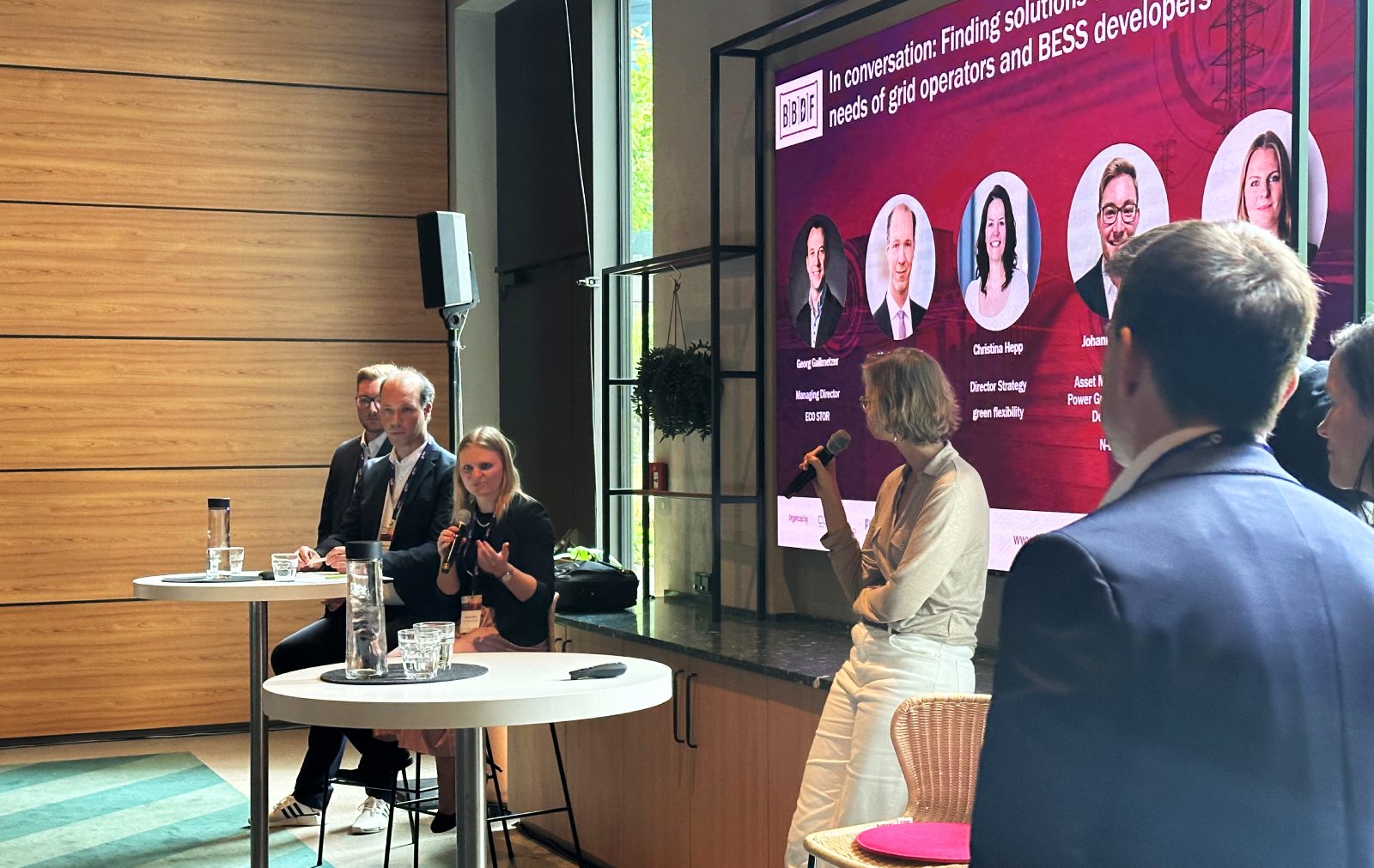
Flexible connection agreements are part of the process and should not be considered a nuisance by project developers. That sentiment summarized the German deep-dive session, “Flexible Access, Stable Revenues – Grid Connection Solutions for BESS,” at the Battery Business & Development Forum 2025 in Frankfurt am Main, Germany.
While many projects in Germany face years-long delays due to grid bottlenecks, some developers are beginning to break new ground with flexible connection agreements and are helping shape new business models.
German distribution system operators (DSOs) have signaled that they will not be able to connect new battery storage projects at scale until the end of the decade. Local congestion is a major issue. With little incentive in the current market design for batteries to operate in a grid-supportive way, the only path forward for grid operators has been conventional grid expansion, which takes time and delays battery projects.
Model projects with bespoke flexibility
Christina Hepp of Green Flexibility presented “Regiolink,” a virtual grid modeling tool developed in-house to support the negotiation of flexible connection agreements (FCAs). “Before we build an asset, we simulate how it would behave in the grid under various local constraints, redispatch needs, and weather forecasts,” she explained.
This allows Green Flexibility to show DSOs how a battery can help relieve local congestion and to convince banks that even limited export capacity can support a viable business model. Their first project using this structure is now operational, including an API to the DSO to support fast export limitation. In this project, Hepp said, the DSO provides a limitation plan by 7 a.m. the day before. This allows Green Flexibility to still consider its options in ancillary service markets and thus optimize the battery on the market.
Georg Gallmetzer of Eco Stor warned against what he called “overcooked expectations” in the market. When expectations for IRR and revenues are so high, it is hard to engage in a dialogue with the DSO about possible limitations. He pointed to what he called the seven plagues currently hampering battery business models in Germany.
“All of these issues eat into your IRR,” Gallmetzer said. “But batteries are intrinsically grid-friendly. Maybe not in every single case and moment, but overall. That must be reflected in how we discuss grid fees, and system relevance,” he said, alluding to the current Agnes process, which seeks to determine grid fees for batteries at the regulatory level.
Economic impact of restrictions
Marcus Fendt of The Mobility House quantified the financial effects of technical restrictions on battery energy storage system (BESS) projects. According to his modeling, ramp rate limits can cut revenues by 44%, while other restrictions, like export limits, supply limits, the 100-hour rule, and envelope (‘Hüllkurve’) limitations, can reduce revenues by 20% to 30%. “These are often applied in combination,” Fendt noted.
Co-location could be the next big thing, he added, especially as older EEG projects phase out and EVs become grid-integrated. “We’re only seeing the first wave of batteries now,” he said. “The second wave will be co-location projects with phased-out subsidies, and it will be bigger.”
Learning to cooperate: developers and DSOs
The panel discussion that followed underlined the need for open communication and mutual understanding. Markus Graebig of the German TSO 50Hertz pointed to 112 GW of connection requests in his grid area alone. “We’re stuck with a first-come, first-served approach; that’s what the law says. But it’s not always the best solution.”
Barbara Plura of the DSO LVN added, “We’re flooded with requests, but there’s no standardized way to assess and answer them. So things take time.”
Developers and operators called for a change in mindset. “Too often, developers go straight to their lawyers,” Gallmetzer said. “But you need to talk to the DSO and understand their issues. That’s part of being successful.” His call for better collaboration drew spontaneous applause from the audience.

More about
Written by





Popular Posts